Programming Languages Used in the Space Industry

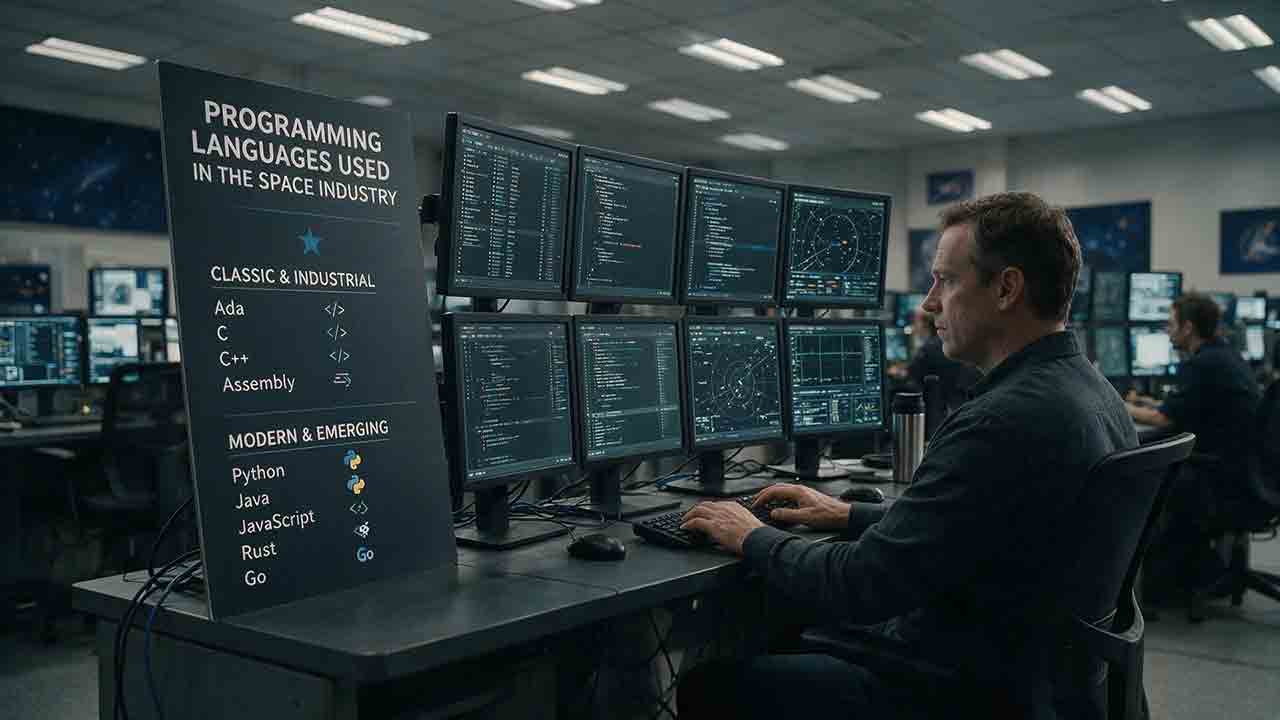
Programming Languages Used in the Space Industry
Publicly documented space projects use C and C++ for many embedded and flight-software systems, Python for analysis, automation, testing, and ground tools, JavaScript with TypeScript tooling for web-based mission interfaces, Java for space-dynamics applications, MATLAB and Simulink for modeling workflows, and Ada or Fortran in established high-integrity and numerical toolchains. The right language depends on where the code runs, what can fail, and how the result will be verified.
Key Takeaways
- There is no single programming language for the entire space industry.
- C and C++ are important for many flight and embedded roles, while Python is broadly useful for analysis, testing, automation, and ground software.
- JavaScript, Java, MATLAB, Simulink, Ada, and Fortran remain valuable in specific technical environments.
- Rust has been demonstrated in a completed NASA cFS research project, but that evidence does not establish broad production adoption.
- A tested project with requirements, failure handling, and documented tradeoffs is stronger career evidence than a long list of language names.
This guide maps programming languages to documented space-software responsibilities, provides a six-gate language-selection tool, and shows how to turn coding skills into credible portfolio evidence.
Which Programming Languages Are Used in the Space Industry?
The most defensible answer comes from documented frameworks and tools rather than an unsupported popularity ranking.
| Language | Documented use | Public example | Important limitation |
|---|---|---|---|
| C | Flight applications, device interfaces, telemetry, commands, and embedded services | NASA’s core Flight System | Manual memory and bounds management require disciplined verification |
| C++ | Component-based flight and embedded software | JPL’s F Prime framework | Unrestricted language features can make memory and timing behavior harder to analyze |
| Python | Mission analysis, automation, testing, telemetry processing, and engineering utilities | JPL’s Monte and NASA’s cFS EDS Ground Station | A conventional Python runtime is not the default choice for tightly bounded hard real-time tasks |
| JavaScript, with TypeScript tooling | Browser-based mission control, telemetry displays, timelines, and operational interfaces | NASA’s Open MCT | Its public API provides TypeScript declarations, but declaration coverage may be incomplete |
| Java | Space-dynamics libraries and mission-analysis integrations | Orekit and NASA’s GMAT | A managed runtime may not suit every onboard processor or assurance environment |
| MATLAB and Simulink | Control design, modeling, simulation, and generated-code workflows | NASA’s cFS Simulink Interface Layer | Licensing and organization-specific workflows can limit independent access |
| Ada | High-integrity embedded software in established aerospace environments | ESA’s Software Facilities documentation | Smaller general-purpose ecosystem and fewer beginner resources |
| Fortran | Established scientific, trajectory, and mission-geometry software | JPL’s SPICE Toolkit | More often encountered in mature numerical codebases than new general applications |
| Rust | Experimental memory-safe integration with cFS | NASA Goddard’s completed Rust in cFS research project | Public experimentation does not establish widespread operational use |
These examples document the use of these languages in identifiable space-software contexts. They do not measure hiring market share, organization-wide adoption, or the suitability of a language for every mission.
NASA’s public cFS repository, for example, describes a reusable framework bundle but explicitly states that it is not a complete flight distribution and has not been fully verified as an operational system. Mission-specific verification and validation remain the responsibility of the mission.
How Does the Software Layer Affect the Language Choice?
The phrase “space software” covers several different engineering environments. The software layer usually matters more than the industry label.
Flight and Embedded Software
Flight software runs on or directly supports spacecraft, instruments, launch systems, robots, and other mission hardware.
Its responsibilities may include:
- Command handling
- Telemetry generation
- Device control
- Communications
- Timing and scheduling
- Fault detection and response
- Guidance, navigation, and control
- Payload operation
- Resource management
C, C++, and Ada are relevant because embedded teams may need direct hardware access, explicit memory behavior, defined binary interfaces, real-time scheduling, and toolchains that can be maintained for the life of a project.
NASA’s core Flight System provides a flight-software architecture assembled from the core Flight Executive, operating-system abstraction, platform support, applications, libraries, and development tools. The public bundle includes example applications but is intended as a starting point rather than a mission-ready distribution.
JPL’s F Prime provides a component-based embedded framework with typed ports, commands, telemetry, events, parameters, code generation, ground-system support, and unit and integration testing tools. F Prime’s tooling generates C++ base classes from component models, while developers implement project-specific behavior in derived classes.
ESA states that much of the software executed on its embedded platforms is written in lower-level languages, particularly C and Ada. That statement documents ESA’s environment; it should not be generalized into a claim that every European or commercial mission follows the same language policy.
Ground and Mission-Operations Software
Ground software sends commands, receives telemetry, supports planning, stores mission data, and helps operators interpret system state.
Python is useful for automation, packet handling, engineering utilities, and testing. JavaScript is useful when mission information must be delivered through a browser. Java and other server-side technologies may also support ground applications when they match the organization’s existing architecture.
NASA describes Open MCT as an open-source, web-based mission-control framework for spacecraft-data visualization, analysis, operations, and mission support.
Open MCT is distributed as JavaScript and provides TypeScript declaration files for code assistance and type checking. Its API documentation also warns that declaration coverage may be incomplete because the typing effort is ongoing.
A mission interface must do more than display attractive charts. It should make it difficult to confuse:
- A valid zero with missing data
- Current data with stale data
- A sensor failure with a communications gap
- A warning threshold with a confirmed fault
- Browser-local time with the mission’s defined time system
Analysis, Simulation, and Engineering Software
Engineering software evaluates trajectories, dynamics, controls, navigation, uncertainty, performance, and test results.
Python, Java, C++, MATLAB, Simulink, and Fortran can all be relevant, depending on the existing libraries and the problem being solved.
JPL describes Monte as an astrodynamic Python platform supporting mission design, analysis, operations, and navigation. Its documented infrastructure includes trajectories, coordinate frames, high-precision time, event searches, sensitivity analysis, numerical integration, and optimization.
NASA’s GMAT R2026 can be operated through a graphical interface, a custom scripting language, or Python and Java programming environments.
Data and Product Infrastructure
Space organizations also build archives, APIs, scientific pipelines, cloud services, geospatial products, public websites, and internal tools.
These systems may use Python, Java, JavaScript, TypeScript, C++, and other conventional software technologies.
SQL and shell languages are useful supporting skills for databases, build automation, deployment, testing, and data workflows. They normally complement a primary application language rather than replacing flight, analysis, or interface software.
The space-specific difficulty often lies in the data rather than the syntax:
- Multiple time systems
- Reference frames
- Sensor calibration
- Units and scaling
- Quality flags
- Data provenance
- Missing observations
- Reproducibility
- Large scientific files
Why Are C and C++ Used in Flight Software?
C and C++ give developers low-level access, mature compiler support, and direct control over data layout and resource use within a defined processor, compiler, and application binary interface environment.
Those properties can matter when software must interact with hardware, process fixed-format packets, run on constrained processors, or meet timing requirements.
The qualification is important. C and C++ do not make every data representation automatically portable. Integer widths, alignment, byte order, compiler behavior, processor architecture, and ABI rules still need to be defined and tested.
What C Skills Matter?
A candidate does not demonstrate flight-software readiness by knowing C syntax alone.
A credible C project should show:
- Bounds checking
- Fixed-width integer awareness
- Explicit memory ownership
- Defined error behavior
- Compiler warnings
- Static analysis where appropriate
- Unit and integration tests
- Abnormal-input tests
- Documented byte order
- Documented packet layouts
The practical question is not “Can you write a loop in C?” It is “Can another engineer understand, test, and review the behavior of your C code under both normal and abnormal conditions?”
What C++ Skills Matter?
C++ can support embedded performance together with reusable components, typed interfaces, templates, classes, and larger architectures.
A project may restrict features such as:
- Dynamic allocation
- Exceptions
- Run-time type information
- Unbounded containers
- Hidden object copying
- Abstractions with unclear execution cost
Using modern C++ in an embedded environment does not mean using every available feature. It means choosing abstractions that improve ownership, interfaces, testing, and reviewability without hiding unacceptable costs.
F Prime’s public documentation illustrates this balance through its component model, typed ports, generated C++ interfaces, testing tools, and support for processors ranging from microcontrollers to multicore systems.
Why Is Python Valuable for Space Engineering?
Python is valuable because it connects numerical computing, automation, testing, plotting, data processing, and system integration in one accessible environment.
Typical Python tasks include:
- Decoding telemetry
- Automating tests
- Processing simulation output
- Generating configuration files
- Plotting engineering data
- Building command-line tools
- Comparing an implementation with a reference model
- Calling C, C++, or Fortran libraries
- Producing repeatable reports
NASA’s public cFS EDS Ground Station is a Python-based ground tool. Its documented utilities can prepare commands, listen for and decode telemetry, and convert stored telemetry into CSV output.
Python’s limitation is contextual. A standard Python runtime normally offers less direct control over execution timing and memory than a constrained embedded implementation.
That does not make Python less technical. It makes Python appropriate for different responsibilities.
Where Do JavaScript, TypeScript, and Java Fit?
JavaScript and TypeScript Tooling
JavaScript is useful for:
- Mission dashboards
- Telemetry visualization
- Timelines
- Event displays
- Planning tools
- Data portals
- Procedure interfaces
TypeScript tooling can improve editor assistance and static checking around JavaScript applications. However, a project should verify the completeness and accuracy of the declarations supplied by the framework it uses.
A strong mission-control project should model data quality and freshness as first-class states rather than treating every missing value as an empty chart.
Java
Java is directly documented in space-mechanics libraries and mission-analysis integrations.
Orekit is implemented in Java and provides capabilities involving dates, time scales, reference frames, orbits, attitude, propagation, events, and physical models.
Java may also support ground-based services where the JVM matches an organization’s existing toolchain. That is a reasonable engineering use case, but Orekit and GMAT alone should not be treated as proof of industry-wide Java backend adoption.
A relevant Java portfolio project might demonstrate:
- Orbit propagation
- Reference-frame conversion
- Event detection
- Time-scale handling
- Unit-safe interfaces
- Numerical comparison tests
Where Do MATLAB, Simulink, Ada, and Fortran Fit?
MATLAB and Simulink
MATLAB and Simulink are relevant to:
- Guidance, navigation, and control
- Dynamic-system modeling
- Controller development
- Signal processing
- Hardware-in-the-loop testing
- Algorithm prototyping
- Model-based development
NASA’s cFS Simulink Interface Layer connects mission-specific code generated from Simulink or other sources to cFS services through generic wrapper code. The documented integration includes access to cFS capabilities such as table, time, software-bus, event, and fault-reporting services.
This public example establishes a documented integration workflow. It does not mean that every controls team or aerospace employer uses the same process.
The transferable skill is not merely operating the software interface. It is being able to explain:
- Model assumptions
- Units
- Solver choices
- Sample rates
- Test cases
- Generated interfaces
- Numerical limitations
- Differences between simulated and deployed behavior
Ada
Ada remains relevant where an established high-integrity embedded toolchain requires it.
ESA’s current Software Facilities page identifies C and Ada as languages used for much of the software executed on its embedded platforms.
An older ESA Coding Languages page also documents historical use of Ada83 in agency satellites and identifies platform command-and-control software as a critical application area. This historical source helps explain why Ada can still appear in long-lived aerospace environments, but it should not be interpreted as a current market-share survey.
Ada is worth prioritizing when a target employer, contractor, launcher organization, or project explicitly asks for it.
Fortran
Fortran remains relevant because mature scientific libraries can remain useful long after newer languages appear.
JPL’s official SPICE Toolkit page lists Toolkit offerings for C, Fortran, IDL, MATLAB, and an alpha-test Java Native Interface. The page also notes that third parties provide wrappers for other languages, including Python.
A developer may therefore encounter Fortran while maintaining, testing, wrapping, or integrating established scientific software even when newer application code is written elsewhere.
Is Rust Used in Space Software?
Rust has documented space-software research activity, but public evidence does not justify describing it as a standard replacement for C or C++.
NASA Goddard conducted the Rust in cFS: Prevent Bugs with Memory-Safe Programming research project from October 1, 2020, through September 30, 2021.
The completed project documented:
- A raw interface between Rust and cFS
- A safer wrapper for selected cFS interfaces
- A demonstration cFS application written in Rust
- Build integration with cFS 6.7
- Command and telemetry interaction with a ground system
The NASA TechPort record was updated after the project ended, but the recorded project period remains 2020–2021. The project documents experimental integration; it does not establish that Rust is now standard across NASA missions or the wider space sector.
Rust is a reasonable learning choice when:
- A target team already supports it
- The processor and operating system have a suitable toolchain
- Required interfaces and libraries are available
- The build can be reproduced and maintained
- The role specifically values memory-safe systems programming
For beginners targeting currently documented cFS and F Prime workflows, C and C++ provide a more direct path to the main public learning resources.
Which Language Should You Learn for Each Space Role?
The following table is an editorial career framework, not a hiring census. Current job descriptions and employer documentation should remain the final source of truth.
| Target role | Practical starting combination | Portfolio evidence to build |
|---|---|---|
| Flight-software engineer | C, then C++ and Python | Components, packet interfaces, tests, bounded behavior, and fault handling |
| Embedded systems engineer | C, C++, Python, and basic assembly concepts | Device communication, timing, debugging, and hardware abstraction |
| Guidance, navigation, and control engineer | Python plus C++, MATLAB/Simulink, or Java | Simulation, estimation, coordinate frames, and numerical validation |
| Mission-analysis engineer | Python plus GMAT, SPICE, Java, C++, or MATLAB | Reproducible orbital calculations with stated assumptions |
| Mission-operations software engineer | Python plus JavaScript and SQL | Telemetry processing, command validation, networking, and operator displays |
| Space-data engineer | Python and SQL | Provenance, validation, scalable processing, and reproducible pipelines |
| Mission-control front-end developer | JavaScript with TypeScript tooling, plus Python | Real-time visualization, freshness, validity, and accessible workflows |
| High-assurance software engineer | C or Ada plus verification tools | Traceability, bounded behavior, reviewability, and test evidence |
| Scientific-software maintainer | Python plus C or Fortran | Numerical testing, wrappers, profiling, and reproducibility |
For an undecided beginner, Python plus C is a practical starting combination.
Python makes it possible to build useful engineering tools quickly. C exposes memory, binary data, compilation, hardware-facing interfaces, and errors that managed runtimes often hide.
This is an editorial recommendation, not a universal employment rule.
How Can You Choose the Right Language for a Space Project?
Use the following six gates in order. Earlier gates represent harder constraints and should override personal preference.
The Six-Gate Language Selection Worksheet
| Gate | Question | Decision effect |
|---|---|---|
| 1. Existing environment | Does the project mandate a processor, framework, operating system, compiler, library, or approved toolchain? | Remove languages that cannot support or maintain that environment |
| 2. Execution location | Will the code run onboard, on a hardware controller, in a ground service, in a browser, or on an analyst’s workstation? | Separate embedded candidates from web, server, and analysis candidates |
| 3. Resource bounds | Must execution time, memory use, startup behavior, or scheduling remain tightly bounded? | Favor runtimes whose resource behavior can be demonstrated |
| 4. Hardware and timing | Does the code access devices, interrupts, buses, registers, or hard real-time tasks? | Strongly consider a systems language supported by the target platform |
| 5. Dominant problem | Is the main task numerical analysis, automation, visualization, data processing, or control? | Match the language to the problem and available project libraries |
| 6. Verification path | Can the team test, review, reproduce, deploy, and maintain the result? | Reject a convenient language if its verification or maintenance path is weak |
Compact Decision Tree
- The project already requires a specific framework or library: use one of its supported languages unless a documented constraint justifies a change.
- The code runs onboard with tight hardware or timing constraints: begin with C, C++, Ada, or another systems language supported by the target platform.
- The product is a browser-based operational interface: begin with JavaScript and add TypeScript tooling where it improves maintainability.
- The task is mission analysis or engineering automation: begin with Python, Java, MATLAB, C++, or Fortran according to the required tools.
- The task is primarily a data workflow: begin with Python and SQL.
- Several candidates remain: select the option the team can verify and maintain for the expected project life.
The key insight is that language selection is a constraint-elimination problem, not a popularity contest.
Worked Example: Selecting Languages for a Small-Satellite Telemetry System
Consider an educational satellite system that measures temperature and sends the result to a ground dashboard.
This example illustrates architecture and decision logic. It is not a flight-certified design.
| Component | Main constraint | Reasonable choice | Reason |
|---|---|---|---|
| Sensor interface | Hardware access and bounded execution | C or C++ | Direct device access and visible resource behavior |
| Onboard telemetry application | Commands, scheduling, status, and fault response | C with cFS or C++ with F Prime | Publicly documented flight-software frameworks |
| Ground decoder | Frequent changes and automated tests | Python | Productive binary-data and testing tools |
| Telemetry storage | Structured queries and data-quality metadata | SQL | Explicit schemas and query support |
| Operator dashboard | Browser delivery and time-series interaction | JavaScript with optional TypeScript checking | Natural fit for web-based visualization |
| Engineering analysis | Plotting, trends, and report generation | Python | Scientific and data-processing ecosystem |
Step 1: Read and Validate the Sensor
The onboard component reads a device response and converts raw counts into an engineering value.
Its interface should define:
- Valid response length
- Byte order
- Conversion formula
- Engineering unit
- Representable range
- Timeout behavior
- Invalid-data status
- Behavior when the device does not respond
Step 2: Define the Telemetry Packet
The packet specification should include:
- Packet identifier
- Format version
- Timestamp
- Device identifier
- Measurement value
- Unit or documented scaling
- Validity flags
- Sequence information
- Integrity field where required
The packet definition becomes the contract between flight and ground software.
Step 3: Decode the Packet
A Python decoder can check the packet identifier and length, decode fields, preserve quality information, and reject unsupported versions.
Negative tests should include:
- Truncated packet
- Unknown version
- Invalid field length
- Impossible timestamp
- Incorrect byte order
- Out-of-range value
- Duplicate sequence number
Step 4: Display Operational State
The dashboard should show the value, timestamp, validity, and freshness.
It should explicitly distinguish:
- Missing data
- Stale data
- Invalid sensor data
- Lost connection
- A valid extreme value
- A confirmed threshold violation
Step 5: Analyze the History
The analysis tool should record:
- Input-file version
- Software dependencies
- Units
- Time system
- Filtering rules
- Missing-data treatment
- Command used to generate the result
The lesson is not that one language wins. The system works because each language has a defined responsibility and each boundary has a documented contract.
How Should You Build a Space-Software Portfolio?
A strong portfolio does not need to recreate a complete spacecraft. It needs to complete a limited engineering task with visible evidence.
Project 1: A Tested Flight-Software Component
Use cFS or F Prime to create a small component such as:
- Temperature monitor
- Command counter
- Health reporter
- File-integrity checker
- Parameter-controlled simulated actuator
- Fault-management state machine
F Prime’s official tutorials cover component creation, hardware deployment, commands, telemetry, events, parameters, cross-compilation, and unit testing.
Publish:
- A short requirement
- An interface or message definition
- Source code
- Build instructions
- Automated tests
- At least three abnormal-input tests
- A design note
- Known limitations
- A sample command-and-telemetry session
Do not describe the project as NASA-approved, certified, mission-ready, or flight-proven merely because it uses an agency-developed framework.
Project 2: A Telemetry Decoder and Dashboard
Create a fictional telemetry stream containing:
- Timestamp
- Device identifier
- Temperature
- Voltage
- Operating mode
- Validity flags
Build a Python decoder and a browser dashboard. Then introduce deliberate faults:
- Truncated message
- Unknown packet version
- Delayed update
- Connection loss
- Impossible value
- Missing validity flag
Document both the program’s response and what the operator sees.
Project 3: A Reproducible Mission-Analysis Tool
Use SPICE, GMAT, Orekit, or another documented tool to answer one narrow question:
- When is a target above a minimum elevation?
- When is a spacecraft illuminated or eclipsed?
- When does a ground station have line of sight?
- How does a reference-frame choice affect the result?
- How sensitive is an event time to an input change?
Include:
- Input sources
- Units
- Time scale
- Reference frame
- Software version
- Reproducible environment
- Comparison case
- Numerical tolerance
- Known limitations
What Makes a Portfolio Project Credible?
Use this evidence ladder.
| Evidence level | Question | Minimum evidence |
|---|---|---|
| Execution | Can another person run it? | Accurate setup and run instructions |
| Verification | How do you know the normal result is correct? | Automated test or documented comparison case |
| Robustness | What happens with late, corrupt, missing, or extreme input? | Negative tests and defined error behavior |
| Traceability | Which code and test satisfy each requirement? | A small requirement-to-test matrix |
| Engineering judgment | Why was this design selected, and what are its limits? | A tradeoff note and limitations section |
A student-scale traceability table can remain small:
| Requirement | Implementation | Verification |
|---|---|---|
| TEMP-001: Decode a valid temperature packet | decode_temperature() |
test_valid_temperature_packet |
| TEMP-002: Reject an incorrect packet length | Decoder length check | test_truncated_packet_rejected |
| TEMP-003: Mark data stale after the configured interval | Dashboard freshness service | test_stale_status_after_timeout |
| TEMP-004: Preserve an invalid-sensor flag | Packet status mapping | test_invalid_sensor_status_displayed |
NASA’s software traceability guidance explains that traceability records connect requirements with design, implementation, and verification, reveal missing or unnecessary functionality, and help teams evaluate the effects of changes.
NASA’s active Software Assurance and Software Safety Standard defines a systematic life-cycle approach to software assurance, software safety, and independent verification and validation.
The current ECSS-E-ST-40C Rev.1 standard, dated April 30, 2025, covers requirements, design, production, verification and validation, transfer, operations, and maintenance for space-system product software.
A student project does not need to claim formal compliance with either standard. It can still demonstrate the underlying habits of clear requirements, verification, traceability, and controlled change.
Which Skills Matter Beyond the Language?
| Role family | Supporting knowledge |
|---|---|
| Embedded and flight | Memory layout, integer representation, endianness, buses, interrupts, concurrency, timing, compiler behavior, and operating-system concepts |
| Ground and operations | Serialization, checksums, message versions, TCP and UDP, retries, database schemas, provenance, and operator error prevention |
| Analysis and GNC | Linear algebra, numerical integration, optimization, estimation, coordinate frames, floating-point behavior, and error propagation |
| All software roles | Version control, build systems, unit and integration testing, static analysis, code review, fault injection, configuration control, and reproducible environments |
What Common Mistakes Should You Avoid?
Calling an Educational Project Flight-Ready
A public framework does not remove the need for project-specific assurance, validation, safety analysis, configuration management, and approval.
NASA’s cFS repository explicitly states that the public bundle has not been fully verified as an operational system and is supplied as a starting point rather than an end product.
Ignoring Units, Time Systems, and Reference Frames
A program can run successfully while producing a physically meaningless result.
State whether values use:
- Meters or kilometers
- Degrees or radians
- UTC, TAI, GPS time, or mission elapsed time
- Earth-fixed or inertial frames
- Raw counts or engineering units
Listing Languages You Cannot Defend
List languages you can use to explain a design, debug behavior, write tests, and discuss limitations.
A shorter evidence-backed list is more credible than a large inventory of briefly encountered tools.
How Can You Troubleshoot a Weak Learning Plan?
| Symptom | Likely cause | Correction |
|---|---|---|
| You keep switching languages | No target software layer | Select one role family and one repository outcome |
| Every project ends with the tutorial | No original requirement | Add one interface, failure mode, and verification case |
| The project works only on your computer | Unrecorded environment | Pin dependencies and test a clean build |
| Your résumé lists skills but lacks evidence | Skills are disconnected from projects | Link each important skill to a visible artifact |
| Results change unexpectedly | Inputs or assumptions are uncontrolled | Version inputs and record units, time, frames, and library versions |
| The dashboard looks good but is ambiguous | Invalid and missing data are treated alike | Add explicit freshness, validity, and connection states |
| Embedded code crashes on malformed input | Only nominal cases were tested | Add truncation, boundary, invalid-enum, and repeated-message tests |
| You cannot explain the language choice | The decision was preference-based | Apply the six-gate worksheet and publish the decision record |
How Should You Prepare for a Space-Software Interview?
Prepare one project story using this structure:
- Requirement: What did the software need to do?
- Constraint: What limited the design?
- Decision: Why did you choose the language and architecture?
- Failure case: Which abnormal condition did you handle?
- Verification: How did you show the result was correct?
- Tradeoff: What would change under different mission constraints?
“Why Did You Choose C Instead of Python?”
Discuss the execution platform, timing, memory, hardware access, existing interfaces, compiler support, and verification path.
Do not claim that one language is universally more professional.
“How Would You Test a Telemetry Decoder?”
Discuss valid packets, boundaries, truncation, wrong identifiers, unsupported versions, invalid values, byte order, duplicate messages, delayed packets, and reproducible test vectors.
“How Would You Verify an Orbital Calculation?”
State the time system, reference frame, units, source data, comparison case, edge conditions, and acceptable numerical tolerance.
“What Happens if the Process Stops?”
Discuss restart behavior, saved state, message loss, watchdogs, operator visibility, degraded modes, and recovery.
Space-Software Portfolio Checklist
- I selected a specific software layer.
- I can explain why the language fits that environment.
- Another person can build the project from the instructions.
- The repository contains automated tests.
- At least one abnormal condition is tested.
- Units, time systems, reference frames, and assumptions are stated.
- External data and software sources are identified.
- Facts, estimates, and design choices are separated.
- The project does not claim agency approval or certification.
- Requirements are connected to implementation and tests.
- Inputs and dependencies are versioned.
- I can explain one technical tradeoff clearly.
- I checked current job eligibility and work-location requirements separately.
What Should You Learn Next?
Choose one target software layer, one primary language, and one portfolio project.
For an undecided beginner, Python plus C is a practical foundation. Python supports analysis, automation, testing, and ground tools, while C develops an understanding of memory, binary interfaces, compilation, and hardware-facing behavior.
Do not add another language until the current project includes reproducible setup instructions, documented requirements, normal and abnormal tests, and one clearly explained technical tradeoff.
Frequently Asked Questions
Is Python enough for a job in the space industry?
Python can be enough for some analysis, automation, testing, data, scientific-computing, and ground-software roles. It is usually not sufficient by itself for positions centered on low-level device control or tightly constrained flight computers. Evaluate the responsibilities and required toolchain rather than the title alone.
Should I learn C or C++ first for spacecraft software?
Start with C when you need a direct foundation in pointers, memory, binary data, compilation, and hardware-facing interfaces. Add C++ for larger component architectures and frameworks such as F Prime. Some roles require both.
Do I need MATLAB or Simulink for aerospace work?
Not for every role. They are most relevant to controls, modeling, signal processing, simulation, and model-based development. Flight-software, data, web, and backend roles may emphasize other environments.
Is Rust replacing C and C++ in space software?
No reliable public evidence supports an industry-wide replacement claim. NASA Goddard completed a 2020–2021 research project demonstrating Rust integration with cFS, but operational adoption still depends on target hardware, supported toolchains, libraries, assurance requirements, and organizational decisions.
Can a web developer work in the space industry?
Yes. Space organizations build mission dashboards, telemetry displays, planning tools, data portals, archives, and internal web systems. A web developer becomes more competitive by learning time-series data, mission time, network failures, data validity, accessibility, and operator-centered design.
How many programming languages should I list on my résumé?
List the languages you can discuss and use meaningfully. Two or three languages supported by relevant projects are generally more credible than a long list with no evidence. Match their order to the target role.
Sources
The examples below document language use in specific projects or technical environments. They are not an industry-wide popularity survey.
- NASA core Flight System public repository
- JPL F Prime documentation
- JPL F Prime features
- JPL F Prime tutorials
- JPL Monte astrodynamics platform
- NASA Open MCT Software Catalog entry
- NASA Open MCT repository
- NASA Open MCT API documentation
- NASA GMAT R2026 Software Catalog entry
- Orekit Java space-mechanics library
- JPL NAIF SPICE Toolkit
- NASA cFS Simulink Interface Layer
- NASA cFS EDS Ground Station
- ESA Software Facilities
- ESA Software Engineering and Standardisation — Coding Languages
- NASA TechPort: Rust in cFS
- NASA Software Assurance and Software Safety Standard
- NASA Software Engineering and Assurance Handbook
- NASA Software Traceability Guidance
- ECSS-E-ST-40C Rev.1 Software Standard
More from Skills, Portfolios & Interviews
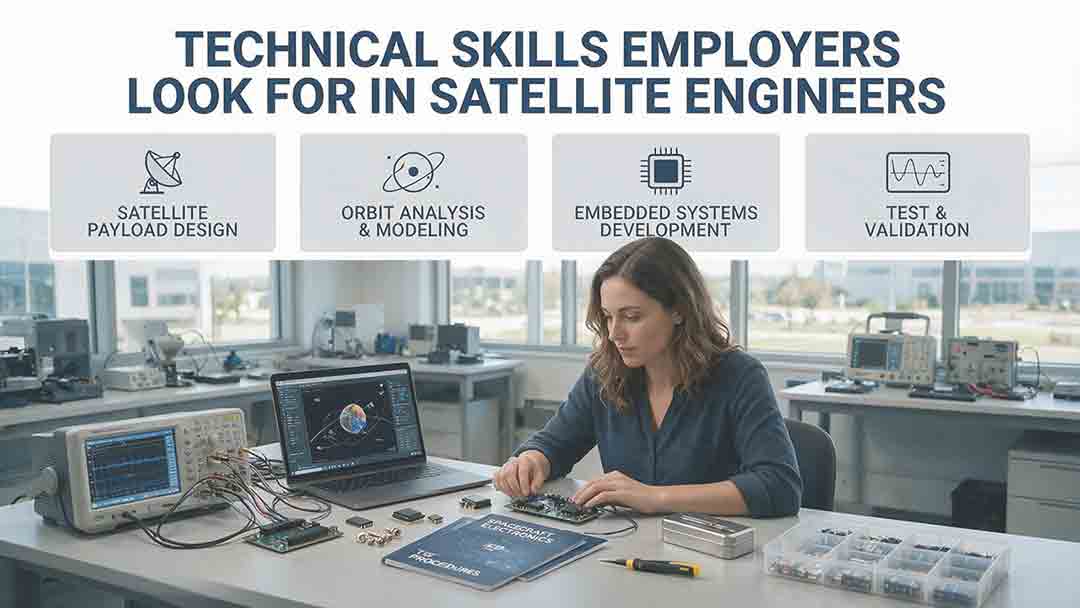
Technical Skills Employers Look for in Satellite Engineers
This guide explains the technical skills employers look for in satellite engineers and shows how those skills differ across systems, power, thermal, GNC, communications, avionics, software, structures, propulsion, ground systems, operations, and integration roles. It focuses on requirements, interfaces, engineering budgets, modeling, verification, testing, configuration control, anomaly reasoning, and technical communication rather than software-name lists. Original tools include the Interface Pairing Rule, which links each skill to inputs, outputs, and failure modes, and the Satellite Skill Proof Ladder, which measures how convincingly a project demonstrates competence. A worked downlink-capacity example illustrates compression, overhead, throughput, assumptions, and engineering limits. Readers also receive role comparisons, evidence chains, practical development steps, troubleshooting guidance, and a detailed checklist for turning technical work into credible résumé, portfolio, and interview evidence while respecting standards, licensing, confidentiality, and disclosure boundaries.
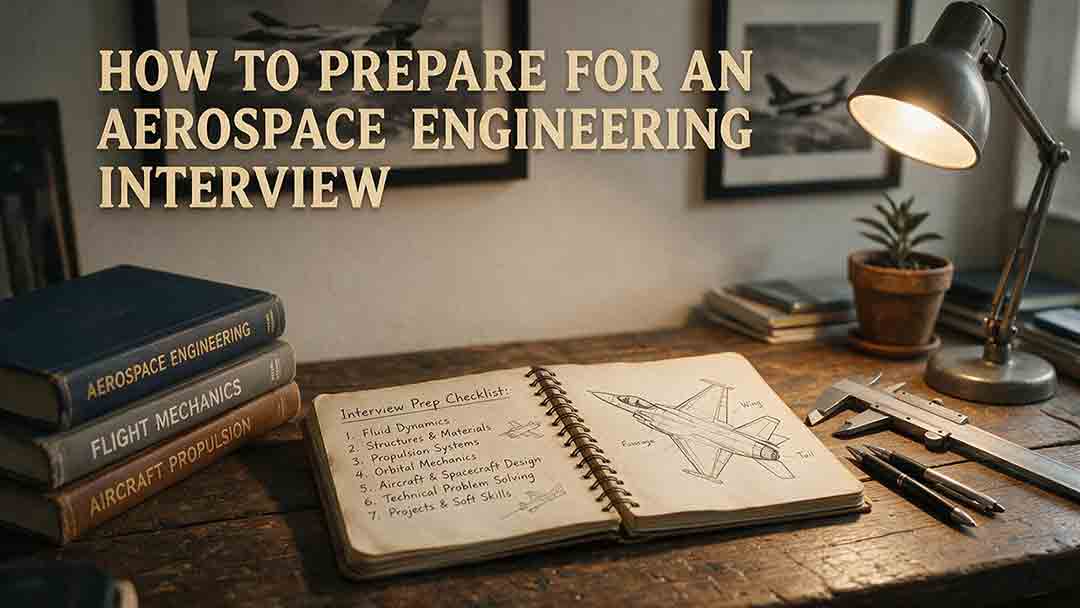
How to Prepare for an Aerospace Engineering Interview
This guide explains how to prepare for an aerospace engineering interview by turning a job description into a focused technical study plan and a set of evidence-backed project stories. It covers common interview formats, role-specific review areas, calculations, coding and data exercises, systems engineering, trade studies, failure discussions, interviewer questions, and disclosure safety. The article introduces original tools including the Aerospace Interview Readiness Matrix, the TRACE technical-answer framework, the STAR-V project structure, and a job-requirement evidence map. A worked energy calculation shows how to state assumptions, check units, and separate a preliminary estimate from a complete engineering conclusion. Readers also receive troubleshooting guidance, preparation priorities for different time windows, and a detailed checklist covering technical readiness, communication, logistics, and restricted information. The result is a practical method for building careful, defensible answers without memorizing scripts or overstating project results.
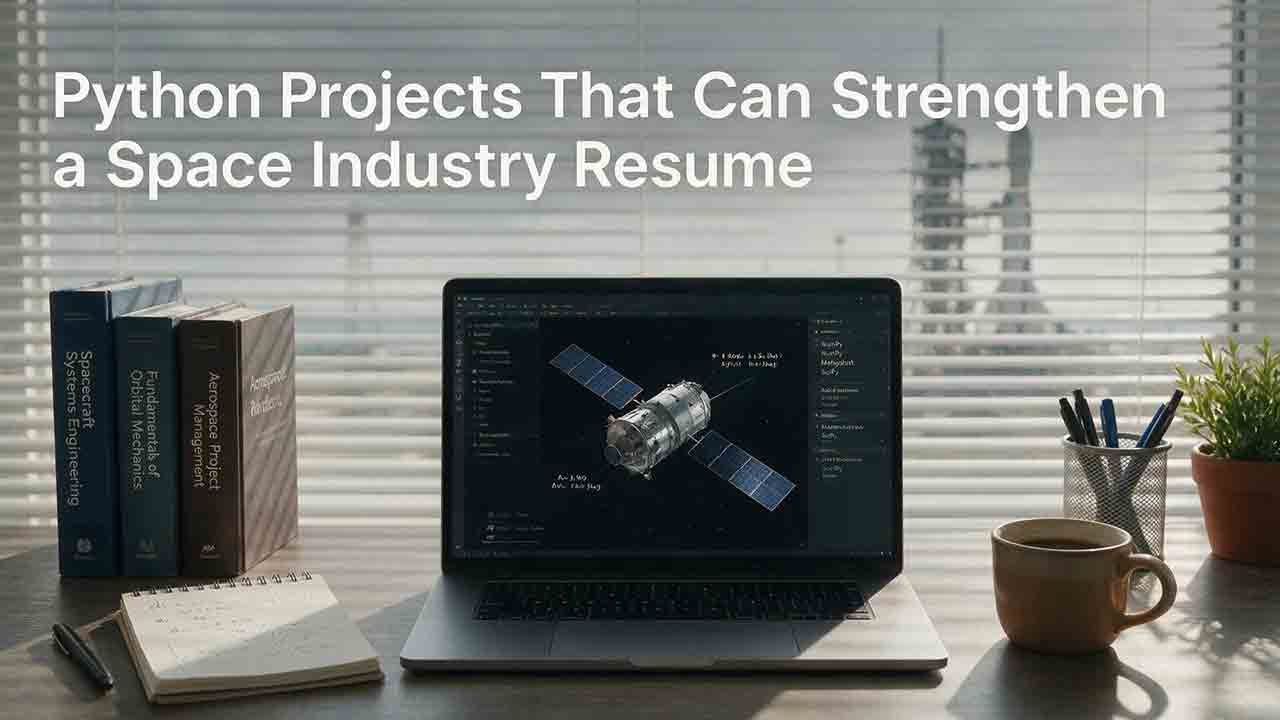
Python Projects That Can Strengthen a Space Industry Resume
This guide explains how to choose and build Python projects that provide credible evidence for space industry roles. It compares seven project directions, including telemetry decoding, JPL Horizons planning, GMAT automation, NOAA space-weather pipelines, Landsat analysis, Exoplanet Archive audits, and small-body mission tools. An original Project Signal Scorecard helps readers evaluate each idea by its domain question, data contract, engineering transformation, verification, failure behavior, and reproducibility. The article also shows how to define inputs and outputs, freeze test fixtures, document units and versions, handle abnormal data, structure a repository, and write honest resume bullets without overstating impact. A worked NOAA example demonstrates how a simple dashboard can become a reviewable engineering case study through boundary tests, provenance, state modeling, and reproducible evidence. Legal and professional guidance addresses API policies, licensing, attribution, credentials, restricted material, and agency endorsement.
Explore More Topics
What Certifications Are Useful for Aerospace and Satellite Jobs?
This guide helps students and professionals identify which certifications are genuinely useful for aerospace and satellite jobs. It maps INCOSE, IPC, ASQ, PMI, ISC2, AWS, NCEES, FAA, AS9100-related training, and IAQG auditor authentication to specific work such as systems engineering, electronics assembly, quality, reliability, project leadership, cybersecurity, cloud infrastructure, licensure, and regulated aviation activities. The article clearly distinguishes professional certification, course completion, organizational AS9100 certification, auditor training, IAQG authentication, government certificates, licenses, and security clearances. Original tools—including the Credential Gate Test, Certification Utility Score, One-Gate Rule, Credential Commitment Ledger, employer-demand audit, and a 30-day decision plan—help readers compare role alignment, eligibility, evidence value, portability, maintenance, and rule-change exposure. It also explains the 2026 IAQG transition, PMI’s announced PMP training-provider change, renewal burdens, accurate résumé wording, and why no credential guarantees employment, salary, professional authority, or access.

Online Courses That Can Help You Prepare for a Space Career
This guide helps students and career changers choose online courses that support a specific space-career goal rather than collecting unrelated certificates. It compares NASA, MIT OpenCourseWare, Harvard CS50, University of Colorado Boulder, EPFLx, and other official resources across programming, remote sensing, spacecraft dynamics, mission design, systems engineering, signal processing, and research practice. The article clearly separates free course materials, completion certificates, CS50 Certificates, edX verified certificates, Coursera Career Certificates, university credit, professional certification, and professional licenses. Original tools—including the Role-to-Course Evidence Chain, Course Utility Score, Four-Layer Learning Stack, Evidence Conversion Protocol, and a 12-week study plan—show readers how to identify a skill gap, select a suitable course, build an inspectable project, verify results, and state limitations honestly. It also explains ARSET certificate eligibility, course-age limits, academic-integrity rules, publication safety, and why coursework cannot replace required degrees, supervised experience, work authorization, or professional authority.

Do You Need a Master’s Degree to Work in Space Technology?
This guide explains when a master’s degree is required, preferred, optional, or unnecessary for space-technology careers. It compares bachelor’s-, associate-, master’s-, and doctoral-level entry routes across engineering, software, hardware, analysis, research, project work, writing, and technical operations. Readers learn how to distinguish an absolute degree requirement from a stated preference or an education-and-experience substitution. Original tools—including the Master’s Necessity Ladder, Master’s Pressure Index, Role-Gap Ledger, Replacement Test, and Graduate Commitment Ledger—help applicants audit job postings, identify whether their real gap is knowledge, evidence, experience, or credentials, and make hidden costs visible. A fictional spacecraft thermal-analysis example demonstrates the calculation process without presenting it as a hiring probability. The article also compares graduate-program formats, explains NASA and astronaut exceptions, addresses accreditation and licensure, and separates education from work authorization, export controls, and security-clearance requirements.