How to Prepare for an Aerospace Engineering Interview

How to Prepare for an Aerospace Engineering Interview
Prepare for an aerospace engineering interview by translating the job description into technical competencies, reviewing the fundamentals behind those competencies, and preparing project examples that show your decisions, calculations, tests, tradeoffs, and limitations. Practice explaining unfamiliar problems aloud, checking units and assumptions, and separating your personal contribution from team results. Do not memorize polished speeches that cannot survive follow-up questions.
Key Takeaways
- Prepare for the specific role, not for an imaginary universal aerospace interview.
- Expect questions about technical reasoning, project evidence, testing, teamwork, risk, and communication.
- A strong technical answer states assumptions, shows a method, checks the result, and explains its limits.
- Project stories should identify your contribution and connect decisions to evidence.
- Discuss only work that you are authorized and otherwise permitted to disclose.
This guide provides a role-based preparation process, two original interview frameworks, a worked calculation example, a project-answer template, troubleshooting guidance, and a final readiness checklist.
What Do Aerospace Engineering Interviews Actually Assess?
Aerospace engineering interviews vary by employer, role, and seniority. A practical preparation approach is to expect that you may need to apply role-relevant technical knowledge, explain project evidence, and communicate a defensible decision.
The exact assessment depends on the role. A structural analyst may be asked about loads, boundary conditions, stress, failure modes, and model verification. A flight-software candidate may face questions about interfaces, timing, testing, state management, and abnormal inputs.
The U.S. Department of Labor’s current O*NET profile for aerospace engineers includes work such as:
- Developing mathematical or computer models
- Planning and conducting tests
- Producing conceptual designs
- Investigating technical problems
- Evaluating compliance with requirements
- Writing technical documentation
- Developing aerospace software
The ABET Criteria for Accrediting Engineering Programs, 2026–2027 similarly identify engineering abilities involving problem solving, design under constraints, experimentation, data interpretation, communication, teamwork, ethics, and acquiring new knowledge.
Neither source is a universal employer interview scorecard. Together, however, they provide a useful basis for identifying the kinds of technical and professional evidence an aerospace candidate may need to explain.
Six Areas an Interview May Probe
| Assessment area | What the interviewer may be looking for | Evidence you can prepare |
|---|---|---|
| Technical fundamentals | Whether you understand the principles behind your tools | Derivation, estimate, model explanation, or comparison |
| Engineering judgment | Whether you can make decisions under constraints | Trade study, assumption, risk, or rejected alternative |
| Verification | Whether you know how to check a result | Hand calculation, test, benchmark, inspection, or sensitivity study |
| Project ownership | Whether your claimed contribution is clear | Files, decisions, tests, analyses, or interfaces you personally owned |
| Team behavior | Whether you can communicate and resolve technical disagreement | Specific situation, action, result, and lesson |
| Professional boundaries | Whether you recognize safety, ethics, confidentiality, and uncertainty | Honest limitation, escalation path, or refusal to overclaim |
What Interview Format Should You Expect?
Prepare for several formats because aerospace employers do not use one standard interview process.
As of August 1, 2026, NASA’s How to Apply and Work With NASA page states that referred candidates may encounter panel, in-person, telephone, or virtual interviews. NASA also notes that a hiring process may include more than one interview round.
A private aerospace company, supplier, research laboratory, startup, or university group may use a different process.
Possible formats include:
| Format | Likely emphasis | Preparation priority |
|---|---|---|
| Recruiter or screening call | Role fit, availability, background, communication | Concise résumé explanation and motivation |
| Hiring-manager interview | Technical relevance, project depth, judgment | Strong project evidence and role-specific fundamentals |
| Panel interview | Consistency across technical and behavioral topics | Structured answers and careful listening |
| Technical problem session | Reasoning, assumptions, calculations, checks | Think aloud and show intermediate logic |
| Coding or data exercise | Correctness, clarity, tests, error handling | Write readable code and explain tradeoffs |
| Design discussion | Requirements, interfaces, alternatives, risk | Use a systems-oriented answer structure |
| Presentation interview | Technical communication and ownership | Clear narrative, readable figures, anticipated questions |
| Laboratory or facility visit | Practical judgment and team interaction | Observe instructions and ask relevant questions |
The U.S. Office of Personnel Management defines a structured interview as an assessment using standardized, job-related questions and consistent rating criteria. Federal aerospace interviews may use structured or panel-based methods, but candidates should not assume that every organization follows the same format.
How Do You Turn a Job Description into an Interview Plan?
Convert each important responsibility into a technical topic, an evidence example, and a likely follow-up question.
Do not prepare only from the job title. “Aerospace engineer” can describe substantially different work.
Step 1: Extract the Action Verbs
Highlight verbs such as:
- Analyze
- Design
- Develop
- Integrate
- Test
- Verify
- Validate
- Troubleshoot
- Document
- Present
- Coordinate
- Review
A verb usually points toward a type of evidence.
For example:
- Analyze may lead to questions about assumptions, models, inputs, and sensitivity.
- Test may lead to questions about procedures, instrumentation, uncertainty, and failures.
- Integrate may lead to questions about interfaces, configuration, compatibility, and ownership.
- Review may lead to questions about standards, traceability, defects, and technical communication.
Step 2: Extract the Technical Nouns
Look for:
- Structures
- Propulsion
- Flight dynamics
- Avionics
- Embedded software
- Thermal systems
- Aerodynamics
- Manufacturing
- Systems engineering
- Requirements
- Telemetry
- Guidance, navigation, and control
- Verification and validation
These nouns determine which fundamentals deserve review.
Step 3: Identify Explicit Constraints
The vacancy may mention:
- Safety
- Cost
- Schedule
- Mass
- Power
- Reliability
- Real-time performance
- Configuration control
- Regulatory requirements
- Documentation
- Cross-functional communication
A strong interview answer should acknowledge relevant constraints rather than treating the problem as a purely mathematical exercise.
Step 4: Build an Evidence Map
Use one row for each major responsibility.
| Job requirement | Technical concept to review | Evidence from your work | Likely follow-up |
|---|---|---|---|
| Analyze structural components | Stress, strain, loads, boundary conditions | Bracket or beam analysis | How did you verify the model? |
| Develop test procedures | Acceptance criteria, instrumentation, uncertainty | Laboratory or subsystem test | What happened when the test failed? |
| Support system integration | Interfaces, configuration, fault isolation | Team subsystem project | How did you resolve an interface mismatch? |
| Write engineering software | Data structures, tests, performance, failure states | Python, C++, MATLAB, or embedded project | What inputs break the program? |
| Present technical findings | Audience, evidence, uncertainty | Design review or report | How did you handle disagreement? |
This table is more useful than a generic list of interview questions because it ties preparation to the actual vacancy.
How Can You Measure Your Interview Readiness?
Use the following original editorial tool.
The Aerospace Interview Readiness Matrix
Score each category from 0 to 2.
This matrix is a preparation aid, not an employer scoring model or predictor of hiring outcomes.
| Dimension | 0 points | 1 point | 2 points |
|---|---|---|---|
| Role alignment | Preparation is based only on the job title | Some responsibilities are mapped | Major responsibilities are linked to topics and evidence |
| Technical recall | Definitions are memorized without application | Familiar problems can be solved | Concepts can be applied, estimated, and checked aloud |
| Project evidence | Project descriptions are vague | Contribution is partly identified | Decisions, artifacts, verification, and limitations are explicit |
| Failure and risk reasoning | Only successful results are prepared | One problem or lesson is available | Several examples show detection, mitigation, and escalation |
| Communication | Answers are improvised or overly long | Main ideas are understandable | Answers are structured, concise, and resilient to follow-ups |
| Interview execution | Format and logistics are unknown | Basic setup is prepared | Format, technology, questions, materials, and contingencies are tested |
Add the six scores:
- 0–4: Preparation is incomplete.
- 5–7: Basic readiness, with important evidence gaps.
- 8–10: Credible interview preparation.
- 11–12: Strong coverage across technical and practical areas.
A high score does not guarantee an offer. It indicates that fewer parts of your candidacy depend on improvisation.
Which Technical Topics Should You Review?
Review the fundamentals that support the role’s actual work, especially the concepts shown in your own résumé.
Do not attempt to relearn an entire aerospace degree before one interview.
Role-Based Review Table
| Target role | Review areas | Evidence worth preparing |
|---|---|---|
| Structures | Free-body diagrams, stress and strain, bending, buckling, fatigue, material properties, FEA assumptions | Hand check, load path, boundary-condition decision, mesh study |
| Aerodynamics | Conservation laws, pressure and velocity relationships, lift and drag, nondimensional parameters, model limits | Airfoil or aircraft study, sensitivity analysis, validation case |
| Propulsion | Thermodynamics, mass flow, pressure, efficiency, nozzle behavior, heat transfer, performance limits | Cycle calculation, test data, uncertainty, trade study |
| GNC | Dynamics, reference frames, stability, estimation, feedback, sensors, disturbances | Controller or estimator, simulation assumptions, stability check |
| Mission analysis | Orbits, state representation, time systems, coordinate frames, maneuvers, propagation assumptions | Parameter study, comparison case, tool configuration |
| Thermal engineering | Conduction, convection, radiation, thermal resistance, boundary conditions, transient behavior | Thermal model, energy balance, test correlation |
| Flight or embedded software | State machines, interfaces, concurrency, timing, memory, error handling, testing | Requirements, unit tests, logs, fault injection |
| Systems engineering | Requirements, interfaces, trade studies, risk, verification, configuration, technical reviews | Requirement matrix, interface definition, risk record |
| Test engineering | Test objectives, instrumentation, calibration, uncertainty, acceptance criteria, anomalies | Procedure, test result, failure investigation |
| Manufacturing or quality | Tolerances, process capability, inspection, materials, nonconformance, configuration | Drawing, process decision, root-cause analysis |
The table is a starting point. The vacancy and your submitted résumé should control the final review list.
How Should You Answer a Technical Question?
Show the reasoning path, not only the final value.
Use the following original framework.
The TRACE Technical Answer
T — Translate the question
Restate the requirement, requested output, and relevant constraints.
R — Reveal assumptions
State units, coordinate frames, loading conditions, simplifications, and missing information.
A — Analyze
Apply a first-principles equation, model, estimate, algorithm, or controlled comparison.
C — Check
Inspect units, order of magnitude, signs, boundary behavior, conservation, or an independent reference.
E — Explain the engineering meaning
Connect the result to a decision and state what the calculation does not establish.
The TRACE framework is an editorial interview aid. It is not a NASA process or industry standard.
Worked Calculation Example
An interviewer asks:
A payload draws 80 watts for 15 minutes, and the avionics draw 25 watts for 45 minutes. Estimate the required energy if you add a 20% planning reserve.
Translate
The requested output is energy, not battery mass or capacity in ampere-hours.
Reveal Assumptions
Assume:
- The stated power values are constant.
- Both operating intervals are accurate.
- The reserve is applied to the calculated energy.
- Conversion losses, temperature effects, aging, depth-of-discharge limits, and peak-power constraints are not yet included.
Analyze
Payload energy:
80 W × 0.25 h = 20 Wh
Avionics energy:
25 W × 0.75 h = 18.75 Wh
Total before reserve:
20 Wh + 18.75 Wh = 38.75 Wh
With a 20% reserve:
38.75 Wh × 1.20 = 46.5 Wh
Check
- Power multiplied by time produces energy.
- The reserved value is larger than the unreserved value.
- The payload uses more power but operates for less time.
- The result is consistent with the stated assumptions.
Explain
The preliminary energy requirement is 46.5 Wh under the stated operating periods and reserve. This is not a complete battery-sizing result because efficiency, voltage, peak load, allowable depth of discharge, temperature, degradation, and mission life have not been evaluated.
This answer is stronger than stating only 46.5 Wh because it distinguishes a defensible estimate from a complete subsystem design.
What Should You Do When You Do Not Know the Answer?
Do not bluff. Convert the unknown into a controlled engineering problem.
A useful response sequence is:
- State what you understand.
- Identify the missing information.
- Ask a focused clarification.
- Declare a reasonable assumption if permitted.
- Outline the method you would use.
- Perform a partial analysis.
- Explain how you would verify the answer.
Example:
I do not remember the exact coefficient, so I would not want to invent it. I can still set up the governing relationship, identify the required inputs, and explain how I would verify the coefficient from the approved reference before using the result.
This approach demonstrates integrity and method. It is not a substitute for reviewing the fundamentals listed in the job description.
How Should You Prepare Project Stories?
Prepare project explanations that survive technical follow-up questions.
The official OPM guidance for structured interview questions describes the STAR elements:
- Situation or task
- Action
- Result
For engineering interviews, add verification and limitations.
The STAR-V Project Answer
This is an editorial extension of STAR for technical project discussions.
S — Situation
What system, problem, or project created the need?
T — Task
What requirement or responsibility did you own?
A — Action
What did you personally calculate, design, code, test, decide, or communicate?
R — Result
What happened, using measured or otherwise supportable evidence?
V — Verification and boundary
How did you check the result, and what remained unverified?
Example Project Answer
Our student team needed to reduce the mass of a small structural assembly without exceeding the allowable deflection defined for the project. I owned the bracket analysis and drawing update. I created the initial load cases, compared two geometries, and used a hand calculation to check the finite-element trend. The revised concept reduced the model’s estimated mass while remaining within the project’s stated deflection criterion. The analysis was limited to the assigned static load cases and did not include fatigue, joint slip, manufacturing variation, or qualification testing.
This answer separates:
- The team objective
- The candidate’s responsibility
- The technical method
- The supported result
- The unverified conditions
Avoid presenting simulated performance as completed physical testing.
Which Project Stories Should You Prepare?
Build a small evidence library rather than memorizing one success story.
Prepare examples involving:
| Story type | What it can demonstrate |
|---|---|
| A difficult technical problem | Analysis and persistence |
| A failed test or incorrect result | Detection, troubleshooting, and learning |
| A tradeoff | Engineering judgment under constraints |
| A team disagreement | Communication and decision process |
| A requirement change | Adaptability and impact assessment |
| An unfamiliar tool or topic | Learning strategy |
| A documentation or review issue | Attention to detail and professional responsibility |
| A schedule or resource constraint | Prioritization and escalation |
One project can support several stories, but do not force the same example into every answer.
How Do You Explain a Team Project Honestly?
State the team result and your contribution separately.
Use language such as:
The five-person team developed the vehicle concept. I owned the mass-properties model, maintained the power-interface assumptions, and prepared the verification evidence for two subsystem requirements.
Be ready to explain:
- Which files you created
- Which decisions you made
- Which interfaces you managed
- Which calculations you performed
- Which tests you conducted
- Which result belonged to another teammate
- How your work changed the team outcome
Avoid saying:
We did all of the design together.
That answer makes technical ownership difficult to evaluate.
How Should You Handle a Design or Trade-Study Question?
Start with requirements and decision criteria before proposing a solution.
A strong design response typically covers:
- Stakeholder need
- Functional requirement
- Constraints
- Candidate concepts
- Decision criteria
- Analysis or test approach
- Interfaces
- Failure modes
- Verification method
- Residual risk
NASA’s Systems Engineering Handbook organizes engineering work around system design, product realization, and crosscutting technical management. Its requirements appendix also shows how requirements can be connected to planned verification methods.
Do not name your preferred technology before understanding the requirement.
Weak Design Answer
I would use carbon fiber because it is lightweight.
Stronger Design Answer
I would first define the load cases, stiffness requirement, temperature range, manufacturing constraints, inspection approach, cost boundary, and interface geometry. Carbon-fiber composite may be a candidate, but material selection would depend on laminate design, joint behavior, damage tolerance, manufacturability, verification needs, and the alternatives being compared.
The stronger answer does not require a final design. It demonstrates an engineering decision process.
How Should You Prepare for a Coding or Data Exercise?
Practice writing small, testable solutions while explaining input assumptions and failure behavior.
Possible exercises may involve:
- Parsing a file
- Transforming engineering data
- Implementing an equation
- Detecting invalid input
- Finding an error in existing code
- Writing a small simulation
- Analyzing time-series data
- Designing a basic interface
- Explaining algorithm complexity
- Adding tests
Preparation should include:
- Clear variable names
- Explicit units
- Input validation
- Boundary cases
- Separation of core logic from display code
- Small test fixtures
- Error messages
- Explanation of tradeoffs
For aerospace software roles, review the languages and tools listed in the vacancy and distinguish whether the work concerns flight software, ground systems, analysis, simulation, or interfaces.
A polished interface will not compensate for untested core logic.
How Should You Prepare for a Systems Engineering Interview?
Practice connecting requirements, interfaces, decisions, verification, and risk.
Be ready to discuss:
- How a stakeholder need became a requirement
- How you identified interfaces
- How changes propagated across a system
- How requirements were verified
- How conflicting constraints were resolved
- How risk was recorded and mitigated
- How configuration was controlled
- How review findings were closed
NASA’s Requirements Verification Matrix illustrates how a requirement can be associated with a source and verification approach.
NASA’s technical risk management guidance describes activities such as identifying risks, developing mitigations, monitoring technical progress, and resolving emerging issues.
Use these sources to understand the concepts, not to imply that a student or commercial project followed NASA’s complete process.
How Should You Discuss Failure?
Describe how the failure was detected, contained, investigated, and used to improve the work.
Avoid turning every failure story into an artificial success.
A useful sequence is:
- Expected behavior
- Observed deviation
- Immediate containment
- Evidence collected
- Candidate causes
- Test used to isolate the cause
- Corrective action
- Verification after the change
- Remaining risk
Example:
A sensor-processing script produced discontinuities at day boundaries. I first confirmed that the raw measurements were continuous, then isolated the problem to a local-time conversion applied before sorting. I changed the internal representation to UTC, added fixtures spanning the date boundary, and documented the interface conversion. The tests covered the known boundary case, but the tool was not evaluated across every time-zone rule.
This answer demonstrates more than saying:
I fixed a timestamp bug.
What Questions Should You Ask the Interviewer?
Ask questions that help you understand the work, interfaces, evidence standards, and expectations.
Useful questions include:
- Which technical decisions would this role own?
- What types of analyses, tests, reviews, or software artifacts does the team produce?
- Which interfaces create the most coordination work?
- How are requirements and design changes managed?
- How does the team verify analytical or software results?
- What distinguishes successful performance during the first several months?
- Which skills would the selected candidate need to develop after joining?
- How are technical disagreements reviewed and resolved?
- What is the balance among analysis, documentation, meetings, testing, and implementation?
Avoid asking questions that are already answered clearly on the employer’s website or in the vacancy.
How Should You Research the Organization?
Research enough to connect your preparation to the organization’s actual work without pretending to know internal details.
Review:
- Official mission or product pages
- Current public programs
- The business unit or technical organization
- The vacancy language
- Public technical papers or conference presentations
- Software or data repositories officially released by the organization
- Regulatory or customer environment, where relevant
Separate confirmed information from inference.
Weak:
I know your team is replacing its flight computer.
Stronger:
The public program material emphasizes avionics integration. I would be interested in learning which interfaces and verification activities this role supports.
Do not rely on rumors, confidential posts, or claims from unidentified sources.
How Much Should You Memorize?
Memorize definitions and relationships that support reasoning, but do not memorize full interview scripts.
Useful items to recall include:
- Core equations relevant to the role
- Common units and conversions
- Fundamental assumptions
- Typical failure modes
- Verification methods
- Your own project data and decisions
- The names and purposes of tools on your résumé
Do not claim proficiency with software you cannot explain.
For each listed tool, prepare to answer:
- Why did you use it?
- What inputs did you provide?
- What assumptions did it make?
- What output did it produce?
- How did you check the output?
- What could make the result wrong?
How Should You Discuss Confidential, Proprietary, or Controlled Work?
Discuss only material that you are authorized and otherwise permitted to disclose.
Aerospace projects may involve:
- Nondisclosure agreements
- Employer-owned intellectual property
- Customer restrictions
- Personal or sensitive data
- Classified information
- Export-controlled software or technical data
- Unreleased test results
- Facility or security restrictions
NASA maintains an agency-wide Export Control Program addressing compliance with U.S. export-control requirements involving technical data, software, and technology.
The U.S. Department of Commerce’s Bureau of Industry and Security administers the Export Administration Regulations. The U.S. Department of State’s Directorate of Defense Trade Controls administers the International Traffic in Arms Regulations, located in 22 CFR Chapter I, Subchapter M. The DDTC website provides current regulatory and compliance resources.
A general interview guide cannot determine whether a specific fact, drawing, model, interface, parameter, or software detail may be disclosed.
Before the interview:
- Review applicable agreements and release rules.
- Identify examples already approved for public discussion.
- Remove restricted material from presentations and files.
- Do not rely on deleting a logo or project name.
- Do not send interviewers files from an employer or laboratory without authorization.
- Ask the responsible legal, security, export-control, contracting, or publication authority when uncertain.
During the interview, a safe response may be:
I cannot discuss that project detail, but I can explain the public problem category, describe an engineering method I am authorized to discuss, or use a separate public example that demonstrates the same skill.
Even a high-level description may remain restricted. Use only material that has been cleared for the intended disclosure.
How Can You Practice Without Memorizing?
Practice in Layers
Layer 1: One-Sentence Answer
State the main conclusion.
Layer 2: Short Technical Explanation
Explain the method and evidence.
Layer 3: Follow-Up Depth
Prepare assumptions, alternatives, calculations, verification, and limitations.
This layered approach helps you remain concise while still being prepared for technical probing.
Record and Review
Record a practice answer and check:
- Did the first sentence answer the question?
- Did I identify my contribution?
- Did I state an assumption?
- Did I explain how the result was checked?
- Did I overclaim?
- Did I stop when the answer was complete?
Do not judge only confidence or speaking style. Evaluate technical content.
Use a Realistic Mock Format
A useful mock interview should:
- Use the actual job description
- Include technical and behavioral questions
- Allow follow-up questions
- Include one unfamiliar problem
- Require explanation aloud
- End with candidate questions
- Reproduce the expected interview technology
The purpose is to expose gaps, not to create a flawless performance.
How Should You Prepare Based on Available Time?
The following is an editorial prioritization guide, not a guaranteed preparation schedule.
If the Interview Is Very Soon
Prioritize:
- Vacancy analysis
- Your résumé and project details
- One strong example for each major competency
- Core role-specific equations and concepts
- Interview format and logistics
- Questions for the interviewer
Do not begin a large new project.
If You Have About a Week
Add:
- Multiple technical practice sessions
- A mock panel or technical conversation
- TRACE calculation practice
- STAR-V project refinement
- Review of likely interfaces and failure modes
- A disclosure-safety review of project materials
If You Have More Time
Add:
- A small gap-filling technical exercise
- Review of public technical documentation
- More difficult follow-up questions
- A presentation rehearsal
- Coding or analysis practice
- Portfolio and repository cleanup
The goal is evidence coverage, not the number of hours spent.
What Common Mistakes Weaken Aerospace Interviews?
Preparing Only Generic Questions
Generic practice cannot replace role analysis.
Start with the vacancy and your résumé.
Giving a Formula Without Assumptions
An equation may be correct while its application is wrong.
State the system, units, frame, loading condition, and simplifications.
Treating Software Output as Proof
A solver, simulation, or script can produce a result from an incorrect model.
Explain the independent check.
Hiding Behind “We”
Team language without personal ownership makes your contribution difficult to assess.
State what you personally did.
Inventing a Number
Do not guess an exact material property, coefficient, standard limit, or project result.
State that you would verify the value from the approved source.
Overusing Acronyms
Acronyms can make a correct explanation difficult to follow.
Define specialized terms when the audience or context is uncertain.
Giving a Perfect Failure Story
A rehearsed story in which every mistake immediately becomes a success can sound uninformative.
Explain the actual detection and correction process.
Describing Every Project as Optimized
Optimization requires a defined objective, constraints, variables, and method.
Use terms such as “compared,” “reduced within the tested cases,” or “selected under the stated criteria” when those are more accurate.
Disclosing Restricted Work
Technical detail is not automatically safe because the interviewer works in aerospace.
Use only authorized material.
Talking Until Interrupted
Long answers can hide the central point.
Give the conclusion, explain the evidence, and pause for follow-up.
How Can You Troubleshoot a Weak Interview Answer?
| Symptom | Likely cause | Practical correction |
|---|---|---|
| The answer sounds generic | No specific evidence is included | Add one decision, artifact, test, or result |
| The technical result seems unsupported | Verification is missing | Add a hand check, benchmark, test, or limiting case |
| The answer is too long | The conclusion appears too late | Start with the direct answer, then add evidence |
| The answer sounds memorized | Wording is fixed but reasoning is shallow | Practice follow-up questions instead of scripts |
| The project contribution is unclear | Team and individual work are mixed | Separate team outcome from personal ownership |
| The calculation stalls | Assumptions and target output are undefined | Use TRACE and write known quantities first |
| The candidate guesses | Uncertainty feels uncomfortable | State the gap and outline a verification method |
| The story lacks engineering content | STAR covers events but not evidence | Add verification and technical limitation |
| The interview feels adversarial | Clarifying questions are interpreted as weakness | Ask concise questions that reduce ambiguity |
| The answer may reveal restricted information | Disclosure boundaries were not prepared | Stop and switch to an authorized public example |
| The virtual interview fails technically | Equipment was not tested | Run a full audio, video, screen-share, and connection check |
Aerospace Engineering Interview Preparation Checklist
Role Analysis
- I have identified the vacancy’s major responsibilities.
- I have mapped technical nouns and action verbs.
- I know which fundamentals support each responsibility.
- I understand which requirements are essential and which are preferred.
Technical Preparation
- I can explain the assumptions behind my main equations and models.
- I can perform at least one relevant estimate aloud.
- I can check units, signs, order of magnitude, and limiting behavior.
- I can explain the limitations of every major tool on my résumé.
- I can distinguish verification from validation.
Project Evidence
- I have prepared several project stories.
- My personal contribution is explicit.
- I can explain one tradeoff.
- I can explain one failed or unexpected result.
- I can describe how an important result was verified.
- I know which claims are supported and which are not.
Behavioral Preparation
- I have examples involving teamwork and disagreement.
- I have an example of learning an unfamiliar topic.
- I have an example involving changing requirements or priorities.
- I can explain a mistake without blaming another person.
- My answers include actions and results rather than opinions alone.
Communication
- My first sentence answers the question.
- I define specialized terms when appropriate.
- I pause after a complete answer.
- I ask clarifying questions when requirements are ambiguous.
- I avoid unsupported certainty.
Disclosure Safety
- My examples are authorized and otherwise permitted for disclosure.
- My presentation contains no restricted drawings, data, code, or photographs.
- I know which project details cannot be discussed.
- I have public alternatives for restricted examples.
- I will not send employer or laboratory files without authorization.
Interview Logistics
- I know the interview date, time zone, platform, and expected format.
- Audio, camera, network, and screen sharing have been tested.
- My résumé, vacancy, notes, and permitted work samples are organized.
- Notifications and unrelated applications are closed.
- I have prepared relevant questions for the interviewers.
- I have a backup contact method.
What Should You Do Next?
Begin with the job description and create an evidence map.
- Student or recent graduate: focus on course, research, student-team, internship, and personal projects with clear ownership.
- Structures, thermal, aerodynamics, propulsion, or GNC candidate: review first principles and practice checked estimates.
- Software or data candidate: prepare interfaces, tests, abnormal inputs, reproducibility, and performance tradeoffs.
- Systems candidate: prepare requirements, interfaces, risks, trade studies, and verification examples.
- Test candidate: prepare procedures, instrumentation, uncertainty, anomalies, and corrective actions.
- Experienced candidate: emphasize decisions, technical leadership, review findings, risk reduction, and authorized outcomes.
Use this preparation chain:
job requirement → technical concept → project evidence → verification → limitation → interview answer
The strongest aerospace interview performance does not come from predicting every question. It comes from being able to build a careful, evidence-based answer when the exact question is unfamiliar.
Frequently Asked Questions
How Technical Is an Aerospace Engineering Interview?
The technical depth depends on the role and experience level. An entry-level interview may emphasize fundamentals and project understanding, while a specialized role may require deeper analysis, coding, design, testing, or domain knowledge. The vacancy and your submitted résumé are the best starting points for predicting depth.
Should I Memorize Aerospace Equations?
Memorize important relationships relevant to the role, but also understand assumptions, units, and limitations. Interviewers may change the conditions or ask how you would verify the result. Conceptual understanding is more robust than memorizing isolated formulas.
Can I Bring an Aerospace Engineering Portfolio?
Bring or share a portfolio only when the interview instructions permit it. Select evidence that shows requirements, decisions, verification, and limitations, and do not include restricted work.
What Should I Say if I Made a Mistake During a Calculation?
Acknowledge it, identify the source, and correct the reasoning. A unit check, sign check, or order-of-magnitude check can help. Attempting to defend a known error is usually less informative than showing how you detect and repair it.
Is It Acceptable to Ask Clarifying Questions?
Yes. A concise clarification can demonstrate that you recognize missing requirements or ambiguous conditions. Avoid using repeated questions to delay the answer; clarify what materially affects the method.
Should I Send a Thank-You Message After the Interview?
Follow the communication instructions provided by the recruiter or hiring contact. A brief professional message can acknowledge the conversation and restate interest, but it should not introduce exaggerated claims, confidential details, or unsolicited technical attachments.
Sources
The sources below support the occupational, interview-process, engineering-practice, and disclosure-safety guidance in this article. The Aerospace Interview Readiness Matrix, TRACE framework, STAR-V extension, worked calculation, evidence map, and troubleshooting table are original editorial tools.
- NASA Careers: How to Apply and Work With NASA
- NASA Careers: Pathways
- U.S. Office of Personnel Management: Structured Interviews
- U.S. Office of Personnel Management: Creating Structured Interview Questions and STAR Responses
- O*NET OnLine: Aerospace Engineers
- ABET Criteria for Accrediting Engineering Programs, 2026–2027
- NASA Systems Engineering Handbook
- NASA Systems Engineering Handbook Appendix
- NASA Requirements Verification Matrix
- NASA Technical Risk Management
- NASA Risk Management
- NASA Export Control and Interagency Liaison Division
- NASA Export Control Program Requirements, NPR 2190.1C
- U.S. Bureau of Industry and Security: Export Administration Regulations
- U.S. Department of State Directorate of Defense Trade Controls
- Electronic Code of Federal Regulations: ITAR, 22 CFR Chapter I, Subchapter M
More from Skills, Portfolios & Interviews
Technical Skills Employers Look for in Satellite Engineers
This guide explains the technical skills employers look for in satellite engineers and shows how those skills differ across systems, power, thermal, GNC, communications, avionics, software, structures, propulsion, ground systems, operations, and integration roles. It focuses on requirements, interfaces, engineering budgets, modeling, verification, testing, configuration control, anomaly reasoning, and technical communication rather than software-name lists. Original tools include the Interface Pairing Rule, which links each skill to inputs, outputs, and failure modes, and the Satellite Skill Proof Ladder, which measures how convincingly a project demonstrates competence. A worked downlink-capacity example illustrates compression, overhead, throughput, assumptions, and engineering limits. Readers also receive role comparisons, evidence chains, practical development steps, troubleshooting guidance, and a detailed checklist for turning technical work into credible résumé, portfolio, and interview evidence while respecting standards, licensing, confidentiality, and disclosure boundaries.
Python Projects That Can Strengthen a Space Industry Resume
This guide explains how to choose and build Python projects that provide credible evidence for space industry roles. It compares seven project directions, including telemetry decoding, JPL Horizons planning, GMAT automation, NOAA space-weather pipelines, Landsat analysis, Exoplanet Archive audits, and small-body mission tools. An original Project Signal Scorecard helps readers evaluate each idea by its domain question, data contract, engineering transformation, verification, failure behavior, and reproducibility. The article also shows how to define inputs and outputs, freeze test fixtures, document units and versions, handle abnormal data, structure a repository, and write honest resume bullets without overstating impact. A worked NOAA example demonstrates how a simple dashboard can become a reviewable engineering case study through boundary tests, provenance, state modeling, and reproducible evidence. Legal and professional guidance addresses API policies, licensing, attribution, credentials, restricted material, and agency endorsement.

How to Build an Aerospace Engineering Portfolio
This guide explains how to build an aerospace engineering portfolio that demonstrates engineering judgment rather than displaying isolated renders, plots, code, or tool names. It shows readers how to select role-relevant projects, document personal contributions, connect requirements to methods and verification, and present limitations honestly. Original tools include the Portfolio Proof Matrix for rating project evidence, an evidence spine for structuring case studies, a release-safety triage for identifying publication risks, and a worked OpenVSP example. The article also compares websites, PDFs, repositories, reports, and presentation decks; explains verification and validation; covers team-project attribution and reproducibility; and provides troubleshooting and publication checklists. Special attention is given to confidentiality, copyright, licensing, privacy, sponsor rules, and export-control restrictions, with links to NASA, ABET, MIT, and U.S. government sources. Readers finish with a practical process for turning one existing project into a clear, credible, evidence-backed portfolio case study.
Explore More Topics
What Certifications Are Useful for Aerospace and Satellite Jobs?
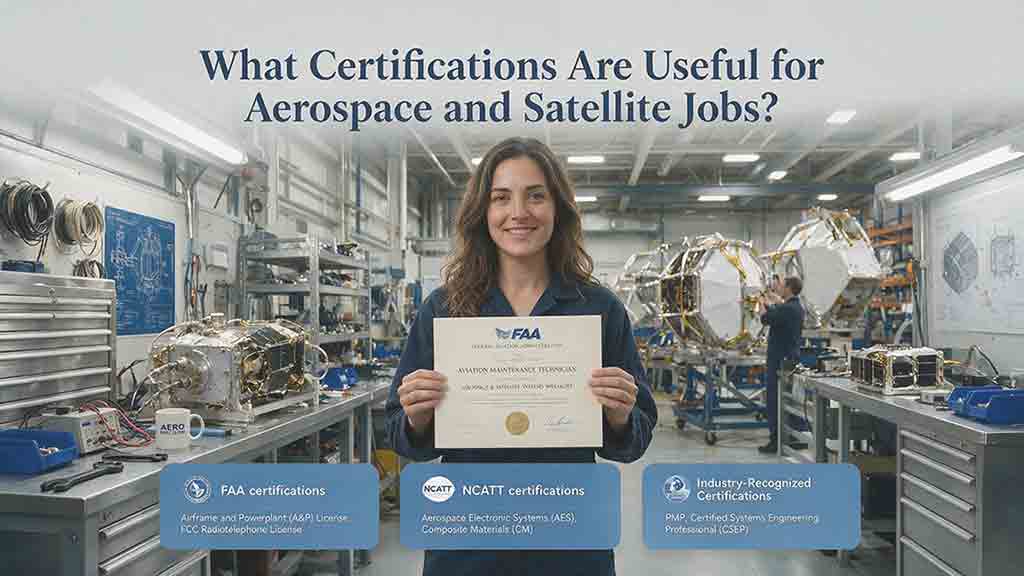
This guide helps students and professionals identify which certifications are genuinely useful for aerospace and satellite jobs. It maps INCOSE, IPC, ASQ, PMI, ISC2, AWS, NCEES, FAA, AS9100-related training, and IAQG auditor authentication to specific work such as systems engineering, electronics assembly, quality, reliability, project leadership, cybersecurity, cloud infrastructure, licensure, and regulated aviation activities. The article clearly distinguishes professional certification, course completion, organizational AS9100 certification, auditor training, IAQG authentication, government certificates, licenses, and security clearances. Original tools—including the Credential Gate Test, Certification Utility Score, One-Gate Rule, Credential Commitment Ledger, employer-demand audit, and a 30-day decision plan—help readers compare role alignment, eligibility, evidence value, portability, maintenance, and rule-change exposure. It also explains the 2026 IAQG transition, PMI’s announced PMP training-provider change, renewal burdens, accurate résumé wording, and why no credential guarantees employment, salary, professional authority, or access.

Online Courses That Can Help You Prepare for a Space Career
This guide helps students and career changers choose online courses that support a specific space-career goal rather than collecting unrelated certificates. It compares NASA, MIT OpenCourseWare, Harvard CS50, University of Colorado Boulder, EPFLx, and other official resources across programming, remote sensing, spacecraft dynamics, mission design, systems engineering, signal processing, and research practice. The article clearly separates free course materials, completion certificates, CS50 Certificates, edX verified certificates, Coursera Career Certificates, university credit, professional certification, and professional licenses. Original tools—including the Role-to-Course Evidence Chain, Course Utility Score, Four-Layer Learning Stack, Evidence Conversion Protocol, and a 12-week study plan—show readers how to identify a skill gap, select a suitable course, build an inspectable project, verify results, and state limitations honestly. It also explains ARSET certificate eligibility, course-age limits, academic-integrity rules, publication safety, and why coursework cannot replace required degrees, supervised experience, work authorization, or professional authority.

Do You Need a Master’s Degree to Work in Space Technology?
This guide explains when a master’s degree is required, preferred, optional, or unnecessary for space-technology careers. It compares bachelor’s-, associate-, master’s-, and doctoral-level entry routes across engineering, software, hardware, analysis, research, project work, writing, and technical operations. Readers learn how to distinguish an absolute degree requirement from a stated preference or an education-and-experience substitution. Original tools—including the Master’s Necessity Ladder, Master’s Pressure Index, Role-Gap Ledger, Replacement Test, and Graduate Commitment Ledger—help applicants audit job postings, identify whether their real gap is knowledge, evidence, experience, or credentials, and make hidden costs visible. A fictional spacecraft thermal-analysis example demonstrates the calculation process without presenting it as a hiring probability. The article also compares graduate-program formats, explains NASA and astronaut exceptions, addresses accreditation and licensure, and separates education from work authorization, export controls, and security-clearance requirements.