Technical Skills Employers Look for in Satellite Engineers

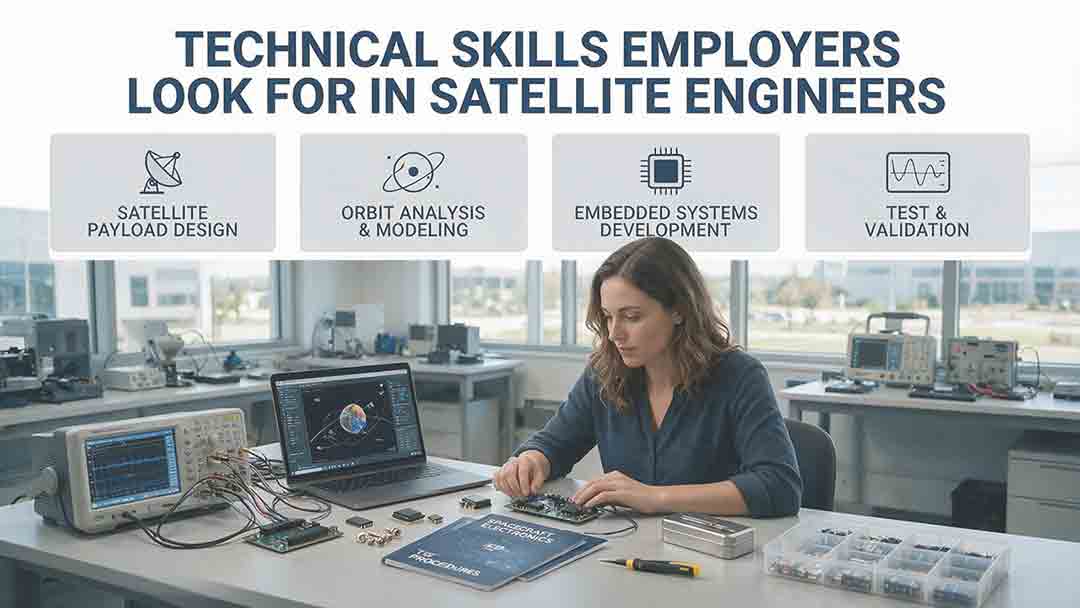
Technical Skills Employers Look for in Satellite Engineers
The most relevant technical skills for satellite engineers are systems thinking, subsystem analysis, interface management, engineering budgets, modeling, verification, software and data handling, environmental testing, configuration control, and operations reasoning. The exact combination varies by role, but candidates are stronger when they can demonstrate depth in one subsystem and explain how their work affects the rest of the spacecraft.
Key Takeaways
- Satellite engineering is an interface-heavy discipline; subsystem knowledge is most valuable when connected to system requirements.
- Employers can evaluate evidence more easily than tool lists, so show calculations, test results, requirements, interfaces, and limitations.
- Systems engineering, verification, configuration control, and anomaly reasoning are broadly useful across satellite roles, although the required depth varies by responsibility.
- Technical depth should be role-specific: power, thermal, GNC, communications, avionics, structures, propulsion, or mission operations.
- One well-documented engineering decision is usually more credible than shallow familiarity with every spacecraft subsystem.
This guide explains which technical skills are most relevant to satellite-engineering work, how priorities differ by role, what evidence demonstrates competence, and how to build a focused development plan without treating every software package or standard as universally required.
Which Technical Skills Matter Most in Satellite Engineering?
The most transferable satellite-engineering skills connect mission needs to technical decisions that can be analyzed, integrated, tested, and operated.
The U.S. Department of Labor’s 2026 O*NET profile for aerospace engineers includes work such as developing mathematical models, planning tests, creating conceptual designs, investigating technical problems, evaluating conformance, writing technical documentation, and developing aerospace software.
NASA’s 2026 State-of-the-Art of Small Spacecraft Technology organizes spacecraft technology around areas including:
- Complete spacecraft platforms
- Electrical power
- In-space propulsion
- Guidance, navigation, and control
- Structures, materials, and mechanisms
- Thermal control
- Avionics and flight software
- Communications
- Integration, launch, and deployment
- Ground data systems and mission operations
These sources do not establish a universal hiring checklist. They do show that satellite development combines analytical, hardware, software, systems, testing, and operational disciplines.
The Core Skill Families
| Skill family | What it enables | Strong evidence |
|---|---|---|
| Requirements and systems engineering | Turning mission needs into verifiable technical requirements | Requirement set, architecture, trade study, verification matrix |
| Interface engineering | Connecting subsystems without incompatible assumptions | Interface control document, signal definition, mechanical drawing, data contract |
| Engineering analysis | Predicting performance and identifying constraints | Calculation, simulation, sensitivity study, uncertainty assessment |
| Budgets and margins | Managing finite spacecraft resources | Mass, power, data, thermal, link, pointing, or propellant budget |
| Subsystem expertise | Designing or evaluating one technical domain in depth | Model, prototype, test, design review, or validated software |
| Verification and testing | Demonstrating that requirements are satisfied | Test procedure, acceptance criteria, results, discrepancy record |
| Software and data engineering | Implementing control, analysis, automation, and telemetry workflows | Tested code, versioned repository, data schema, fault handling |
| Configuration and traceability | Preserving the relationship among requirements, designs, builds, and tests | Version baseline, change record, traceability table |
| Mission operations reasoning | Understanding how the spacecraft will be commanded, monitored, and recovered | Procedure, telemetry logic, fault response, operations scenario |
| Technical communication | Making engineering decisions reviewable | Concise report, diagram, test summary, review presentation |
Why Is Systems Thinking So Important for Satellite Engineers?
A satellite succeeds as an integrated system, not as a collection of independently optimized components.
NASA defines systems engineering as a methodical, multidisciplinary approach covering the design, realization, technical management, operation, and retirement of a system. The NASA Systems Engineering Handbook emphasizes requirements, interfaces, design alternatives, integration, verification, validation, configuration, and technical risk.
A satellite engineer does not need equal expertise in every subsystem. The engineer should understand enough system context to identify when a local decision creates a problem elsewhere.
Examples include:
- Increasing transmitter power may affect battery sizing and thermal rejection.
- Tightening pointing requirements may affect sensors, actuators, structural stability, software, and power.
- Increasing onboard processing may reduce downlink demand but increase avionics power and software complexity.
- Changing a material may affect stiffness, thermal conduction, outgassing, manufacturability, and test behavior.
- Increasing payload duty cycle may affect storage, downlink capacity, temperature, and energy balance.
This cross-system awareness is often called systems thinking: the ability to evaluate a technical decision in relation to requirements, interfaces, lifecycle effects, and system-level consequences.
What Is the Best Skill Profile: Generalist or Specialist?
A practical satellite-engineering profile combines subsystem depth with cross-system literacy.
A pure generalist may understand the vocabulary of many disciplines without being able to perform a defensible analysis. A narrow specialist may produce excellent subsystem work but miss interface or mission-level consequences.
A stronger profile resembles a “T”:
- The horizontal bar represents system context, interfaces, requirements, verification, and operations.
- The vertical bar represents depth in one or two technical areas.
Comparing Three Skill Profiles
| Profile | Strength | Limitation | Best improvement |
|---|---|---|---|
| Broad beginner | Understands major satellite subsystems | Cannot yet produce deep technical evidence | Complete one subsystem analysis and verification case |
| Narrow specialist | Strong technical depth | May overlook interfaces and mission consequences | Add requirements, budgets, and integration context |
| T-shaped engineer | Combines depth with system awareness | Still requires continued domain development | Strengthen lifecycle, test, and operational judgment |
The appropriate depth depends on the role. A thermal analyst and a flight-software engineer should not have identical skill profiles.
Which Skills Matter Most for Different Satellite Roles?
| Target role | Highest-priority technical skills | Useful evidence |
|---|---|---|
| Satellite systems engineer | Requirements, architecture, interfaces, budgets, trade studies, risk, verification | System block diagram, requirements matrix, interface map, trade record |
| Power engineer | Energy balance, solar generation, batteries, converters, load switching, fault protection | Orbit-based energy budget, power management and distribution (PMAD) model, test data, derating analysis |
| Thermal engineer | Conduction, radiation, materials, boundary conditions, thermal networks, correlation | Thermal model, hand check, hot/cold case, test correlation |
| GNC engineer | Dynamics, estimation, control, reference frames, sensors, actuators, stability | Simulation, pointing budget, Monte Carlo study, hardware-in-the-loop result |
| Communications engineer | Link budgets, RF or optical architecture, antennas, modulation, coding, licensing constraints | Link analysis, antenna pattern, contact study, measured data |
| Avionics engineer | Processor architecture, memory, interfaces, timing, radiation effects, fault tolerance | Interface design, board analysis, timing budget, fault-injection test |
| Flight-software engineer | State machines, real-time behavior, command and telemetry, testing, fault management | Requirements-linked tests, simulator, logs, code review evidence |
| Structures engineer | Loads, stiffness, stress, vibration, buckling, materials, mechanisms | Load path, FEA with hand check, modal analysis, environmental test |
| Propulsion engineer | Thrust, specific impulse, flow, storage, feed systems, thermal effects, contamination | Performance model, propellant budget, test result, uncertainty analysis |
| Ground-systems engineer | Commanding, telemetry processing, databases, networking, automation, cybersecurity | Telemetry pipeline, procedure automation, interface test |
| Mission-operations engineer | Flight rules, procedures, anomaly response, scheduling, telemetry interpretation | Operations scenario, fault tree, procedure, rehearsal result |
| Integration and test engineer | Interface verification, configuration, instrumentation, environmental testing, anomaly tracking | Test procedure, discrepancy report, end-to-end test evidence |
The table is a planning tool, not a claim that every employer uses identical job boundaries.
How Do Requirements and Interfaces Become Technical Skills?
Requirements define what the system must accomplish; interfaces define how system elements interact.
A technically strong satellite engineer can move between:
- Mission objective
- Stakeholder need
- System requirement
- Subsystem requirement
- Interface definition
- Design or implementation
- Verification evidence
NASA’s Systems Engineering Handbook appendix includes guidance on writing requirements and constructing requirements verification matrices.
Requirement Skills
A good requirement should be:
- Necessary
- Clear
- Singular
- Feasible
- Verifiable
- Consistent
- Traceable
- Appropriate to the level of the system
Weak:
The satellite shall have good pointing.
Stronger:
During the defined imaging mode, the spacecraft shall maintain the specified pointing error within the stated limit under the documented disturbance and sensor conditions.
The stronger statement still needs an actual value, operating mode, reference frame, duration, and verification method before it becomes a complete project requirement.
Interface Skills
Satellite interfaces may be:
- Mechanical
- Electrical
- Thermal
- Software
- Data
- Timing
- RF
- Optical
- Operational
- Organizational
An engineer working on an interface should be able to answer:
- What crosses the boundary?
- In which direction?
- In what units or format?
- Under what timing or environmental conditions?
- Which side owns the definition?
- What happens when the input is missing, delayed, invalid, or out of range?
- How will compatibility be verified?
What Is the Interface Pairing Rule?
For every technical skill you claim, pair it with:
- An input interface
- An output interface
- A failure mode
This is an original editorial test for determining whether a skill is connected to actual spacecraft behavior.
Example: Power Analysis
- Input interface: orbit illumination and subsystem load profile
- Output interface: regulated power available to avionics and payload
- Failure mode: battery state of charge falls below the permitted threshold
Example: Thermal Analysis
- Input interface: component dissipation and external environment
- Output interface: predicted component temperature
- Failure mode: a unit exceeds its operational or survival limit
Example: Flight Software
- Input interface: command packet or sensor measurement
- Output interface: actuator command, telemetry, or state transition
- Failure mode: stale, malformed, duplicated, or out-of-sequence input
The rule prevents a résumé from reducing engineering work to isolated tool names.
Which Engineering Budgets Should Satellite Engineers Understand?
A budget tracks a limited technical resource, its allocations, predicted use, uncertainty, and remaining margin.
Common satellite budgets include:
| Budget | Typical elements |
|---|---|
| Mass | Structure, payload, avionics, harness, propulsion, contingency |
| Power | Generation, storage, conversion losses, operating modes, margin |
| Data | Payload generation, housekeeping, compression, storage, downlink |
| Communications link | Transmit power, antenna gains, path loss, noise, required performance |
| Pointing | Sensor errors, alignment, control error, structural effects, knowledge error |
| Thermal | Dissipation, external loads, conductance, radiation, heater power |
| Propellant | Maneuvers, attitude control, disposal, residuals, margin |
| Processing | CPU use, memory, storage, timing, throughput |
| Reliability or fault tolerance | Failure modes, redundancy, detection, isolation, recovery |
| Schedule | Design, procurement, integration, testing, rework, reserves |
A budget is not just a spreadsheet total. A defensible budget identifies:
- Source of each input
- Unit and sign convention
- Operating mode
- Assumptions
- Uncertainty
- Margin policy
- Version
- Owner
- Verification method
Worked Example: Can the Downlink Keep Up with the Payload?
Consider a fictional satellite with the following planning assumptions:
- Payload data rate: 2 Mbit/s
- Payload operating time: 8 minutes per orbit
- Orbits per day: 15
- Compression ratio: 2:1, meaning the compressed payload volume is half the raw payload volume
- Added transmission overhead: 20% of the compressed payload volume
- Available downlink throughput: 5 Mbit/s of total transmitted bits during usable contact time
- Ground contacts: 4 per day
- Usable contact time: 8 minutes per pass
For this example, the 5 Mbit/s throughput carries both the compressed payload bits and the defined 20% added overhead. No other coding, framing, synchronization, retransmission, or file-transfer costs are included.
This is a preliminary data-volume estimate, not a complete communications design.
Step 1: Calculate Raw Daily Payload Data
2 Mbit/s × 480 s/orbit × 15 orbits/day
= 14,400 Mbit/day
= 14.4 Gbit/day
Step 2: Apply the Defined Compression Ratio
Because the assumed 2:1 compression ratio reduces the raw payload volume by half:
14.4 Gbit/day ÷ 2
= 7.2 Gbit/day
Step 3: Add the Defined Transmission Overhead
For this example, overhead is defined as additional transmitted bits equal to 20% of the compressed payload volume.
7.2 Gbit/day × 1.20
= 8.64 Gbit/day
Step 4: Calculate Nominal Daily Transmitted-Bit Capacity
5 Mbit/s × 480 s/pass × 4 passes/day
= 9,600 Mbit/day
= 9.6 Gbit/day
Step 5: Compare Required Transmitted Bits with Available Capacity
9.6 Gbit/day − 8.64 Gbit/day
= 0.96 Gbit/day nominal excess capacity
The nominal capacity is about 11% greater than the planned transmitted volume:
0.96 ÷ 8.64 ≈ 0.111
What the Estimate Shows
Under the stated bit-accounting boundary, the nominal daily transmitted-bit capacity exceeds the planned compressed payload volume plus the defined overhead.
What the Estimate Does Not Show
The calculation does not yet address:
- Whether the assumed 5 Mbit/s transmitted-bit throughput remains available under actual coding, protocol, antenna, and link conditions
- Overhead not included in the stated 20%, such as additional framing, coding, synchronization, retransmission, or file-transfer costs
- Link availability
- Ground-station scheduling conflicts
- Antenna pointing
- Weather effects for optical links
- Contact-time uncertainty
- Regulatory constraints
- File-system and onboard-storage overhead
- Data-priority rules
- Recorder capacity
- Safe-mode data
- Failed or shortened passes
A strong satellite engineer defines the bit-accounting boundary before comparing generated data with downlink capacity.
How Important Are Modeling and Simulation Skills?
Modeling is valuable when the assumptions, inputs, configuration, and verification method are visible.
Models can support:
- Concept selection
- Requirements development
- Performance prediction
- Trade studies
- Test planning
- Failure investigation
- Operations planning
A model becomes weak evidence when the engineer cannot explain:
- Governing physics
- Boundary conditions
- Input sources
- Units
- Coordinate frames
- Numerical settings
- Simplifications
- Sensitivity
- Comparison case
- Valid range
Analytical Depth Levels
| Level | Example |
|---|---|
| Formula use | Calculates one result from supplied inputs |
| Parametric analysis | Varies inputs and explains sensitivity |
| Model verification | Checks implementation against a known or limiting case |
| Model validation | Compares the model with appropriate real-world evidence |
| Decision support | Uses the model with requirements, uncertainty, and trade criteria |
NASA distinguishes verification and validation:
- Verification asks whether a product conforms to specified requirements.
- Validation asks whether the product fulfills its intended use in the relevant environment.
Do not describe a simulation as validated merely because it runs without errors.
Which Subsystem Skills Are Most Valuable?
Electrical Power
NASA’s 2026 small-spacecraft power chapter discusses generation, storage, power management, distribution, conversion, switching, monitoring, and fault protection.
Useful skills include:
- Orbit-based energy balance
- Solar-array performance
- Battery state-of-charge analysis
- Converter efficiency
- Load profiles and operating modes
- Power management and distribution
- Inrush and transient awareness
- Fault detection and isolation
- Harness losses
- Derating and margin
Strong evidence includes a mode-based power budget with a battery or energy-storage analysis and at least one sensitivity case.
Thermal Control
NASA’s small-spacecraft thermal-control chapter covers passive and active approaches, including materials, coatings, insulation, conductance, heat transport, orientation, and powered control.
Useful skills include:
- Radiation heat transfer
- Conductive paths
- Thermal resistance networks
- Hot and cold cases
- Internal dissipation
- Surface properties
- Heater logic
- Contact conductance
- Thermal-vacuum test interpretation
- Model correlation
A thermal contour without boundary conditions or material assumptions is weak evidence.
Guidance, Navigation, and Control
NASA’s GNC chapter covers sensors, actuators, attitude control, navigation, and increasingly autonomous capabilities.
Useful skills include:
- Coordinate frames
- Rigid-body dynamics
- Sensor models
- State estimation
- Control stability
- Actuator limits
- Momentum management
- Disturbance modeling
- Pointing budgets
- Monte Carlo analysis
- Safe-mode behavior
Strong evidence explains how sensor uncertainty, actuator authority, disturbance torque, and control objectives interact.
Communications
NASA’s 2026 communications chapter covers RF and optical communication systems, ground and space segments, antennas, radios, policies, and design considerations.
Useful skills include:
- Link budgets
- Antenna gain and patterns
- Path loss
- Noise and required performance
- Frequency-band constraints
- Modulation and coding
- Data rate and contact planning
- Uplink, downlink, and crosslink architecture
- Pointing implications
- Spectrum and licensing awareness
A data-rate claim is incomplete without the associated bit-accounting and link conditions.
Avionics and Flight Software
NASA’s 2026 small-spacecraft avionics chapter discusses processors, memory, electrical interfaces, radiation tolerance, onboard processing, flight-software frameworks, and operating systems.
Useful skills include:
- Processor and memory constraints
- Digital interfaces
- Timing and scheduling
- State machines
- Command and telemetry
- Boot and reset behavior
- Watchdogs
- Error handling
- Fault detection, isolation, and recovery
- Unit and integration testing
- Logging and observability
- Radiation-effect mitigation concepts
A flight-software candidate should be able to discuss what the software does when its assumptions fail.
Structures, Materials, and Mechanisms
NASA’s structures, materials, and mechanisms chapter covers primary structures, deployables, mechanisms, manufacturing approaches, reliability considerations, and testing.
Useful skills include:
- Load paths
- Stress and deformation
- Buckling
- Modal behavior
- Fasteners and joints
- Tolerance analysis
- Material selection
- Mechanism reliability
- Manufacturing constraints
- Inspection
- Vibration-test interpretation
Finite-element analysis should be supported by load justification, boundary-condition reasoning, convergence evidence, or an independent check.
In-Space Propulsion
NASA’s 2026 in-space propulsion chapter covers publicly available chemical, electric, and propellant-less propulsion technologies for small spacecraft.
Useful skills include:
- Thrust and impulse
- Specific impulse
- Propellant storage
- Feed-system behavior
- Thruster duty cycle
- Thermal constraints
- Contamination awareness
- Propellant and maneuver budgets
- Measurement uncertainty
- Test-data interpretation
A propulsion performance claim should identify the operating condition, measurement method, uncertainty, and limits of the available evidence.
Mission Operations and Ground Systems
NASA’s ground data systems and mission operations chapter covers ground stations, mission operations, data systems, and supporting infrastructure.
Useful skills include:
- Command generation and validation
- Telemetry processing
- Pass planning
- Procedure development
- Flight rules
- Scheduling
- Data archiving
- Automation
- Anomaly response
- Simulation and rehearsal
- Ground-to-space interface testing
Operations engineering requires more than dashboard design. It requires explicit handling of stale, invalid, missing, delayed, or conflicting information.
How Important Are Software and Programming Skills?
Programming is valuable when it supports an engineering workflow, not merely when a language appears on a résumé.
Satellite engineers may use software for:
- Numerical analysis
- Mission design
- Data processing
- Test automation
- Hardware control
- Telemetry decoding
- Flight software
- Simulation
- Optimization
- Report generation
- Configuration comparison
Languages and tools vary by employer and subsystem. Commonly encountered categories include:
| Work type | Example technical capabilities |
|---|---|
| Analysis scripting | Arrays, numerical methods, plotting, unit handling, reproducible inputs |
| Flight or embedded software | C or C++ concepts, memory, timing, interfaces, testing, state machines |
| Ground and data systems | Python, databases, networking, APIs, telemetry pipelines |
| Modeling and simulation | Dynamic models, solver settings, Monte Carlo studies |
| Test automation | Instrument control, logging, limits, repeatability, result parsing |
| Data engineering | Schemas, timestamps, quality flags, provenance, storage |
| Configuration tooling | Version control, automated comparison, build and release records |
Programming-language requirements vary across flight, ground, analysis, and data roles, so candidates should match tools to the software layer used in the target position.
A stronger software example includes:
- Defined inputs
- Explicit units
- Testable core logic
- Invalid-input behavior
- Reproducible environment
- Version control
- Expected outputs
- Known limitations
Which Tools Should a Satellite Engineer Learn?
Choose tools that support the target role’s engineering method; do not collect software names without producing evidence.
| Tool category | Example use | What matters more than the brand |
|---|---|---|
| Numerical computing | Budgets, simulations, data analysis | Correct equations, units, tests, sensitivity |
| CAD | Mechanical design and interfaces | Datums, tolerances, manufacturability, drawings |
| FEA | Structural or thermal prediction | Loads, mesh, boundary conditions, verification |
| Mission analysis | Orbits, contacts, maneuvers, visibility | Frames, time systems, force models, comparison |
| Requirements tools | Traceability and verification planning | Clear requirements, ownership, controlled changes |
| Version control | Software, models, scripts, documents | Meaningful history, reviews, reproducible releases |
| Test software | Instrumentation and automation | Calibration, limits, logs, repeatability |
| Data visualization | Engineering communication | Correct axes, units, uncertainty, decision relevance |
| MBSE tools | Architecture and model relationships | Useful model purpose, consistency, traceability |
A job posting may require a specific product because the employer already uses it. Learn the required product when appropriate, but do not confuse software navigation with engineering competence.
What Is the Satellite Skill Proof Ladder?
Use this original framework to evaluate how convincingly a project demonstrates a technical skill.
| Level | Evidence | Interpretation |
|---|---|---|
| 0 — Named | A tool or subject appears on the résumé | Familiarity is unknown |
| 1 — Applied | A calculation, model, drawing, or program exists | The candidate can produce an output |
| 2 — Requirement-linked | The work addresses a defined requirement or decision | The output has engineering context |
| 3 — Interface-aware | Inputs, outputs, dependencies, and failure states are documented | The work can participate in a system |
| 4 — Verified and controlled | The result is checked, versioned, traceable, and limited appropriately | The evidence supports a defensible technical claim |
The ladder is an editorial evaluation tool, not an employer standard.
Example: Thermal Skill Claim
Level 0
Used thermal-analysis software.
Level 1
Created a steady-state thermal model.
Level 2
Evaluated whether a component remained within its assigned temperature limits.
Level 3
Documented dissipation, conductive interfaces, surface properties, orbit assumptions, and heater behavior.
Level 4
Compared the model with an independent energy balance or test result, recorded the configuration, and explained where the model was not valid.
The project becomes more credible without becoming larger.
How Can You Prove Satellite Engineering Skills?
Use Requirement-to-Evidence Chains
A useful evidence chain is:
mission need → requirement → analysis or design → interface → verification → limitation
Examples include:
- A power requirement linked to an orbit-based energy budget
- A pointing requirement linked to sensor, actuator, and control analyses
- A data requirement linked to storage and downlink calculations
- A thermal limit linked to a model and thermal-vacuum result
- A software requirement linked to unit, integration, and fault-injection tests
Show Intermediate Artifacts
Useful artifacts include:
- Requirements table
- Architecture diagram
- Interface definition
- Engineering budget
- Trade study
- Model description
- Test procedure
- Verification matrix
- Discrepancy report
- Configuration record
- Operations procedure
- Post-test analysis
A polished final rendering is not a substitute for engineering evidence.
Explain Personal Ownership
For team projects, state:
- What you personally designed
- Which analysis you performed
- Which interface you owned
- Which code you wrote
- Which tests you planned or executed
- Which decisions you influenced
- Which result belonged to the team
Technical evidence should clearly distinguish the candidate’s own work from team contributions, shared infrastructure, and inherited design decisions.
How Important Are Verification and Test Skills?
Verification skills distinguish a plausible design from a demonstrated one.
NASA’s Product Realization guidance describes implementation, integration, verification, validation, and transition as connected lifecycle processes.
Verification methods commonly include:
- Test
- Analysis
- Inspection
- Demonstration
Strong test skills include:
- Writing acceptance criteria
- Selecting instrumentation
- Confirming calibration
- Establishing the test configuration
- Controlling software and hardware versions
- Recording raw data
- Identifying anomalies
- Separating test failure from article failure
- Repeating or revising a test appropriately
- Producing a traceable result
NASA’s active Payload Test Requirements standard provides an Agency-wide basis from which test programs are developed for NASA payloads. NASA’s standards system identifies NASA-STD-7002 as an Office of the Chief Engineer-endorsed standard, but not a NASA mandatory standard.
The active GSFC General Environmental Verification Standard provides guidelines for environmental verification programs for Goddard Space Flight Center payloads, subsystems, and components. It describes test and analytical approaches for demonstrating performance in expected mission environments and meeting minimum workmanship expectations.
These standards apply within their defined NASA and GSFC contexts. Projects may establish applicable requirements and authorized tailoring through their own governing processes. Reading a standard does not make a candidate qualified to approve a flight test program.
Environmental Test Awareness
Depending on the mission, a satellite engineer may encounter:
- Vibration
- Acoustic exposure
- Shock
- Thermal vacuum
- Thermal cycling
- Electromagnetic compatibility
- Radiation
- Deployment testing
- Leak testing
- Functional testing before and after exposure
A strong candidate understands why the test exists, which requirement it supports, how the configuration is controlled, and how anomalies are handled.
Why Do Configuration Control and Traceability Matter?
A result is difficult to trust if the underlying hardware, software, model, or requirement version is unknown.
Configuration control connects:
- Requirement version
- Design version
- Software build
- Model inputs
- Hardware serial number
- Test setup
- Procedure revision
- Calibration status
- Result
- Corrective action
Without configuration control, a team may not know whether:
- A test used the intended software
- A model represented the tested hardware
- A drawing included the latest interface change
- A corrected result applies to the released configuration
- A requirement was verified against the final design
Employers may express this skill through terms such as:
- Configuration management
- Change control
- Baseline
- Version control
- Traceability
- Release management
- As-built configuration
- As-tested configuration
How Important Are Standards and Product Assurance?
Satellite engineers should know how to locate, interpret, tailor, and comply with the standards that apply to their project.
ESA describes the European Cooperation for Space Standardization as a coordinated standards system covering project management, engineering, product assurance, and sustainability for space projects.
NASA maintains technical standards covering areas such as:
- Systems engineering
- Flight-hardware testing
- Materials and processes
- Software assurance
- Environmental verification
- Safety
- Reliability
The technical skill is not memorizing every standard number. It is knowing how to:
- Identify the governing requirement.
- Determine whether it applies.
- Interpret the requirement in context.
- Document any authorized tailoring.
- Preserve objective evidence of compliance.
- Escalate ambiguity to the responsible authority.
Do not claim that a student project is “NASA-compliant” or “ECSS-certified” unless the applicable requirements, tailoring, reviews, and evidence support that statement.
How Do Operations and Anomaly Skills Strengthen a Satellite Engineer?
Operations reasoning reveals whether the engineer understands how a design behaves outside the nominal case.
Useful questions include:
- What happens after a reset?
- Which state is safe?
- How is a failed sensor detected?
- Which telemetry confirms the command succeeded?
- Can the spacecraft recover without a ground contact?
- What if a pass is missed?
- What if stored data exceed capacity?
- What if an actuator saturates?
- What if a deployment indication is contradictory?
- Which command should be inhibited in a degraded state?
A good anomaly response process may include:
- Protect the system.
- Preserve evidence.
- Confirm the configuration.
- Identify the observed deviation.
- Separate symptoms from causes.
- Test candidate explanations.
- Select a corrective action.
- Verify recovery.
- Record remaining risk.
This logic applies to hardware, software, analysis, testing, and mission operations.
How Should You Build These Skills Step by Step?
Step 1: Choose a Target Role
Select a primary path:
- Systems
- Power
- Thermal
- GNC
- Communications
- Avionics
- Flight software
- Structures
- Propulsion
- Ground systems
- Operations
- Integration and test
Do not begin with a list of unrelated tools.
Step 2: Learn the Subsystem’s Governing Physics or Logic
Examples include:
- Energy balance for power
- Heat transfer for thermal
- Rigid-body dynamics for GNC
- Electromagnetic and signal principles for communications
- Mechanics and vibration for structures
- State and timing logic for software
- Orbital mechanics for mission analysis
Step 3: Add One System Interface
Connect the subsystem to another part of the spacecraft.
Examples:
- Power to avionics
- Thermal to structure
- GNC to communications
- Payload to storage
- Flight software to actuators
- Satellite to ground system
Step 4: Build One Controlled Analysis or Prototype
Define:
- Requirement
- Inputs
- Units
- Assumptions
- Output
- Success criterion
Keep the first version narrow.
Step 5: Add Verification
Use at least one appropriate method:
- Hand calculation
- Independent model
- Limiting case
- Benchmark
- Measurement
- Inspection
- Unit test
- Integration test
Step 6: Record Configuration and Limitations
State:
- Software version
- Data source
- Model configuration
- Hardware revision
- Test conditions
- Known exclusions
- Valid operating range
Step 7: Convert the Work into Reviewable Evidence
Prepare:
- A concise project summary
- One architecture or interface diagram
- One result
- One verification artifact
- One limitation
- Source files that are authorized and otherwise permitted for release
A relevant software project can support a résumé, portfolio, or interview when it shows a clear space-related problem, defensible methods, testing, and documented results.
Which Common Mistakes Weaken a Satellite Engineering Skill Profile?
Listing Every Subsystem
Claiming familiarity with power, thermal, GNC, RF, avionics, structures, propulsion, and operations may create breadth without evidence.
Choose one area for depth and connect it to the system.
Treating a Tool as a Skill
“Used CAD” does not explain what was designed, which constraints applied, or how the result was checked.
Describe the engineering decision.
Showing Only Nominal Behavior
Satellite systems must handle uncertainty, degraded modes, invalid inputs, and environmental variation.
Include at least one off-nominal case.
Ignoring Interfaces
An isolated subsystem model cannot demonstrate compatibility.
Document at least one physical, electrical, software, data, or operational interface.
Using Margins Without Definitions
A margin is meaningless unless the allocation, predicted value, convention, and governing policy are clear.
State how the margin was calculated.
Calling Every Simulation Validated
A comparison with one expected value may verify part of an implementation without validating the full model.
Use narrower language.
Skipping Configuration Information
A result without its version, inputs, and setup may be impossible to reproduce.
Record the baseline.
Overstating Standards Knowledge
Reading a standard does not prove project compliance.
Show how a requirement was interpreted and verified.
Publishing Restricted Material
Satellite work may involve proprietary, export-controlled, classified, security-sensitive, personal, or contract-restricted information.
Do not place restricted material in a portfolio, repository, presentation, or interview attachment.
How Can You Troubleshoot a Weak Skill Profile?
| Symptom | Likely cause | Practical correction |
|---|---|---|
| The résumé contains many tools but little engineering | Software names replace decisions | Add requirement, method, result, and verification |
| Projects feel disconnected from satellites | No mission or subsystem context | Connect the work to a spacecraft function and interface |
| The candidate appears too general | No technical depth | Complete one subsystem-specific analysis or test |
| The candidate appears too narrow | System consequences are missing | Add budgets, interfaces, and operational effects |
| Models look polished but untrustworthy | Assumptions and checks are absent | Publish inputs, sensitivity, and an independent check |
| Hardware work lacks credibility | Test evidence is missing | Add procedure, configuration, criteria, and result |
| Software work looks like a generic application | Timing, interfaces, and faults are absent | Add command, telemetry, state, and abnormal-input behavior |
| Budget numbers cannot be defended | Sources and margin conventions are unclear | Document every input and calculation rule |
| Team contribution is difficult to identify | Ownership is vague | Separate personal artifacts from team outcomes |
| Skills do not match the target vacancy | Preparation is tool-driven | Map the vacancy to subsystem tasks and evidence |
| Strong work cannot be published | Release authority is unresolved | Build a new public example from independent inputs |
Satellite Engineering Skills Checklist
System Context
- I can explain the satellite’s mission and operating concept.
- I understand the main spacecraft subsystems.
- I can explain how my subsystem affects at least two others.
- I can identify the main technical constraints.
Requirements and Interfaces
- I can write or interpret a measurable requirement.
- I can identify inputs, outputs, units, timing, and ownership.
- I can describe one interface failure mode.
- I can connect a requirement to a verification method.
Analysis
- My equations, assumptions, units, and frames are documented.
- I have performed a sensitivity or boundary analysis.
- I can explain where the model is valid.
- I have independently checked an important result.
Budgets
- I understand at least one satellite engineering budget.
- Inputs have traceable sources.
- Margins and reserves are clearly defined.
- Operating modes are represented appropriately.
- Rate and overhead definitions use the same accounting boundary.
Software and Data
- Core logic is testable.
- Invalid and missing inputs are handled.
- Versions and dependencies are recorded.
- Data units, timestamps, quality states, and provenance are clear.
Verification and Testing
- Success criteria are defined before the test.
- The test configuration is recorded.
- Instrumentation and calibration are appropriate.
- Anomalies and deviations are documented.
- Results are linked to requirements.
Configuration and Communication
- Files and models are under version control.
- Changes are documented.
- Figures include labels, units, and meaningful captions.
- I can explain the technical result without hiding behind software jargon.
- My personal contribution is explicit.
Publication Safety
- I am authorized and otherwise legally permitted to disclose the material.
- Employer, customer, sponsor, or laboratory files are not included without formal approval.
- Proprietary, classified, personal, security-sensitive, or controlled information is absent.
- Third-party licenses and attribution requirements are followed.
- Agency or employer endorsement is not implied.
How Should Different Candidates Prioritize Their Next Skill?
- Student without a specialization: learn system architecture, one engineering budget, Python or another analysis tool, and basic verification.
- Subsystem-focused student: deepen the governing physics, then add one interface and one test or validation case.
- Software candidate: focus on state machines, timing, telemetry, interfaces, testing, configuration, and fault behavior.
- Hardware candidate: focus on requirements, drawings, tolerances, environmental constraints, instrumentation, and test interpretation.
- Systems candidate: focus on requirements, interfaces, budgets, trade studies, risk, and verification planning.
- Operations candidate: focus on commanding, telemetry, procedures, fault isolation, automation, and recovery logic.
- Experienced engineer changing domains: translate existing analysis, test, software, or systems evidence into satellite-specific interfaces and environments.
For interview preparation, turn these technical areas into role-specific examples and be ready to explain the decisions, tradeoffs, and verification behind each one.
What Should You Do Next?
Choose one satellite role and identify:
- One governing technical concept
- One spacecraft interface
- One engineering budget
- One failure mode
- One verification method
- One reviewable artifact
Then build a narrow project that links those six elements.
A credible satellite-engineering skill claim follows this chain:
requirement → subsystem method → interface → result → verification → limitation
Employers may use different tools, standards, and organizational structures. The enduring technical value lies in producing decisions that are traceable, testable, integrated, and appropriately limited.
Frequently Asked Questions
Do Satellite Engineers Need to Know Every Spacecraft Subsystem?
No. Satellite engineers benefit from understanding the purpose and interfaces of the major subsystems, but most roles require deeper expertise in a limited area. System awareness helps specialists recognize cross-subsystem effects without pretending to replace every other discipline.
Is Systems Engineering More Important Than Subsystem Expertise?
The answer depends on the role. A systems engineer needs broader requirements, interface, budget, trade, and verification skills. A subsystem engineer needs greater technical depth. Both benefit from understanding how local decisions affect mission and system behavior.
Which Programming Language Is Best for Satellite Engineering?
There is no single best language. Python is widely useful for analysis, automation, testing, data processing, and ground tools. C and C++ concepts are important in many embedded and flight-software contexts. The strongest choice is the language used to solve a relevant engineering problem with testing and documentation.
Do Satellite Engineers Need RF Knowledge?
Communications engineers need substantial RF or optical communications depth. Other satellite engineers should usually understand basic data-rate, antenna, link, pointing, power, and ground-segment implications because communications constraints can affect the entire mission.
Are CubeSat Projects Valuable to Employers?
They can be valuable when the candidate demonstrates requirements, interfaces, analysis, testing, configuration, and personal ownership. A CubeSat project is not automatically strong evidence merely because it involves space hardware.
How Can I Gain Satellite Engineering Experience Without Working for a Space Company?
Use public mission data, open-source software, university projects, student teams, documented simulations, and independently created subsystem studies. Build a narrow, reproducible project and avoid claiming flight qualification, operational validation, or agency endorsement.
Sources
The sources below support the occupational, subsystem, systems-engineering, testing, standards, and publication-safety guidance in this article. The Satellite Skill Proof Ladder, Interface Pairing Rule, role comparison, worked data-volume example, and troubleshooting table are original editorial tools.
- O*NET OnLine: Aerospace Engineers
- NASA Systems Engineering Handbook
- NASA Systems Engineering Handbook Appendix
- NASA Product Realization
- NASA State-of-the-Art of Small Spacecraft Technology, 2026
- NASA Small Spacecraft Technology: Complete Spacecraft Platforms
- NASA Small Spacecraft Technology: Power
- NASA Small Spacecraft Technology: In-Space Propulsion
- NASA Small Spacecraft Technology: Guidance, Navigation, and Control
- NASA Small Spacecraft Technology: Structures, Materials, and Mechanisms
- NASA Small Spacecraft Technology: Thermal Control
- NASA Small Spacecraft Technology: Avionics
- NASA Small Spacecraft Technology: Communications
- NASA Small Spacecraft Technology: Integration, Launch, and Deployment
- NASA Small Spacecraft Technology: Ground Data Systems and Mission Operations
- NASA Payload Test Requirements, NASA-STD-7002
- NASA GSFC General Environmental Verification Standard
- NASA Standard Materials and Processes Requirements for Spacecraft
- ESA Requirements and Standards
- ESA Overview of ECSS
- NASA Export Control Program
- U.S. Bureau of Industry and Security: Export Administration Regulations
- U.S. Department of State Directorate of Defense Trade Controls
- Electronic Code of Federal Regulations: ITAR, 22 CFR Chapter I, Subchapter M
More from Skills, Portfolios & Interviews
How to Prepare for an Aerospace Engineering Interview
This guide explains how to prepare for an aerospace engineering interview by turning a job description into a focused technical study plan and a set of evidence-backed project stories. It covers common interview formats, role-specific review areas, calculations, coding and data exercises, systems engineering, trade studies, failure discussions, interviewer questions, and disclosure safety. The article introduces original tools including the Aerospace Interview Readiness Matrix, the TRACE technical-answer framework, the STAR-V project structure, and a job-requirement evidence map. A worked energy calculation shows how to state assumptions, check units, and separate a preliminary estimate from a complete engineering conclusion. Readers also receive troubleshooting guidance, preparation priorities for different time windows, and a detailed checklist covering technical readiness, communication, logistics, and restricted information. The result is a practical method for building careful, defensible answers without memorizing scripts or overstating project results.
Python Projects That Can Strengthen a Space Industry Resume
This guide explains how to choose and build Python projects that provide credible evidence for space industry roles. It compares seven project directions, including telemetry decoding, JPL Horizons planning, GMAT automation, NOAA space-weather pipelines, Landsat analysis, Exoplanet Archive audits, and small-body mission tools. An original Project Signal Scorecard helps readers evaluate each idea by its domain question, data contract, engineering transformation, verification, failure behavior, and reproducibility. The article also shows how to define inputs and outputs, freeze test fixtures, document units and versions, handle abnormal data, structure a repository, and write honest resume bullets without overstating impact. A worked NOAA example demonstrates how a simple dashboard can become a reviewable engineering case study through boundary tests, provenance, state modeling, and reproducible evidence. Legal and professional guidance addresses API policies, licensing, attribution, credentials, restricted material, and agency endorsement.

How to Build an Aerospace Engineering Portfolio
This guide explains how to build an aerospace engineering portfolio that demonstrates engineering judgment rather than displaying isolated renders, plots, code, or tool names. It shows readers how to select role-relevant projects, document personal contributions, connect requirements to methods and verification, and present limitations honestly. Original tools include the Portfolio Proof Matrix for rating project evidence, an evidence spine for structuring case studies, a release-safety triage for identifying publication risks, and a worked OpenVSP example. The article also compares websites, PDFs, repositories, reports, and presentation decks; explains verification and validation; covers team-project attribution and reproducibility; and provides troubleshooting and publication checklists. Special attention is given to confidentiality, copyright, licensing, privacy, sponsor rules, and export-control restrictions, with links to NASA, ABET, MIT, and U.S. government sources. Readers finish with a practical process for turning one existing project into a clear, credible, evidence-backed portfolio case study.
Explore More Topics
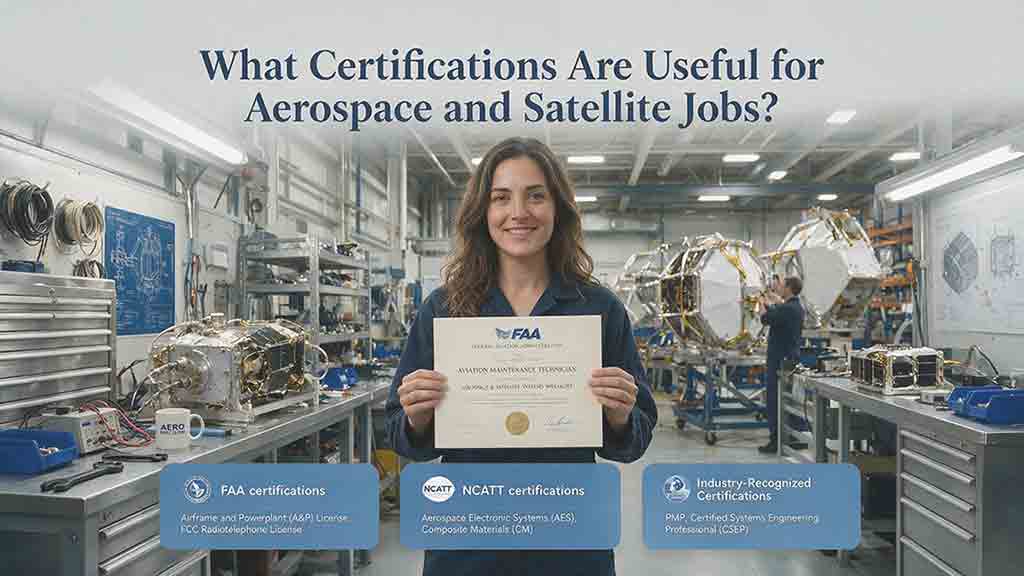
What Certifications Are Useful for Aerospace and Satellite Jobs?
This guide helps students and professionals identify which certifications are genuinely useful for aerospace and satellite jobs. It maps INCOSE, IPC, ASQ, PMI, ISC2, AWS, NCEES, FAA, AS9100-related training, and IAQG auditor authentication to specific work such as systems engineering, electronics assembly, quality, reliability, project leadership, cybersecurity, cloud infrastructure, licensure, and regulated aviation activities. The article clearly distinguishes professional certification, course completion, organizational AS9100 certification, auditor training, IAQG authentication, government certificates, licenses, and security clearances. Original tools—including the Credential Gate Test, Certification Utility Score, One-Gate Rule, Credential Commitment Ledger, employer-demand audit, and a 30-day decision plan—help readers compare role alignment, eligibility, evidence value, portability, maintenance, and rule-change exposure. It also explains the 2026 IAQG transition, PMI’s announced PMP training-provider change, renewal burdens, accurate résumé wording, and why no credential guarantees employment, salary, professional authority, or access.

Online Courses That Can Help You Prepare for a Space Career
This guide helps students and career changers choose online courses that support a specific space-career goal rather than collecting unrelated certificates. It compares NASA, MIT OpenCourseWare, Harvard CS50, University of Colorado Boulder, EPFLx, and other official resources across programming, remote sensing, spacecraft dynamics, mission design, systems engineering, signal processing, and research practice. The article clearly separates free course materials, completion certificates, CS50 Certificates, edX verified certificates, Coursera Career Certificates, university credit, professional certification, and professional licenses. Original tools—including the Role-to-Course Evidence Chain, Course Utility Score, Four-Layer Learning Stack, Evidence Conversion Protocol, and a 12-week study plan—show readers how to identify a skill gap, select a suitable course, build an inspectable project, verify results, and state limitations honestly. It also explains ARSET certificate eligibility, course-age limits, academic-integrity rules, publication safety, and why coursework cannot replace required degrees, supervised experience, work authorization, or professional authority.

Do You Need a Master’s Degree to Work in Space Technology?
This guide explains when a master’s degree is required, preferred, optional, or unnecessary for space-technology careers. It compares bachelor’s-, associate-, master’s-, and doctoral-level entry routes across engineering, software, hardware, analysis, research, project work, writing, and technical operations. Readers learn how to distinguish an absolute degree requirement from a stated preference or an education-and-experience substitution. Original tools—including the Master’s Necessity Ladder, Master’s Pressure Index, Role-Gap Ledger, Replacement Test, and Graduate Commitment Ledger—help applicants audit job postings, identify whether their real gap is knowledge, evidence, experience, or credentials, and make hidden costs visible. A fictional spacecraft thermal-analysis example demonstrates the calculation process without presenting it as a hiring probability. The article also compares graduate-program formats, explains NASA and astronaut exceptions, addresses accreditation and licensure, and separates education from work authorization, export controls, and security-clearance requirements.