Online Courses That Can Help You Prepare for a Space Career

Online Courses That Can Help You Prepare for a Space Career
Online courses can help you prepare for a space career when they close a role-specific skill gap and lead to work you can demonstrate. Strong options include NASA training in open science and remote sensing, university courses in aerospace dynamics and mission design, and rigorous programming, mathematics, and signal-processing courses. They supplement—but do not replace—required degrees, supervised experience, licenses, or employer eligibility rules.
Key Takeaways
- Choose courses by the work you want to perform, not by whether the title contains “space.”
- A useful course should provide relevant practice and help you produce an inspectable artifact, such as tested software, a simulation, a data analysis, or a requirements document.
- Free course materials, completion certificates, paid verified certificates, university credit, professional certification, and professional licenses are different products.
- NASA and university course completion does not guarantee employment, admission, technical authority, or professional competence.
- One coherent course stack followed by a substantial project is usually more useful than collecting unrelated certificates.
This guide compares credible online learning options, shows which career paths they support, and provides a method for turning coursework into safe, honest portfolio evidence.
Method and scope: This guide is based on official course descriptions, provider documentation, government occupational information, and practical selection criteria rather than hands-on testing of every course. Course availability, platform access, fees, certificate rules, assignments, and software requirements may change. Details were reviewed on August 1, 2026 and should be confirmed on the provider’s current page before enrollment.
Which Online Courses Can Help You Prepare for a Space Career?
The most useful online courses teach a skill that appears in your target role and require you to apply that skill.
The following list is a selected starting point, not a universal ranking.
| Course or resource | Best suited to | Current format or access | Useful evidence to create |
|---|---|---|---|
| NASA Open Science Essentials | Research orientation, data stewardship, science communication | Public course; approximately two hours; digital badge and certificate available after successful completion | Open-science checklist, data-management outline, reproducibility plan |
| NASA Open Science 101 | Research, scientific software, data analysis, graduate-study preparation | Public five-module course; approximately 12 hours; digital badge and certificate available after successful completion | Reproducible research plan, data and software sharing workflow |
| NASA Applied Remote Sensing Training Program | Earth observation, remote sensing, environmental data, disaster analysis | Scheduled training and public archived materials; certificate eligibility depends on the specific offering, and past recordings do not qualify for completion certificates under the current FAQ | Satellite-data notebook, map, comparison of sensors, documented workflow |
| MIT OpenCourseWare: Introduction to Aerospace Engineering and Design | Early exploration of aerospace design and engineering tradeoffs | Free open materials; no MIT credit or certificate | Design trade study, performance estimate, requirements-to-design comparison |
| University of Colorado Boulder: Spacecraft Dynamics and Control | Spacecraft attitude dynamics, simulation, guidance, and control | Advanced four-course online specialization with a Mars-mission capstone; a Coursera Career Certificate offered by the University of Colorado Boulder is available after completion; the specialization itself does not carry university credit | Attitude simulation, control-performance report, verified numerical model |
| EPFLx: Space Mission Design and Operations | Mission architecture, orbital concepts, spacecraft subsystems, operations | Self-paced intermediate course; current page estimates eight weeks at two to four hours per week | Mission concept, operations timeline, subsystem trade study |
| MIT OpenCourseWare: Linear Algebra | Controls, estimation, simulation, data science, machine learning | Free independent-study materials with lectures, problems, and solutions; no MIT credit or certificate | Matrix-based analysis notebook, least-squares model, state-estimation exercise |
| MIT OpenCourseWare: Signals and Systems | Communications, telemetry, control systems, signal processing | Free lecture notes, videos, problems, and solutions; no MIT credit or certificate | Filter analysis, sampled-signal experiment, telemetry-processing demonstration |
| Harvard CS50’s Introduction to Programming with Python | Beginners preparing for software, data, automation, or scientific programming | Free CS50 OpenCourseWare route; learners who satisfy the published course requirements may receive a free CS50 Certificate, while an optional verified certificate is available separately through edX | Tested Python program with documentation and unit tests |
| Harvard CS50x | Broader computer-science foundations, algorithms, data structures, software design | Free CS50 OpenCourseWare course with problem sets and a final project; eligible completers may receive a free CS50 Certificate, with an optional verified certificate available separately through edX | Substantial software project with source code, tests, and design explanation |
| NASA Systems Engineering Handbook | Systems engineering, requirements, verification, validation, technical management | Public reference rather than a standalone public course | Requirements set, verification matrix, interface analysis, validation plan |
The NASA Systems Engineering Handbook appears in the table because it is a useful companion to systems-oriented study. It should not be described as a course or certificate program.
How Should You Choose Among These Courses?
Start with a role and work backward.
A course is useful when it connects four elements:
- A real task performed in the target role
- A skill you currently lack
- Assessed or repeatable practice
- Evidence you can explain and defend
For example, “learn orbital mechanics” is a subject goal.
“Build and validate a simple orbit-propagation model for a documented mission scenario” is an evidence goal.
The second statement is more useful because it identifies something that can be inspected.
Which Courses Fit Different Space-Career Paths?
Spacecraft Dynamics, Guidance, Navigation, and Control
A useful sequence may include:
- Linear algebra
- Differential equations and classical dynamics
- Spacecraft kinematics and kinetics
- Feedback control
- Numerical simulation
- A validated attitude-control project
The University of Colorado Boulder specialization is designed for advanced learners. A beginner who lacks calculus, differential equations, mechanics, or linear algebra should close those gaps first.
The current Coursera page describes the completion credential as a Career Certificate offered by the University of Colorado Boulder. It also states that the specialization itself does not carry university credit, although an individual institution may independently decide whether to recognize the certificate.
A possible final artifact is a simulation that:
- Defines reference frames
- States equations and assumptions
- Models disturbances
- Implements a controller
- Measures pointing error
- Tests more than one operating condition
- Explains numerical limitations
Completing the specialization does not make a student a flight-qualified guidance engineer. The artifact demonstrates learning, not operational authority.
Flight Software and Ground Systems
A useful sequence may include:
- Programming fundamentals
- Data structures and algorithms
- File and network data handling
- Unit and integration testing
- Error handling
- Version control
- A mission-themed software project
CS50P is a practical starting point for learners who specifically need Python. CS50x provides broader computer-science foundations, including algorithms, memory, data structures, Python, SQL, and web development.
Both courses distinguish between two credentials:
- A free CS50 Certificate for learners who satisfy the published completion requirements
- An optional paid verified certificate from edX
These credentials should be listed separately on a resume or profile. The free CS50 Certificate is issued by CS50; the edX verified certificate uses edX’s identity-verification process.
Possible projects include:
- A telemetry packet parser using synthetic data
- A command-sequence validator
- A ground-pass scheduling prototype
- A satellite-state visualization tool
- A test harness for a simplified flight algorithm
The strongest projects include tests, failure cases, clear interfaces, and a limitations section.
Remote Sensing and Earth Observation
A useful sequence may include:
- Remote-sensing fundamentals
- Spatial, spectral, and temporal resolution
- Satellite-data discovery
- Data-quality filtering
- Python or R
- Geographic information systems
- A reproducible analysis
NASA ARSET is particularly relevant because its training focuses on NASA datasets, sensors, analysis tools, and applied Earth-observation problems.
ARSET offers scheduled instructor-led training as well as publicly accessible recordings and materials. The program also develops self-paced learning resources, but credential rules must be checked for the particular offering.
NASA’s current ARSET FAQ states that certificates of completion are awarded to eligible participants in real-time training who satisfy the attendance and assigned-homework requirements. Certificates are not awarded for past training viewed only through archived recordings.
ARSET certificates document participation and completion. They do not imply subject-matter proficiency and should not be described as professional certification.
Possible portfolio artifacts include:
- A land-cover comparison
- A surface-temperature map
- A flood-extent analysis
- A vegetation-index time series
- A comparison of two sensors
- A data-quality and uncertainty report
Use public data and state the dataset version, processing steps, projection, spatial resolution, quality filters, and limitations.
Scientific Research and Data Analysis
A useful sequence may include:
- Python or another research language
- Linear algebra
- Probability and statistics
- Domain science
- Open-science practices
- A reproducible research project
NASA Open Science 101 is most useful when paired with an actual analysis. Its value lies in planning transparent and reusable research—not merely adding a badge to a profile.
A strong project package may contain:
- Research question
- Public dataset
- Data dictionary
- Processing script
- Environment or dependency record
- Results
- Uncertainty analysis
- Reproduction instructions
- Data and software license notes
Space Mission Design and Operations
A useful sequence may include:
- Introductory mechanics
- Orbital concepts
- Space environment
- Spacecraft subsystem overview
- Mission phases
- Operations concepts
- Risk and reliability
- A mission concept document
EPFLx’s Space Mission Design and Operations course covers mission objectives, orbital mechanics, spacecraft architecture, propulsion, attitude control, onboard systems, risk, and operations.
A useful artifact is not a fictional mission description alone. It should connect:
- Mission objective
- Stakeholders
- Operational concept
- Orbit choice
- Major subsystem needs
- Constraints
- Risks
- Success criteria
Systems Engineering
A systems-oriented learning path should cover:
- Stakeholder expectations
- Technical requirements
- Functional decomposition
- Interfaces
- Design alternatives
- Verification
- Validation
- Risk
- Configuration and decision records
The NASA Systems Engineering Handbook can help learners use terminology consistently and distinguish verification from validation.
A useful public project might include:
- Ten well-formed requirements
- Requirements rationale
- Traceability table
- Interface diagram
- Verification method
- Validation scenario
- Open issues and assumptions
Do not describe a student requirements exercise as an approved NASA process, official mission product, or professional certification.
Communications and Signal Processing
Signals-and-systems coursework supports the foundations of:
- Telemetry
- Filtering
- Modulation
- Sampling
- Feedback
- Sensor processing
- Communications analysis
MIT OpenCourseWare’s Signals and Systems materials provide relevant theory and problems. However, a general signals course does not replace coursework in circuits, electromagnetics, radio-frequency design, antennas, communications, or hardware laboratories when those subjects are required by the target role.
A suitable project might:
- Generate a synthetic telemetry signal
- Add controlled noise
- Apply and compare filters
- Measure error and delay
- Explain sampling choices
- Document where the simplified model differs from a real communications link
Technical Communication, Policy, Business, and Project Roles
Non-engineering professionals also benefit from technical domain knowledge.
A communications, procurement, project, policy, or customer professional could combine:
- One introductory space or mission-design course
- One role-specific course in writing, finance, supply chain, policy, or project work
- One artifact based on public information
Examples include:
- A sourced mission briefing
- A supplier-evaluation framework
- A project risk register
- A public communications correction protocol
- A stakeholder map
- A budget-assumption memo
A technical overview course does not authorize the learner to make engineering, legal, financial, or safety decisions outside the learner’s training and role.
What Can Online Courses Realistically Do?
Online courses can help you:
- Test whether you enjoy a subject
- Learn terminology
- Fill a defined prerequisite gap
- Practice a technical method
- Build a public project
- Prepare for formal coursework
- Strengthen an internship application
- Support a career transition
- Document continued learning
Online courses generally cannot, by themselves:
- Replace an accredited degree when a role requires one
- Provide professional engineering licensure
- Grant authority to approve flight or safety decisions
- Guarantee employment
- Replace supervised laboratory experience
- Substitute for every internship or professional experience requirement
- Grant a security clearance
- Change citizenship or work authorization
- Authorize access to export-controlled or classified technology
The U.S. Bureau of Labor Statistics identifies a bachelor’s degree as the typical entry education for occupations such as aerospace engineering and software development. Research-oriented atmospheric-science roles may require a master’s degree or PhD.
A short online course should not be presented as equivalent to those complete education routes.
What Is the Difference Between a Course Certificate and Professional Certification?
A course certificate usually records completion of a learning activity.
Professional certification generally involves an external body, defined eligibility rules, an examination or competency process, renewal requirements, or professional standards.
| Credential type | What it usually establishes | What it does not automatically establish |
|---|---|---|
| Digital badge | Completion of defined learning requirements | Professional authorization |
| Certificate of completion | Participation and completion | Independent mastery or workplace competence |
| Free provider certificate | Completion under the provider’s stated rules | Verified identity or university credit unless stated |
| Verified platform certificate | Verified identity and course completion under platform rules | University credit unless explicitly stated |
| Career Certificate | Completion of the named online learning program under the platform’s rules | A university degree, academic certificate, or credit unless explicitly stated |
| University academic credit | Completion of credit-bearing study | Employment or licensure |
| Degree | Completion of an academic program | Guaranteed job readiness |
| Professional certification | Satisfaction of the certifying body’s stated requirements | Authority outside the certification’s scope |
| Professional license | Legal authorization within a jurisdiction and scope | Expertise in every related specialty |
NASA ARSET explicitly states that its completion certificates do not imply proficiency and should not be treated as professional certification.
MIT OpenCourseWare states that it provides free course materials without MIT credit or certification.
The current Coursera page describes the Spacecraft Dynamics and Control credential as a Career Certificate offered by the University of Colorado Boulder. The page also states that the specialization itself does not carry university credit, although another institution may independently choose to recognize it.
CS50P and CS50x offer a free CS50 Certificate to eligible completers and an optional verified certificate from edX through a separate route. The two credentials should not be collapsed into one generic “course certificate.”
Always use the provider’s exact terminology.
The Role-to-Course Evidence Chain
The Role-to-Course Evidence Chain is an original framework developed for this guide.
It prevents learners from selecting courses based only on reputation or branding.
Step 1: Extract a Work Product
Find a recurring output in target role descriptions.
Examples:
- Control simulation
- Tested Python tool
- Remote-sensing analysis
- Verification matrix
- Mission operations procedure
- Technical briefing
Step 2: Identify the Missing Skill
Write the smallest credible gap.
Weak statement:
I need to learn space engineering.
Better statement:
I need to model rigid-body attitude motion and evaluate control error.
Step 3: Select the Course
Choose a course whose syllabus directly addresses the gap.
Check:
- Prerequisites
- Exercises
- Assessment
- Software
- Expected workload
- Course age
- Provider
- Certificate and credit terms
Step 4: Define the Evidence Before Starting
Decide what you will produce.
The artifact should be more specific than “course notes.”
Step 5: Add Verification
Determine how you will check the result.
Possible methods include:
- Unit tests
- Comparison with an analytical solution
- Independent calculation
- Sensitivity analysis
- Baseline model
- Published reference case
- Data-quality checks
- Peer or instructor review
Step 6: State the Boundary
Explain what the project does not prove.
Example:
This educational simulation demonstrates implementation of a simplified attitude-control model. It has not been validated for flight use and does not represent an approved spacecraft design.
The Course Utility Score
The Course Utility Score is an original comparison tool for evaluating courses against one target role.
Score each factor from 1 to 5.
| Factor | Weight | Question |
|---|---|---|
| Role alignment | 30% | Does the course teach a skill repeatedly used in the target role? |
| Practice quality | 25% | Does it require problems, code, analysis, design, or assessment? |
| Evidence value | 20% | Can the work become a credible, explainable artifact? |
| Prerequisite fit | 15% | Can you complete the course without major hidden gaps? |
| Access practicality | 10% | Are cost, schedule, tools, and access manageable? |
Calculate:
Course Utility Score = 0.30R + 0.25P + 0.20E + 0.15F + 0.10A
Where:
R= role alignmentP= practice qualityE= evidence valueF= prerequisite fitA= access practicality
The result remains on a 1-to-5 scale.
It is not a universal course ranking, hiring probability, academic-credit evaluation, or measure of instructor quality.
Worked Example: Preparing for an Earth-Observation Analyst Role
Consider a fictional learner targeting an entry-level role involving satellite imagery and environmental data.
The learner compares three options:
- NASA remote-sensing training
- A general introductory astronomy survey
- An advanced machine-learning course
| Factor | Weight | NASA remote sensing | Intro astronomy | Advanced machine learning |
|---|---|---|---|---|
| Role alignment | 30% | 5 | 2 | 4 |
| Practice quality | 25% | 4 | 2 | 5 |
| Evidence value | 20% | 4 | 1 | 5 |
| Prerequisite fit | 15% | 5 | 5 | 2 |
| Access practicality | 10% | 5 | 5 | 3 |
NASA Remote-Sensing Training
(0.30 × 5) + (0.25 × 4) + (0.20 × 4) + (0.15 × 5) + (0.10 × 5) = 4.55
Introductory Astronomy
(0.30 × 2) + (0.25 × 2) + (0.20 × 1) + (0.15 × 5) + (0.10 × 5) = 2.55
Advanced Machine Learning
(0.30 × 4) + (0.25 × 5) + (0.20 × 5) + (0.15 × 2) + (0.10 × 3) = 4.05
The advanced machine-learning course has strong long-term relevance, but its prerequisite score is low. The NASA remote-sensing course is the more practical first step for this fictional learner.
The learner could complete remote-sensing fundamentals, build a validated analysis, and then reconsider advanced machine learning.
These scores are illustrative judgments, not measured outcomes.
The Four-Layer Learning Stack
A useful course plan normally includes four layers.
Layer 1: Foundation
Examples:
- Programming
- Calculus
- Linear algebra
- Probability
- Physics
- Technical writing
Layer 2: Domain
Examples:
- Spacecraft dynamics
- Remote sensing
- Mission operations
- Signals and systems
- Systems engineering
- Atmospheric science
Layer 3: Artifact
Examples:
- Simulation
- Tested program
- Data analysis
- Mission concept
- Requirements package
- Technical report
Layer 4: Review
Examples:
- Unit tests
- Independent calculation
- Instructor feedback
- Public reference case
- Peer review
- Reproducibility check
A learner who completes only the foundation layer may lack space context.
A learner who starts with an advanced domain course may lack the foundation needed to understand or defend the work.
A learner who completes courses without an artifact may have little evidence beyond a certificate.
How Do You Turn Coursework Into Portfolio Evidence?
Use the Evidence Conversion Protocol.
1. Preserve the Original Assignment Boundary
Identify what the course required and what you added.
Do not present instructor-provided code, templates, datasets, or solutions as entirely original work.
2. Create a Public and Independent Variant
Change the problem without copying a solution.
Examples:
- Use a different public dataset.
- Change the simulated mission scenario.
- Add a new operating condition.
- Compare an additional method.
- Implement a separate validation test.
3. Define a Requirement
State what the project must accomplish.
Example:
The program shall identify malformed telemetry records and report the record number without terminating the full processing run.
4. Add Verification
Document how you checked the result.
5. Record Assumptions
Examples:
- Simplified dynamics
- Ideal sensors
- No communications delay
- Synthetic telemetry
- Publicly available orbital elements
- Educational units and constants
6. Write a Reproduction Guide
Include:
- Software version
- Dependencies
- Input data
- Commands
- Expected output
- Known limitations
7. Cite the Course and Source Material
Credit:
- Course
- Instructor
- Provider
- Dataset
- Libraries
- Adapted methods
- External references
8. Add a Safety and Authority Statement
State that the work is educational and not approved for operational, flight, safety-critical, legal, or regulated use.
What Should You Avoid Publishing?
Do not publish:
- Employer-confidential information
- Proprietary designs
- Export-controlled technical data
- Classified information
- Restricted laboratory data
- Credentials or access tokens
- Personal data
- Course solutions prohibited by academic-integrity rules
- Instructions that create avoidable safety or legal risks
- Material whose license does not permit redistribution
Use:
- Public government datasets
- Openly licensed course materials
- Synthetic data
- Simplified simulations
- Public specifications
- Original diagrams and explanations
When uncertain, ask the data owner, instructor, employer, or qualified compliance professional before publishing.
How Should You Evaluate a Course Before Enrolling?
Check the Provider
Verify:
- Institution or agency
- Instructor identity
- Official course domain
- Contact information
- Published syllabus
- Provider terms
A university logo displayed by an unrelated reseller is not enough.
Check the Learning Outcomes
A useful outcome uses observable verbs:
- Analyze
- Design
- Implement
- Compare
- Test
- Interpret
- Validate
- Document
“Understand space” is too broad to evaluate.
Check the Assignments
Look for:
- Problem sets
- Programming exercises
- Laboratories
- Simulations
- Case studies
- Capstone projects
- Instructor or automated feedback
Video-only courses may still be informative, but they provide weaker evidence of application.
Check the Prerequisites
An advanced spacecraft-controls course may assume:
- Calculus
- Differential equations
- Linear algebra
- Rigid-body dynamics
- Numerical programming
Starting too far above your current preparation may produce copied calculations rather than genuine understanding.
Check the Course Date
Foundational mathematics remains useful for many years.
Other subjects change faster:
- Software libraries
- Data portals
- Mission tools
- Cybersecurity
- Regulations
- Platform interfaces
- Satellite products
MIT’s introductory aerospace course in this guide was taught in 2003. It remains useful for introductory design thinking, but it should not be treated as a source for current standards, software, certification rules, or industry procedures.
Check the Credential Language
Confirm whether the provider offers:
- No credential
- Digital badge
- Free provider certificate
- Completion certificate
- Career Certificate
- Verified certificate
- Academic credit
- Professional certification
Do not rewrite one category as another.
Check the Full Access Terms
“Enroll for free” may not mean that graded assignments, long-term access, or certificates are free.
Check:
- Audit access
- Trial period
- Subscription
- Assessment access
- Certificate fee
- Financial aid
- Refund rules
- Geographic restrictions
Avoid publishing a fixed price unless the provider clearly displays it and the information will be maintained.
Free Course, Paid Certificate, or Academic Credit: Which Is Better?
The right format depends on your goal.
| Format | Best use | Main benefit | Main limitation |
|---|---|---|---|
| Free open materials | Exploration and self-study | Low financial barrier | No instructor, credit, or certificate |
| Free structured public training | Role-specific orientation and practice | Accessible and often practical | Schedule and certificate rules may vary |
| Free provider certificate | Documenting completion under published rules | No certificate fee | Identity may not be independently verified |
| Paid verified certificate | Guided or identity-verified completion record | Verification and shareable credential | Not automatically academic credit |
| Career Certificate | Completion of a named online program | Structured multi-course record | Not automatically a university academic credential |
| Credit-bearing university course | Formal prerequisite or degree progress | Transcripted academic study | Higher cost and admission requirements |
| Professional certification preparation | A named professional credential | Aligns with certifying-body requirements | Useful only when the credential matters to the role |
A free course with strong exercises may be more useful than an expensive course with weak practice.
A credit-bearing course may be necessary when you need an official prerequisite.
A certificate track may be reasonable when identity verification, grading, or feedback matters.
How Many Online Courses Should You Take?
Take enough courses to support one coherent outcome.
A practical early stack might contain:
- One foundation course
- One role-specific course
- One supporting course
- One substantial project
Example for remote sensing:
- Python programming
- Remote-sensing fundamentals
- Open-science practices
- Reproducible satellite-data analysis
Example for spacecraft controls:
- Linear algebra
- Signals and systems
- Spacecraft dynamics and control
- Attitude simulation with validation
Completing ten unrelated courses can create more activity without creating stronger evidence.
What Common Mistakes Should You Avoid?
Choosing Courses by the Word “Space”
A broad space-exploration course may inspire you without teaching a job-relevant method.
Inspiration and occupational preparation are different benefits.
Collecting Certificates Without Building Anything
A certificate records completion under the provider’s rules.
It does not show how you apply the material to a new problem.
Starting With an Advanced Course Too Early
A prestigious advanced course is not efficient when foundational gaps prevent independent work.
Treating MIT OpenCourseWare as MIT Enrollment
MIT OpenCourseWare does not provide enrollment, MIT academic credit, or an MIT certificate.
Calling an ARSET Certificate a Professional Certification
NASA ARSET expressly distinguishes completion certificates from professional certification and subject-matter proficiency.
Expecting an ARSET Certificate From an Archived Training
NASA’s current ARSET FAQ states that certificates are not awarded for past training. Watching an archived recording or completing historical homework does not create certificate eligibility under that rule.
Calling a Career Certificate University Credit
The University of Colorado Boulder Spacecraft Dynamics and Control specialization offers a Coursera Career Certificate, but the specialization itself does not carry university credit.
Combining a Free CS50 Certificate With an edX Verified Certificate
CS50’s free certificate and edX’s optional verified certificate are separate credentials with different issuing and verification arrangements.
Treating a Platform Certificate as University Credit
A university may offer a course through a platform without awarding academic credit for the public course version.
Check the exact program terms.
Copying a Course Capstone Into a Portfolio
Separate instructor-provided material from your original contribution.
Follow the course’s academic-integrity and reuse rules.
Using Real Restricted Mission Data
Public portfolio work should use public, synthetic, or clearly authorized data.
Ignoring Tool Versions
A notebook that runs only in an obsolete environment is difficult to inspect.
Document dependencies and test the project in a clean environment.
Claiming Professional Authority
Do not describe an educational exercise as:
- Flight-qualified
- NASA-approved
- Safety-certified
- Professionally licensed
- Production-ready
- Cleared for operational use
unless an authorized organization has actually made that determination.
Assuming Courses Replace a Degree
Some occupations commonly require a bachelor’s, master’s, or doctoral degree. A course may strengthen preparation without replacing the complete credential.
How Can You Troubleshoot a Course Plan?
| Problem | Likely cause | Practical response |
|---|---|---|
| You do not know which course to choose | The target role is too broad | Select one work product and use the Role-to-Course Evidence Chain |
| Every course looks useful | You have not ranked current gaps | Score each course with the Course Utility Score |
| The course feels incomprehensible | Prerequisites are missing | Pause and complete the smallest foundation course needed |
| You finish videos but cannot solve problems | Learning is too passive | Add problem sets, coding exercises, or a supervised project |
| You have many certificates but few interviews | Evidence is weak or poorly targeted | Build one role-specific artifact and document it clearly |
| Your project works only once | Verification is missing | Add tests, multiple inputs, and reproducibility instructions |
| The course uses outdated software | Tooling has changed | Preserve the concepts and rebuild the project with a maintained tool |
| The certificate is expensive | The credential may not be necessary | Compare audit access, free provider certificates, financial aid, and employer demand |
| You need official prerequisite credit | Self-study is not transcripted | Use an accredited institution’s credit-bearing course |
| You cannot publish your course project | License, integrity, or confidentiality limits apply | Build an original public-data variant |
| You want a non-engineering role | The course stack is too technical | Pair one domain course with role-specific business, policy, writing, or operations study |
| You expect the course to create job eligibility | Education and eligibility are being combined | Review degree, experience, work authorization, export, and clearance rules separately |
A 12-Week Space-Career Course Plan
This plan is an educational framework, not an employment guarantee.
Weeks 1–2: Define the Role
Collect 10 to 15 entry-level or adjacent postings.
Record:
- Work products
- Required skills
- Preferred skills
- Education
- Experience
- Tools
- Eligibility language
Select one output to build.
Weeks 3–5: Complete the Foundation
Examples:
- Python
- Linear algebra
- Statistics
- Mechanics
- Technical writing
Complete exercises rather than watching lectures only.
Weeks 6–8: Complete the Domain Course
Examples:
- Remote sensing
- Spacecraft dynamics
- Mission design
- Signals and systems
- Open science
Maintain structured notes that connect each topic to the target role.
Weeks 9–10: Build the Artifact
Use a public or synthetic problem.
Document:
- Requirement
- Inputs
- Method
- Results
- Verification
- Limitations
Week 11: Test and Review
Ask another learner, instructor, or qualified reviewer to follow your reproduction guide.
Fix:
- Missing dependencies
- Unclear assumptions
- Broken links
- Unexplained outputs
- Unsupported claims
Week 12: Publish the Evidence Package
Include:
- Short project summary
- Original contribution
- Course attribution
- Technical documentation
- Reproduction steps
- Results
- Limitations
- Safety and authority statement
Do not include restricted information or prohibited course solutions.
Online Course Selection Checklist
Role Fit
- I have selected a specific role family.
- I can name the work product I want to create.
- The course teaches a skill used in that work product.
- I have reviewed current job descriptions rather than relying on the course title.
Provider and Course Quality
- The provider and instructor are identifiable.
- The syllabus is available.
- The learning outcomes are observable.
- The course includes practice or assessment.
- I checked the publication or update date.
- I understand the prerequisites.
Credential Accuracy
- I know whether the course offers a badge, free provider certificate, completion certificate, Career Certificate, verified certificate, academic credit, or no credential.
- I will use the provider’s exact credential name.
- If a provider offers both a free completion certificate and a paid verified certificate, I have identified them as separate credentials.
- I will not describe course completion as professional certification.
- I have verified current certificate, fee, and access terms.
- I have confirmed whether archived materials remain eligible for a certificate.
- I have confirmed whether the course carries university credit.
Evidence
- I defined an artifact before starting.
- The artifact uses public or authorized information.
- I will add testing or validation.
- I will document assumptions and limitations.
- I will identify my original contribution.
- I will cite the course, data, tools, and adapted methods.
Safety and Legal Boundaries
- I will not publish proprietary, classified, or export-controlled material.
- I will follow academic-integrity rules.
- I will review licenses before redistributing materials.
- I will not claim NASA, university, employer, or professional approval.
- I understand that the course does not change work authorization or security-clearance eligibility.
Practical Fit
- I can meet the time commitment.
- I have access to the required software and hardware.
- I understand refund, subscription, and certificate terms.
- I have a plan if the course is discontinued.
- The course is more useful than a smaller targeted intervention.
Which Course Should You Take First?
Choose CS50P when you need a beginner-friendly introduction to Python for data, automation, or scientific work.
Choose CS50x when you need broader computer-science foundations and are willing to study multiple languages and computing concepts.
For either CS50 course, decide whether you need only the free CS50 Certificate or also want the separately offered edX verified certificate.
Choose MIT Linear Algebra when controls, estimation, simulation, machine learning, or quantitative data work is blocked by weak matrix knowledge.
Choose MIT Signals and Systems when your target work involves communications, telemetry, filtering, sensor data, or feedback.
Choose MIT Introduction to Aerospace Engineering and Design when you want a no-cost introduction to aerospace design thinking and understand that the course materials are historical rather than a current industry-standard curriculum.
Choose the University of Colorado Boulder Spacecraft Dynamics and Control specialization when you already have the required mathematics and dynamics background and want advanced spacecraft-attitude analysis. Its Coursera Career Certificate is not university credit.
Choose EPFLx Space Mission Design and Operations when you want a structured overview of mission design, spacecraft subsystems, risk, and operations.
Choose NASA ARSET when your goal involves satellite Earth observations, environmental data, remote sensing, or geospatial applications. Use archived training for learning, but do not expect a completion certificate for a past training viewed only through recordings.
Choose NASA Open Science Essentials or Open Science 101 when you need stronger research transparency, reproducibility, data stewardship, and collaborative science practices.
The best first course is the smallest credible course that removes your current bottleneck and moves you toward an inspectable work product.
Frequently Asked Questions
Can Online Courses Help You Get a Space-Industry Job?
They can strengthen preparation and provide evidence, but they do not guarantee employment. Their value depends on relevance, practice quality, the artifact produced, and the other qualifications required by the role.
Are NASA Online Courses Free?
NASA Open Science training is publicly available, and ARSET provides public online training materials and scheduled offerings. Registration and participation conditions vary by offering.
For ARSET, archived recordings may be used for learning, but the current FAQ states that completion certificates are reserved for eligible participants in real-time training who satisfy the attendance and homework requirements. Certificates are not awarded for past training.
Is an Online Course Certificate Worth Adding to a Resume?
A relevant certificate can document structured learning. List the exact credential and provider, but emphasize the skill and project rather than implying that the certificate proves professional competence.
For example, distinguish a free CS50 Certificate from an edX verified certificate, and distinguish a Coursera Career Certificate from university academic credit.
Can Online Courses Replace an Aerospace Engineering Degree?
Not when a position requires an engineering degree or equivalent formal preparation. Courses can help with exploration, prerequisites, specialization, or portfolio work, but they are not automatically equivalent to an accredited degree program.
Should You Take a Space Course or a Programming Course First?
Take the programming course first when the space course requires coding that you cannot yet perform independently. Take the domain course first when you already have the technical foundation and need role-specific context.
How Do You Show an Online Course Project Without Violating Academic Rules?
Follow the course’s academic-integrity and licensing policies. Clearly separate instructor-provided material from your original work, cite the course, and create an independent public-data variant when publishing the original assignment is not permitted.
Sources
NASA Science. Open Science Trainings. Public access, course structure, estimated duration, digital badges, and completion certificates for Open Science Essentials and Open Science 101. Accessed August 1, 2026.
NASA Earthdata. Applied Remote Sensing Training Program (ARSET). Current official ARSET program home with training topics, featured courses, application areas, and program resources. Accessed August 20, 2026.
NASA Earthdata. ARSET Contact and Frequently Asked Questions. Current official guidance on live and self-paced training certificates, attendance and homework requirements, archived training, and the distinction between completion certificates and professional certification. Accessed August 20, 2026.
NASA Earthdata. Earthdata Trainings. Current NASA Earthdata training catalog, including ARSET remote-sensing courses and related Earth-observation learning resources. Accessed August 20, 2026.
NASA Earthdata. Applied Remote Sensing Training Program. Current ARSET program location and training announcements. Accessed August 1, 2026.
Massachusetts Institute of Technology OpenCourseWare. Get Started With MIT OpenCourseWare. Open access, self-paced use, and the absence of MIT credit or certification. Accessed August 1, 2026.
Massachusetts Institute of Technology OpenCourseWare. Introduction to Aerospace Engineering and Design. Course scope, design activities, assignments, and original teaching date. Accessed August 1, 2026.
Massachusetts Institute of Technology OpenCourseWare. Linear Algebra. Independent-study structure, lectures, problem-solving materials, assignments, and exams. Accessed August 1, 2026.
Massachusetts Institute of Technology OpenCourseWare. Signals and Systems. Signal representations, transforms, sampling, system analysis, feedback, and course materials. Accessed August 1, 2026.
Harvard University. CS50x 2026. Computer-science topics, problem sets, programming languages, and final-project structure. Accessed August 1, 2026.
Harvard University. CS50’s Introduction to Programming With Python. Free OpenCourseWare route, Python topics, problem sets, testing, debugging, and final project. Accessed August 1, 2026.
Harvard University. CS50P Final Project. Current final-project and testing requirements. Accessed August 1, 2026.
Harvard University. CS50P Certificate. Eligibility for the free CS50 Certificate and the separately available verified certificate from edX. Accessed August 1, 2026.
Harvard University. CS50x 2026 Certificate. Eligibility for the free CS50 Certificate and the separately available verified certificate from edX. Accessed August 1, 2026.
University of Colorado Boulder and Coursera. Spacecraft Dynamics and Control Specialization. Advanced course level, four-course sequence, Mars Mission capstone, Career Certificate terminology, online format, and university-credit limitation. Accessed August 1, 2026.
University of Colorado Boulder. Advanced Spacecraft Dynamics and Control Specialization. Provider description, prerequisite recommendation, course sequence, and advanced learning outcomes. Accessed August 1, 2026.
École Polytechnique Fédérale de Lausanne and edX. Space Mission Design and Operations. Current format, workload estimate, level, and subject coverage. Accessed August 1, 2026.
NASA. Systems Engineering Handbook. Systems engineering processes, system design, product realization, verification, validation, technical management, and requirements guidance. Accessed August 1, 2026.
U.S. Bureau of Labor Statistics. Aerospace Engineers. Typical entry education, educational preparation, internship context, and occupational duties. Accessed August 1, 2026.
U.S. Bureau of Labor Statistics. Software Developers, Quality Assurance Analysts, and Testers. Typical entry education, employer graduate-degree preferences, internships, and occupational duties. Accessed August 1, 2026.
U.S. Bureau of Labor Statistics. Atmospheric Scientists, Including Meteorologists. Bachelor’s-level entry, research-degree expectations, programming preparation, and internship context. Accessed August 1, 2026.
More from Degrees, Courses & Certifications
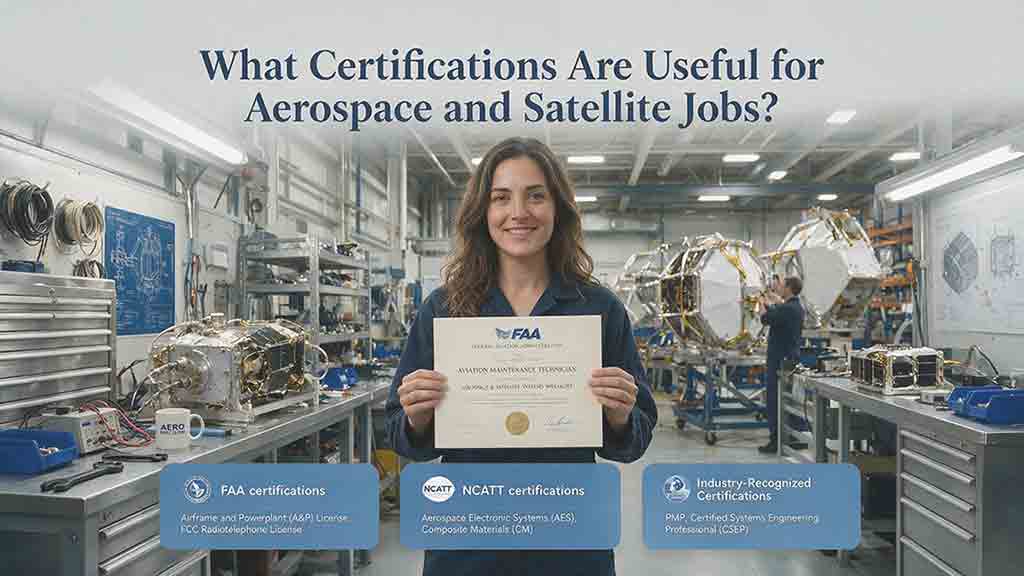
What Certifications Are Useful for Aerospace and Satellite Jobs?
This guide helps students and professionals identify which certifications are genuinely useful for aerospace and satellite jobs. It maps INCOSE, IPC, ASQ, PMI, ISC2, AWS, NCEES, FAA, AS9100-related training, and IAQG auditor authentication to specific work such as systems engineering, electronics assembly, quality, reliability, project leadership, cybersecurity, cloud infrastructure, licensure, and regulated aviation activities. The article clearly distinguishes professional certification, course completion, organizational AS9100 certification, auditor training, IAQG authentication, government certificates, licenses, and security clearances. Original tools—including the Credential Gate Test, Certification Utility Score, One-Gate Rule, Credential Commitment Ledger, employer-demand audit, and a 30-day decision plan—help readers compare role alignment, eligibility, evidence value, portability, maintenance, and rule-change exposure. It also explains the 2026 IAQG transition, PMI’s announced PMP training-provider change, renewal burdens, accurate résumé wording, and why no credential guarantees employment, salary, professional authority, or access.

Do You Need a Master’s Degree to Work in Space Technology?
This guide explains when a master’s degree is required, preferred, optional, or unnecessary for space-technology careers. It compares bachelor’s-, associate-, master’s-, and doctoral-level entry routes across engineering, software, hardware, analysis, research, project work, writing, and technical operations. Readers learn how to distinguish an absolute degree requirement from a stated preference or an education-and-experience substitution. Original tools—including the Master’s Necessity Ladder, Master’s Pressure Index, Role-Gap Ledger, Replacement Test, and Graduate Commitment Ledger—help applicants audit job postings, identify whether their real gap is knowledge, evidence, experience, or credentials, and make hidden costs visible. A fictional spacecraft thermal-analysis example demonstrates the calculation process without presenting it as a hiring probability. The article also compares graduate-program formats, explains NASA and astronaut exceptions, addresses accreditation and licensure, and separates education from work authorization, export controls, and security-clearance requirements.
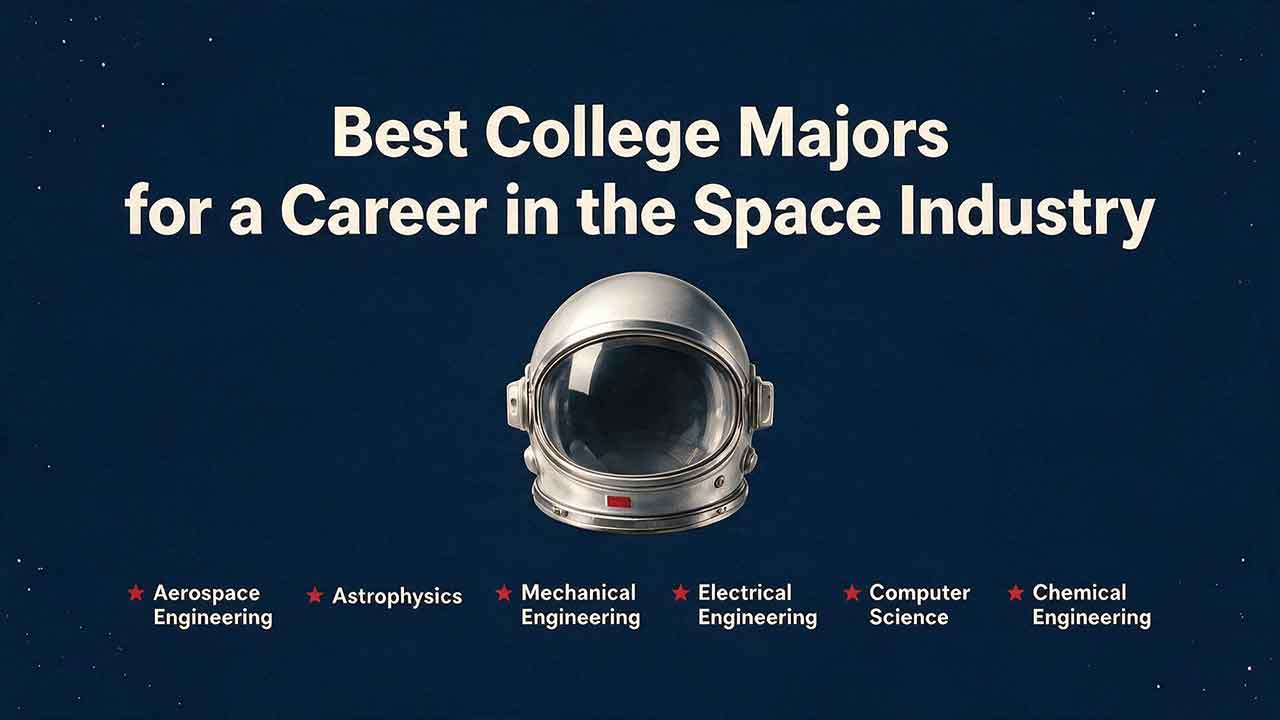
Best College Majors for a Career in the Space Industry
This guide helps students choose among engineering, computing, science, data, production, business, communication, policy, and legal-support majors for space-industry careers. Instead of ranking degrees by name, it connects each major to real mission outputs such as spacecraft design, avionics, software, research, Earth observation, manufacturing, procurement, and public communication. The article compares curricula, graduate-school expectations, salary data, accreditation, legal-education pathways, and international-student constraints while clearly separating occupations from degree outcomes. Original tools—including the Mission Output Map, Major-to-Mission Fit Score, Graduation Evidence Inventory, Bridge Load Test, and Two-Semester Major Validation Plan—help readers evaluate specific programs, identify missing preparation, estimate transition difficulty, and build credible work samples. Practical tables, worked calculations, troubleshooting guidance, and checklists give students a structured way to select a major that matches their intended work, financial limits, and long-term flexibility.
Explore More Topics
A Guide to Space Industry Employers and the Roles They Hire For
This guide maps the main types of space industry employers to the roles, outputs, customers, and constraints that define their work. It covers government agencies, intergovernmental organizations, research centers, space-relevant national laboratories, prime manufacturers, suppliers, launch providers, satellite operators, data companies, ground-system firms, contractors, universities, and professional-service organizations. Original tools include the Space Employer Output Map, ORBIT Employer Fit Test, Employer-Role Search Coverage calculation, and a worked geospatial career example. Readers learn why the same job title can mean different responsibilities across employer models, how to verify the legal employer, how to evaluate decision authority and contract conditions, and how to build a focused target list. The article also includes role comparisons, employer-type tradeoffs, eligibility guidance, troubleshooting advice, and a detailed research checklist.
How to Get a Space Industry Job With No Previous Aerospace Experience
This guide explains how to enter the space industry without previous aerospace employment by identifying transferable tasks, choosing realistic entry roles, and building evidence for the constraints that are genuinely new. It introduces the Aerospace Entry Distance Ladder, CLEAR Transfer Test, and Five-Part Bridge Project Standard to help readers distinguish direct task transfer, domain learning, evidence gaps, and formal eligibility barriers. A detailed industrial-automation example shows how test, software, instrumentation, and failure-analysis experience can be translated into spacecraft integration and test without exaggerating authority. The article also covers federal qualifications, contractors, internships, public data, NASA software release categories, résumé wording, interviews, networking, education choices, citizenship, clearance, export controls, and disclosure safety. Readers receive a decision tree, troubleshooting table, candidate-specific recommendations, and a final checklist for planning an accurate, legally safer career transition.
Government vs Commercial Space Careers
This guide compares government, contractor, and commercial space careers through the factors that most affect real career decisions: mission, legal employer, decision authority, technical work, pay structure, benefits, continuity risk, eligibility, publication rights, and long-term mobility. Original tools include the Three-Lane Space Career Model, Decision-Authority Test, Continuity Stack, SPACE Career Fit Matrix, and an offer-normalization worksheet. Worked examples show how to compare federal and commercial compensation while keeping guaranteed cash, target bonuses, estimated benefits, and equity separate. The article also explains contractor authority limits, citizenship, security clearance, export-control access, intellectual property, post-government ethics, and sector-to-sector skill translation. Readers receive interview questions, troubleshooting guidance, candidate-specific recommendations, and a detailed checklist for evaluating actual roles instead of relying on stereotypes about government stability or commercial speed.