How to Become an Aerospace Engineer

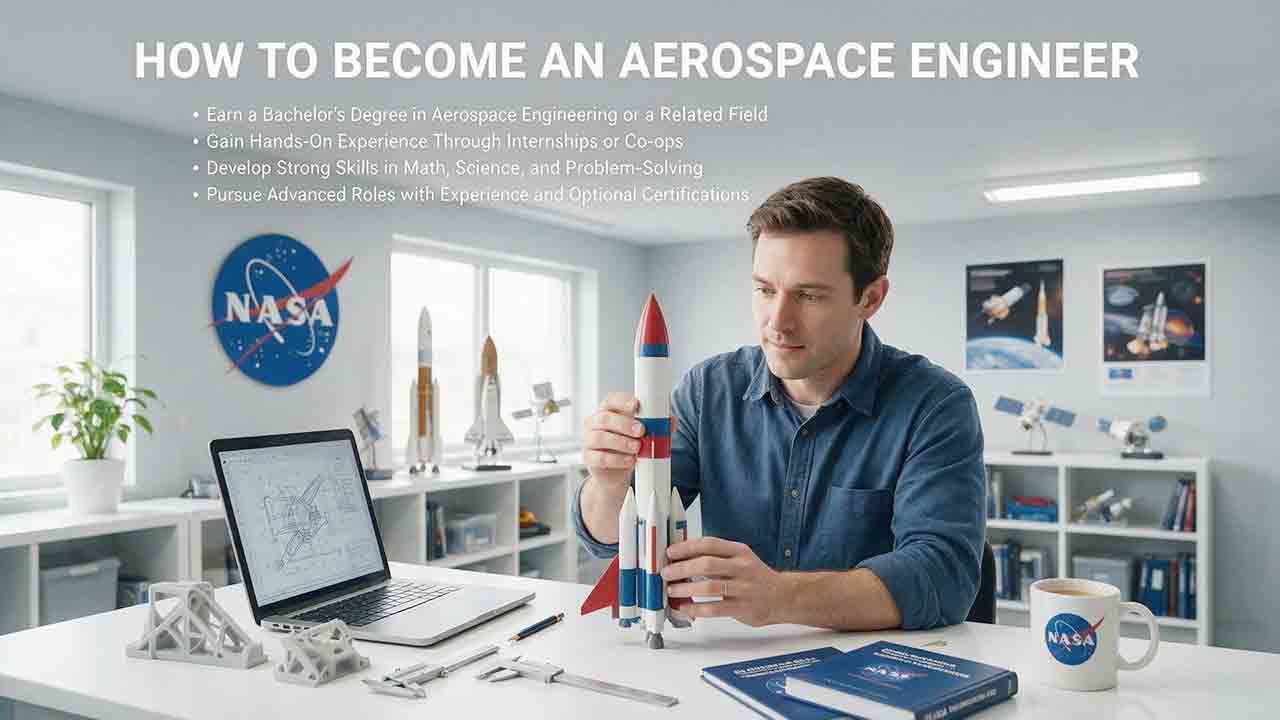
How to Become an Aerospace Engineer
To become an aerospace engineer, earn a bachelor’s degree in aerospace engineering or an appropriate related discipline, develop strong mathematics and physics fundamentals, and produce evidence that you can analyze, design, test, and document technical systems. Projects, research, engineering teams, and internships should demonstrate those abilities—not merely add software names or course titles to your resume.
Key Takeaways
- A bachelor’s degree is the typical entry-level qualification, but the degree does not always have to be titled “aerospace engineering.”
- The best degree depends on whether you want to work in structures, propulsion, controls, avionics, software, manufacturing, testing, or another specialty.
- Employers need evidence that you can turn theory into a model, design decision, test, or verified result.
- Two deeply documented projects can be more persuasive than a long list of activities with unclear contributions.
- Work authorization, employer sponsorship, export controls, security clearances, citizenship rules, and professional licensure are separate issues.
- No degree, project, certification, framework, or career plan can guarantee employment.
This guide explains how to choose an education path, select a technical direction, build credible engineering evidence, evaluate your readiness, and apply for aerospace roles without relying on vague career advice.
Scope: Employment, wage, education, licensing, and regulatory information in this guide focuses primarily on the United States. Requirements differ by country, employer, project, and jurisdiction. This article provides general educational information, not legal, immigration, export-control, licensing, or employment advice.
What Is the Most Direct Path to Becoming an Aerospace Engineer?
The most direct path is to earn an appropriate engineering degree, select a technical specialty, complete projects that include verification, gain relevant team experience, and apply according to engineering function rather than title alone.
A practical path looks like this:
| Stage | Primary objective | Evidence you should produce |
|---|---|---|
| 1. Explore the work | Identify the engineering problems you want to solve | A shortlist of two or three possible specialties |
| 2. Choose a degree | Build the required technical foundation | Relevant coursework and an appropriately accredited degree where needed |
| 3. Learn core methods | Use computation, design, and testing tools correctly | Code, models, drawings, reports, or test procedures |
| 4. Complete projects | Apply theory to a constrained problem | A documented analysis-design-verification cycle |
| 5. Gain experience | Work within an engineering team and process | Research, internships, laboratories, or student-team contributions |
| 6. Build a portfolio | Make your reasoning inspectable | Two to four concise technical case studies |
| 7. Apply strategically | Match evidence to employer requirements | Targeted resumes, project summaries, and interview preparation |
This path is not identical for every engineer. A flight-software engineer and a structural-analysis engineer may work on the same spacecraft while requiring substantially different preparation.
What Does an Aerospace Engineer Actually Do?
An aerospace engineer applies engineering principles to aircraft, spacecraft, launch vehicles, satellites, propulsion systems, and related subsystems.
The work can include mathematical modeling, design, simulation, testing, failure investigation, manufacturing support, technical documentation, software development, and verification.
The U.S. Department of Labor’s O*NET profile for aerospace engineers identifies core tasks such as:
- Creating mathematical and computational models
- Planning environmental, operational, and stress tests
- Developing designs against engineering requirements
- Investigating technical problems and failures
- Evaluating whether systems meet performance criteria
- Preparing reports, procedures, and technical documentation
- Coordinating design, fabrication, modification, and testing work
This leads to an important career distinction:
Aerospace engineering is usually organized around functions, subsystems, and life-cycle stages—not around one engineer designing an entire aircraft or spacecraft.
Aeronautical Engineering vs. Astronautical Engineering
Aeronautical engineering primarily concerns vehicles operating within Earth’s atmosphere.
Astronautical engineering primarily concerns spacecraft, launch systems, orbital operations, and the space environment.
| Field | Typical systems | Common technical subjects |
|---|---|---|
| Aeronautical engineering | Airplanes, helicopters, drones, atmospheric propulsion systems | Aerodynamics, flight mechanics, stability, aircraft structures, propulsion |
| Astronautical engineering | Spacecraft, satellites, launch vehicles, space instruments | Orbital mechanics, attitude control, space structures, thermal systems, communications |
| Aerospace engineering | Atmospheric and spaceflight systems | A combination of aeronautical and astronautical subjects |
The distinction can help you choose courses and projects, but job titles are not consistent across employers. A mechanical engineer, controls engineer, avionics engineer, test engineer, systems engineer, or software engineer may perform aerospace work without holding the title “aerospace engineer.”
What Degree Do You Need to Become an Aerospace Engineer?
A bachelor’s degree in aerospace engineering or a related engineering field is the typical entry-level qualification in the United States.
The U.S. Bureau of Labor Statistics identifies a bachelor’s degree as the occupation’s typical entry-level education. A related discipline may qualify when its curriculum and the candidate’s experience match the position.
Which Engineering Degree Is Best?
There is no single best degree for every aerospace role. Choose the degree that provides the strongest preparation for the engineering function you want to perform.
| Degree | Strong aerospace applications | Main advantage | Gap you may need to fill |
|---|---|---|---|
| Aerospace engineering | Aerodynamics, flight mechanics, propulsion, aircraft or spacecraft design | Direct exposure to flight-related systems | May offer less curricular flexibility outside aerospace |
| Mechanical engineering | Structures, mechanisms, thermal systems, propulsion, manufacturing | Broad physical-engineering foundation | May require aerospace electives or projects |
| Electrical engineering | Avionics, sensors, communications, power, control hardware | Strong preparation for electronic subsystems | Usually provides less depth in structures and fluid mechanics |
| Computer engineering | Embedded systems, flight computers, autonomy, digital hardware | Connects software with physical hardware | May require additional dynamics or aerospace-domain study |
| Computer science | Flight software, simulation, autonomy, and data systems | Strong software-development preparation | May not satisfy engineering-degree requirements for every position |
| Materials engineering | Composites, failure analysis, high-temperature materials | Relevant to structures, manufacturing, and propulsion | Fewer whole-vehicle design subjects |
| Systems engineering | Requirements, interfaces, verification, mission architecture | Strong multidisciplinary perspective | Some entry-level positions still require depth in another technical discipline |
| Engineering technology | Applied analysis, implementation, testing, manufacturing, maintenance, and system oversight | Practical and laboratory-oriented preparation | Not automatically equivalent to an engineering degree for every job, federal qualification standard, graduate program, or licensing route |
How Is Engineering Technology Different?
Engineering and engineering technology are related but distinct educational routes.
ABET’s 2026–2027 engineering technology criteria describe baccalaureate aeronautical engineering technology programs as preparing graduates to apply technical knowledge, modern equipment, and practical skills to the analysis, development, implementation, or oversight of aerospace systems and processes.
An engineering technology degree can support work in areas such as:
- Testing and instrumentation
- Manufacturing and production support
- Operations and maintenance
- System integration
- Quality and inspection
- Technical implementation
- Applied analysis
Individual job announcements may accept an engineering technology degree for particular positions, but eligibility must be determined from the exact education and accreditation language used by the employer.
Do not assume that an engineering technology degree will satisfy every requirement that specifies:
- An engineering degree
- A degree accredited by ABET’s Engineering Accreditation Commission
- A federal professional-engineering qualification
- Admission to a particular graduate program
- A state professional-licensure education pathway
Check the exact program title, degree level, accreditation commission, and employer requirement.
Does the Program Need ABET Accreditation?
ABET accreditation is not legally required for every aerospace job, but it can affect employer qualifications, federal employment, graduate admissions, and future professional licensure.
ABET accredits individual programs rather than entire universities. Verify the exact program name, degree level, campus, and accreditation commission through the official ABET Accredited Program Search.
Under ABET’s 2026–2027 engineering accreditation criteria, aerospace and similarly named engineering programs must include modeling, simulation, computing, and testing applied to aerospace systems or subsystems.
The criteria also distinguish the curricular scope:
- Aeronautical programs must cover atmospheric flight.
- Astronautical programs must cover spaceflight and the means of reaching space.
- Aerospace programs must include both aeronautical and astronautical content.
Do not choose a program by title alone. Compare required courses, laboratories, design projects, electives, student teams, faculty research, total cost, and internship access.
What About Federal Aerospace Engineering Positions?
Federal requirements can differ from private-sector hiring standards.
The U.S. Office of Personnel Management places professional federal aerospace engineering positions in the Aerospace Engineering Series 0861 and directs agencies to the broader qualification requirements for professional engineering positions.
A current federal vacancy announcement is the controlling source for that particular application. Read its education, experience, citizenship, grade-level, and documentation requirements rather than assuming that a private-sector qualification will transfer automatically.
Can You Become an Aerospace Engineer Without an Aerospace Degree?
Yes. Mechanical, electrical, computer, materials, and other engineering graduates may qualify when they demonstrate the knowledge required for the position.
For example, a mechanical engineering student targeting spacecraft thermal engineering could combine:
- Thermodynamics and heat-transfer courses
- Numerical methods
- A spacecraft thermal-network model
- Environmental-test or laboratory experience
- A report explaining radiation, conduction paths, assumptions, and model limitations
The strongest application does not merely state that a degree is “related.” It shows how the degree prepares the candidate for a specific subsystem or engineering function.
When comparing aerospace and mechanical engineering, focus on the coursework, systems, environments, and daily engineering tasks associated with the specialty you want to pursue.
Which Aerospace Specialty Should You Choose?
Choose a specialty according to the engineering work you enjoy, not only the vehicle you want to work on.
A student may be excited by spacecraft but discover that their preferred daily work involves embedded programming, thermal analysis, structural testing, manufacturing, or mission planning.
| Specialty | Typical question | Useful preparation | Strong project evidence |
|---|---|---|---|
| Aerodynamics and CFD | How does a fluid move around a vehicle? | Fluid mechanics, numerical methods, CFD, experiments | Model validation, mesh study, wind-tunnel comparison |
| Structures and loads | Will a component survive expected loads? | Statics, dynamics, materials, finite-element analysis | Hand calculation, FEA, test comparison, failure discussion |
| Propulsion | How can thrust or power be produced efficiently and safely? | Thermodynamics, fluids, heat transfer, combustion | Performance model, trade study, test plan |
| Guidance, navigation, and control | How does a vehicle estimate and control its motion? | Dynamics, control theory, estimation, programming | Dynamic model, controller, sensor noise, stability analysis |
| Avionics | How do sensors, computers, communications, and power systems interact? | Circuits, signals, embedded systems, digital design | Working hardware, interface documentation, fault tests |
| Flight or mission software | How should the system behave under normal and abnormal conditions? | Software engineering, algorithms, simulation, testing | Tested software, requirements traceability, failure handling |
| Thermal engineering | Will temperatures remain within allowable limits? | Heat transfer, thermodynamics, numerical modeling | Thermal model, boundary conditions, sensitivity study |
| Manufacturing engineering | Can the design be built repeatedly and inspected? | Manufacturing, tolerances, CAD, quality methods | Process plan, fixture design, inspection strategy |
| Test engineering | How can performance and compliance be measured? | Instrumentation, statistics, data acquisition, procedures | Test plan, calibrated data, uncertainty analysis |
| Systems engineering | Do requirements, interfaces, risks, and verification plans fit together? | Requirements, architecture, trade studies, communication | Requirements matrix, interface map, verification plan |
A Three-Question Specialty Filter
For every specialty you are considering, answer:
- Which problems would I solve repeatedly?
- Which evidence could I realistically build within six months?
- Would I still enjoy the work if the vehicle were less exciting?
The third question prevents a common mistake: choosing a field for its public image rather than its actual work.
Which Mathematics, Science, and Engineering Skills Matter Most?
Aerospace engineers need enough mathematical and physical understanding to build models, evaluate results, and recognize when an answer is unrealistic.
A strong undergraduate foundation commonly includes:
- Calculus
- Differential equations
- Linear algebra
- Probability and statistics
- Classical mechanics
- Electricity and magnetism
- Thermodynamics
- Fluid mechanics
- Mechanics of materials
- Numerical methods
- Computer programming
Not every aerospace engineer uses every subject daily. The required depth depends on the specialty.
A structures engineer may rely heavily on mechanics and materials. A guidance engineer may use linear algebra, differential equations, control theory, programming, and probability more frequently.
What Does “Knowing the Fundamentals” Mean?
Knowing a subject means more than passing a course. You should be able to:
- Define the physical system.
- Identify relevant assumptions.
- Choose an appropriate model.
- Track units and coordinate systems.
- Estimate the expected scale of the result.
- Compare the output with an independent check.
- Explain when the model should not be trusted.
This reasoning process is more transferable than memorizing a particular software interface.
Do Aerospace Engineers Need to Know Programming?
Programming is not equally central to every position, but computational literacy is useful across much of modern aerospace engineering.
Engineers use code for:
- Modeling and simulation
- Data processing
- Test automation
- Optimization
- Embedded systems
- Control algorithms
- Mission analysis
- Repetitive calculations
- Verification and regression testing
What Does Published Job-Posting Data Show?
O*NET’s U.S. employer-posting data for January through December 2025 reported the following software mention rates for postings linked to the aerospace-engineer occupation:
| Technology | Share of linked postings mentioning it |
|---|---|
| MATLAB | 15% |
| Python | 14% |
| Microsoft Office | 13% |
| C++ | 9% |
| Microsoft Excel | 8% |
| Microsoft PowerPoint | 6% |
| SolidWorks | 6% |
| Simulink | 6% |
| AutoCAD | 5% |
| C | 5% |
| CATIA | 5% |
Source: O*NET In-Demand Technologies for Aerospace Engineers, based on Lightcast U.S. job-posting data for 2025.
These percentages are separate mention rates and should not be added together. One posting can mention multiple technologies, and the dataset covers a broad occupation rather than one specialty, employer, or region.
The Tool-Fragmentation Observation
The highest individual software mention rate in the O*NET dataset was 15%.
That supports a useful but limited career observation:
No single software package functions as a universal ticket into aerospace engineering.
The market signal is fragmented because aerospace work includes different specialties, employers, products, and technical environments. Learning one relevant tool deeply and using it to produce verified engineering evidence is generally more defensible than collecting a long list of software names.
This is an interpretation of the published O*NET dataset, not a claim that software proficiency is unimportant.
Which Programming Language Should You Learn First?
| Target work | Practical starting point |
|---|---|
| Analysis, plotting, automation, or general simulation | Python |
| Controls and model-based engineering | MATLAB and Simulink, where available |
| Embedded systems or flight software | C or C++ |
| Data-intensive research or optimization | Python, MATLAB, or the language used by the research group |
| Programmable logic or digital hardware | A relevant hardware-description language |
The language is secondary to the evidence. A candidate who can explain and test one complete model is usually more credible than a candidate who lists five languages without a defensible project.
How Should You Learn Aerospace Engineering Software?
Learn software through an engineering problem, not through isolated button-by-button tutorials.
For every technical tool, your project should answer:
- What physical or logical system was modeled?
- Why was this method appropriate?
- Which assumptions were made?
- Which inputs and boundary conditions were used?
- How was the model checked?
- How sensitive was the result to uncertain inputs?
- What decision did the result support?
A simulation image is not proof that the simulation is valid. Credible engineering work includes an independent check such as:
- A hand calculation
- A simplified analytical solution
- A published reference case
- Experimental data
- A mesh or time-step study
- A unit test
- A sensitivity analysis
- A comparison with a second method
The Aerospace Evidence Ladder
The Aerospace Evidence Ladder is an original self-audit framework developed for this guide. It is not an employer standard, validated hiring assessment, or predictor of employment.
| Level | Type of evidence | Example for Python |
|---|---|---|
| 0 | Claim only | “Python” appears in a skills list |
| 1 | Guided use | Completed a tutorial or course assignment |
| 2 | Independent artifact | Wrote a flight-performance or orbital model |
| 3 | Verified artifact | Compared the model with a reference case or test data |
| 4 | Engineering decision | Used verified results to compare designs or recommend an action |
The same ladder can be applied to CAD, CFD, controls, electronics, testing, systems engineering, manufacturing, or technical communication.
How to Use the Evidence Ladder
Choose the eight capabilities most relevant to your target role and score each from 0 to 4.
[\text{Evidence Score} =\frac{\text{Total points earned}}{\text{Maximum possible points}}\times 100]
For eight capabilities, the maximum score is:
[8 \times 4 = 32]
A student with 21 points would calculate:
[\frac{21}{32} \times 100 = 65.6%]
This percentage is not a hiring probability. It reveals whether your resume relies mainly on claims and coursework or contains verified engineering decisions.
Worked Example
Suppose a student targeting controls positions assigns the following scores:
| Capability | Evidence level |
|---|---|
| Dynamics | 3 |
| Control theory | 3 |
| Python or MATLAB | 3 |
| Simulation verification | 2 |
| Sensor modeling | 2 |
| Embedded implementation | 1 |
| Technical writing | 3 |
| Team experience | 2 |
| Total | 19 / 32 |
The weakest important area is embedded implementation.
The next useful step may not be another general controls course. It may be a small hardware-connected project that raises embedded implementation from Level 1 to Level 2 or 3.
The framework is designed to identify the next useful piece of evidence—not to create an artificial pass or fail score.
What Makes a Strong Aerospace Engineering Project?
A strong project demonstrates how you made and checked an engineering decision.
It should contain an evidence chain:
- Problem: What needs to be solved?
- Requirements: What must the system achieve?
- Constraints: What limits the solution?
- Model: How will behavior be predicted?
- Trade study: Which alternatives were compared?
- Decision: Why was one option selected?
- Verification: How was the result checked?
- Limitations: Where could the conclusion be wrong?
- Revision: What changed after testing or review?
Weak Project vs. Strong Project
| Weak presentation | Strong presentation |
|---|---|
| “Designed a satellite in CAD” | Defined interfaces, mass limits, load cases, and manufacturing constraints |
| “Ran a CFD simulation” | Explained boundary conditions, convergence behavior, mesh sensitivity, and validation |
| “Built a rocket” | Documented requirements, calculations, test procedures, anomalies, and corrective actions |
| “Programmed a drone” | Modeled dynamics, tested control behavior, handled sensor noise, and recorded failure modes |
| “Worked on a team” | Identified individual responsibility, interfaces, decisions, and verified deliverables |
A smaller project with transparent assumptions and credible verification is more useful than a visually impressive project that you cannot defend.
What Projects Can You Build Without Expensive Equipment?
Many useful aerospace projects can be completed with modest computing resources, university facilities, or publicly available technical data.
Possible projects include:
- Aircraft performance or stability analysis
- A two-body orbital propagator with error analysis
- A spacecraft power-budget model
- A satellite ground-contact calculator
- An attitude-control simulation
- A thermal-network model for an electronics enclosure
- Structural analysis of a lightweight bracket
- A sensor-calibration and data-acquisition system
- A requirements and verification matrix for a small mission
- A test fixture with uncertainty calculations
- A failure-mode analysis for an aerospace subsystem
Avoid choosing a project only because it sounds ambitious. Select one with a clear finish line and at least one credible validation method.
How Do You Build an Aerospace Engineering Portfolio?
An aerospace engineering portfolio should make your reasoning inspectable. It should not function as a gallery of screenshots.
For each project, include:
- A one-sentence problem statement
- Your individual responsibility
- Requirements and constraints
- A system diagram
- Key equations or design logic
- Important assumptions
- The method used
- Verification or test evidence
- Results and uncertainty
- Failures, revisions, and limitations
- A concise conclusion
Recommended Case-Study Structure
A recruiter may spend only a short time on the first page, while an engineer may examine the technical details later.
Use a layered format:
- One-page summary: Problem, role, method, result, and verification.
- Technical appendix: Calculations, diagrams, test data, and assumptions.
- Repository or files: Clean code, revision history, and reproduction instructions where appropriate.
Do not publish proprietary, confidential, employer-owned, export-controlled, or security-sensitive information.
When permission is uncertain, describe the general engineering skill without exposing protected technical details. A sanitized summary is safer than assuming that work may be published because you personally created it.
How Can You Measure Your Match to Real Job Postings?
National career descriptions cannot tell you which capabilities are most important for your preferred specialty, location, and employer group.
Create a small, transparent job-posting dataset instead.
The 20-Posting Role-Match Method
- Collect 20 positions you would realistically consider.
- Keep the seniority level and specialty reasonably consistent.
- Record each required and preferred capability separately.
- Merge clearly equivalent terms, such as “FEA” and “finite-element analysis.”
- Remove duplicate listings.
- Count how often each capability appears.
- Select the eight most frequent capabilities.
- Link every capability to evidence you possess.
- Identify the highest-frequency capability with the weakest evidence.
A Documented 20-Posting Boeing Job-Title Snapshot
The following snapshot demonstrates one part of the Role-Match Method: identifying function-specific titles that may not appear in a search limited to the exact phrase “aerospace engineer.”
It is a documented editorial snapshot of individual employer job pages—not a random sample, complete census, or representative labor-market survey.
How the Title Labels Were Prepared
The labels in the table are editorially normalized title labels, not verbatim transcriptions or direct quotations from Boeing.
During editing, title labels may have been normalized for:
- Capitalization
- Dash style
- Ampersands
- Parentheses
- Abbreviations
- Spacing
- Minor location or business-unit suffixes
- Consistent presentation of career levels
Normalization was used only to make the table easier to scan. It was not intended to change the underlying role or engineering function.
The linked individual Boeing Careers page is the controlling source for the employer’s displayed wording. Readers should use the live source page—not the normalized table label—when quoting a position, searching for the exact vacancy, or preparing an application.
Evidence Standard Used for This Snapshot
For each row, the editorial review recorded:
- An editorially normalized title label
- The individual Boeing Careers page used as the source
- The location displayed during review
- One editorially assigned function group
The table does not claim that its title labels reproduce Boeing’s capitalization, punctuation, abbreviations, parenthetical wording, or business-unit suffixes exactly.
The analysis also does not treat numeric strings appearing in Boeing URL paths as formal Job IDs or employer-issued identifiers.
What This Snapshot Can and Cannot Establish
Readers can:
- Follow each normalized title label to the associated individual Boeing Careers page
- Compare the editorial label with the employer’s displayed wording
- Review the location shown while the page remains available
- Recalculate the editorial function totals
- Evaluate the inclusion, exclusion, normalization, and coding rules
The article does not claim that the live pages will remain available permanently. Boeing may update, repost, redirect, close, or remove job pages after the review date.
No immutable archive, downloaded raw dataset, screenshot collection, or cryptographic page record accompanies this article. The snapshot is documented and auditable from its published table, but it is not presented as a permanently reproducible historical dataset.
Collection Scope
The 20 positions were reviewed on August 1, 2026.
This was a purposive convenience snapshot assembled from individual U.S. Boeing Careers pages that were accessible during the editorial review and met the inclusion rules below.
The collection was not:
- A random selection
- A complete list of Boeing engineering vacancies
- The first 20 results from a preserved search query
- A ranking of aerospace employers or careers
- A measure of Boeing hiring volume
- A study of applicant outcomes
- A representative survey of the U.S. aerospace labor market
Inclusion Rules
A position was included when:
- The individual page identified a U.S. location.
- The displayed title or page identified an entry-level, early-career, associate, or associate-eligible position.
- The work was engineering or closely aligned technical work.
- The record represented a distinct role.
- An individual Boeing Careers page was reviewed for each row at the time the snapshot was compiled.
Exclusion and Deduplication Rules
The snapshot excluded:
- Senior-only, lead-only, principal-only, or manager-only roles
- Technician roles
- Internships
- Nontechnical business roles
- Duplicate shift versions of the same underlying role
- Duplicate copies of the same title and location
- Listings that could not be individually verified at the time the snapshot was compiled
Multi-level postings were included only when an associate or entry-level option was explicitly present on the source page.
Source Register and Editorial Coding
| # | Editorially normalized title label | Location recorded during review | Editorial primary function |
|---|---|---|---|
| 1 | Entry-Level Systems Engineer: Digital Communications and Networks | El Segundo and Los Angeles, California | Systems |
| 2 | DSP Algorithms Engineer: Entry-Level | El Segundo and Los Angeles, California | Algorithms and software |
| 3 | Early-Career Environmental Test Engineer: First Shift | El Segundo and Los Angeles, California | Test engineering |
| 4 | Associate ASIC/FPGA Design or Verification Engineer | California and Virginia locations | Digital electronics |
| 5 | Digital Electronics Circuit and Unit Hardware Design Engineer: Associate or Mid-Level | El Segundo and Los Angeles, California | Digital electronics |
| 6 | Test Procedure Development Engineer: Associate or Mid-Level | El Segundo and Los Angeles, California | Test engineering |
| 7 | Ground Systems Engineer for a Military Satellite Communications Program: Associate or Mid-Level | El Segundo, Seal Beach, and Los Angeles, California | Systems |
| 8 | Systems Engineer: Digital Signal Processing, Associate or Mid-Level | El Segundo and Los Angeles, California | Systems |
| 9 | Mechanical Product Design and Analysis Engineer: Associate or Mid-Level | El Segundo and Los Angeles, California | Mechanical design |
| 10 | Guidance, Navigation, and Control Engineer: Associate or Mid-Level | El Segundo and Los Angeles, California | Guidance, navigation, and control |
| 11 | Payloads Design Engineer: Associate or Mid-Level | Long Beach, California | Product design |
| 12 | Entry-Level Structural Analysis Engineer | North Charleston, South Carolina | Structural analysis |
| 13 | Associate Mechanical Systems Design and Analysis Engineer | Everett, Washington | Mechanical systems |
| 14 | Hydro-Mechanical Systems Service Engineer: Entry-Level | Seal Beach, California | Systems and service |
| 15 | Entry-Level Manufacturing Engineer | Hazelwood, Missouri | Manufacturing |
| 16 | Product Review Engineer: Associate or Mid-Level | Jacksonville, Florida | Product review and liaison |
| 17 | Design, Analysis, and Test Engineer: Entry-Level or Associate | Missouri and Illinois locations | Electronic systems design and test |
| 18 | Software Engineer: Entry-Level | Annapolis Junction, Maryland | Software |
| 19 | Systems Engineer: Associate or Mid-Level | Tukwila, Washington | Systems |
| 20 | Materials, Processes, and Physics Engineer: Mechanical, Structures, and Assembly, Associate or Mid-Level | Berkeley, Missouri | Materials and processes |
Current Boeing openings: Individual job postings in this review snapshot may close or move. For current roles, use Boeing Engineering Careers and Boeing Job Search.
How Were Titles Coded?
Each position was assigned to one primary function group according to the dominant technical function communicated by the normalized title label and the Boeing source page available during the review snapshot.
The coding rules were:
- Systems, environmental testing, test-procedure development, GNC, and service engineering were grouped when the role centered on system behavior, integration, verification, testing, or operational support.
- Software and algorithm titles were grouped when the role centered on software or algorithm development.
- ASIC, FPGA, circuit, hardware-design, and electronic design-and-test roles were grouped as digital or electronic engineering.
- Mechanical, structural, payload, and mechanical-systems roles were grouped as mechanical, structural, or product design.
- Manufacturing, materials and processes, and product-review roles were grouped when the work centered on production, material processes, or review and disposition of built hardware.
This classification is an editorial interpretation. It is not Boeing’s official job-family system. Individual postings can expire, so readers should use Boeing’s current career pages for live responsibilities, qualifications, and openings.
Function Counts
| Editorial function group | Positions | Share of snapshot |
|---|---|---|
| Systems, test, service, or GNC | 8 | 40% |
| Software or algorithms | 2 | 10% |
| Digital or electronic design and verification | 3 | 15% |
| Mechanical, structural, or payload design | 4 | 20% |
| Manufacturing, materials, or product review | 3 | 15% |
| Total | 20 | 100% |
The percentages are simple counts divided by 20. They describe only the positions shown in this table.
What Does the Snapshot Support?
Two direct observations apply to this defined snapshot:
- None of the 20 normalized title labels consisted solely of “Aerospace Engineer.”
- Every record identified a function, subsystem, work type, or technical specialty.
Because the labels are editorially normalized, these observations apply to the documented records and their linked roles—not to exact punctuation or capitalization on the employer pages.
The snapshot does not establish how common these title patterns are across Boeing or the broader aerospace labor market.
It supports a narrower search-strategy conclusion:
A job search limited to the exact title “aerospace engineer” can miss relevant openings advertised under systems, software, algorithms, electronics, testing, GNC, mechanical design, structural analysis, manufacturing, materials, or product-review titles.
Evidence and Preservation Limits
The evidence remains subject to the limitations of live employer pages:
- A linked page may later close, redirect, or display updated information.
- A role may be reposted under a different page or employer identifier.
- The table is not an official Boeing historical archive.
- The article does not preserve the complete candidate pool from which the 20 pages were selected.
- The article does not publish raw HTML, screenshots, page hashes, or a downloadable research dataset.
- Title labels in the table are editorially normalized and should not be quoted as verbatim Boeing titles.
- Numeric strings in URL paths are not reported or interpreted as formal Job IDs.
A stronger historical-reproducibility claim would require preserving, where lawful and permitted:
- The complete candidate pool
- Exact search queries and filters
- Collection order
- Collection timestamp and timezone
- Archived page copies or screenshots
- A structured raw-data file
- Verbatim source titles
- Coding decisions and revision history
This article does not claim that those materials currently exist.
Important Interpretation Limits
The snapshot:
- Covers one employer
- Uses a manually selected convenience set
- Includes multiple engineering functions
- Includes some multi-level postings
- Uses normalized title labels rather than verbatim title quotations
- Does not measure required or preferred skill frequency
- Does not measure hiring volume
- Does not measure the number of vacancies represented by each page
- Does not measure applicant competition
- Does not predict whether a particular candidate will qualify
- Does not represent the entire aerospace labor market
Its value is as a transparent job-title and search-strategy demonstration, not as a definitive workforce study.
Build Your Own Capability Worksheet
For personal career planning, select postings that match your preferred specialty, location, and experience level. Then record required and preferred capabilities separately.
| Capability | Required mentions | Preferred mentions | Evidence level, 0–4 | Improvement needed |
|---|---|---|---|---|
| Python or MATLAB | ||||
| Test or verification | ||||
| CAD | ||||
| Systems or requirements | ||||
| C or C++ | ||||
| Technical documentation |
Do not copy the Boeing title-snapshot percentages into your worksheet. The snapshot classifies job records; it does not count the qualifications inside the full postings.
Calculate Your Evidence Coverage
Count a capability as covered when you have at least Level 2 evidence: an independent artifact you can explain.
[\text{Evidence Coverage} =\frac{\text{Top capabilities with Level 2–4 evidence}}{\text{Total top capabilities tracked}}\times 100]
If you have credible evidence for six of eight capabilities:
[\frac{6}{8} \times 100 = 75%]
Evidence Coverage is not a prediction of employment. It helps you decide which project, course, or experience would close the largest documented gap.
Repeat the analysis periodically because job descriptions, software preferences, and hiring priorities change.
How Do You Gain Experience Without an Aerospace Internship?
An aerospace-company internship is useful, but it is not the only route to relevant experience.
Transferable experience can come from:
- University research
- Aircraft, rocketry, robotics, satellite, or vehicle teams
- Manufacturing laboratories
- Mechanical-design internships
- Electronics or embedded-systems work
- Software testing
- Energy or automotive engineering
- Data acquisition and instrumentation
- Quality engineering
- Open-source technical projects
- Faculty-supervised independent study
The important question is not whether the employer had “aerospace” in its name. It is whether you practiced relevant work such as modeling, design, testing, configuration control, documentation, failure investigation, manufacturing, or multidisciplinary coordination.
What Should You Know About NASA Internships?
NASA currently describes two principal student internship routes:
- OSTEM internships provide shorter-term, project-based experiences.
- Pathways internships are federal employment appointments that may provide a route to later civil-service employment.
As of the August 1, 2026 review date, NASA’s official internship eligibility FAQ lists U.S. citizenship as a requirement for both OSTEM and Pathways.
NASA requirements, deadlines, available disciplines, and sessions may change. Check the current official listing before preparing an application.
A candidate who is not eligible for a particular NASA program can still investigate universities, research laboratories, commercial space companies, suppliers, software companies, manufacturers, robotics organizations, and other employers with different requirements.
For internship preparation, target roles that let you demonstrate analysis, design, testing, software, manufacturing, systems work, or other skills relevant to the engineering function you want.
How Should You Apply for Aerospace Engineering Jobs?
Apply according to the engineering function you can perform, not only the phrase “aerospace engineer.”
Relevant titles may include:
- Aerodynamics engineer
- Flight sciences engineer
- Structural analysis engineer
- Stress engineer
- Loads and dynamics engineer
- Propulsion engineer
- Thermal engineer
- Guidance, navigation, and control engineer
- Flight-controls engineer
- Avionics engineer
- Embedded-software engineer
- Flight-software engineer
- Test engineer
- Manufacturing engineer
- Systems engineer
- Mission-analysis engineer
- Reliability engineer
- Mechanical design engineer
Read the responsibilities before rejecting a title. Aerospace organizations employ engineers from multiple disciplines.
How to Write Strong Project Resume Bullets
A strong bullet connects four elements:
problem + engineering action + verification + consequence
Weak:
Worked on a CubeSat attitude-control project.
Stronger:
Developed a spacecraft attitude-dynamics model, compared controller behavior under sensor noise and actuator limits, and verified the numerical implementation against simplified analytical cases.
The stronger version does not invent a commercial result. It tells the employer what technical work was completed and how it was checked.
How to Prepare for Technical Interviews
Be ready to explain:
- Why you chose a model
- Which assumptions matter most
- How units and coordinate systems were handled
- How you checked the result
- What failed
- What you would improve
- How your work interacted with other subsystems
- Which part of a team project was yours
Do not memorize a polished project speech without understanding the technical details. Follow-up questions may be used to distinguish individual work from team-level claims.
Is a Master’s Degree Required?
No. A master’s degree is not the typical minimum education for the occupation. The Bureau of Labor Statistics lists a bachelor’s degree as the standard entry-level education.
A graduate degree may be useful when:
- You want deeper specialization.
- You are moving from another field into aerospace.
- Your target roles involve advanced research or simulation.
- You need access to specialized laboratories.
- Employers in your selected market repeatedly prefer graduate education.
A master’s degree is not automatically the best response to weak project evidence or an unfocused job search.
Before enrolling, compare:
- Total tuition and living cost
- Assistantship availability
- Laboratory access
- Research relevance
- Employer recruiting
- Graduate placement
- Courses unavailable in your current program
- Education requirements in actual target postings
Do Aerospace Engineers Need the FE Exam or a PE License?
The U.S. Bureau of Labor Statistics does not identify Professional Engineer licensure as the occupation’s typical entry-level qualification.
However, the legal importance of licensure depends on the jurisdiction, the responsibilities involved, and the type of engineering work being performed.
There is no single nationwide U.S. PE license. Licenses are issued by individual states and territories.
The official NCEES licensure overview organizes the most commonly accepted engineering-licensure path into three categories:
- Education
- Qualifying engineering experience
- Examinations
The separate NCEES FE Exam page states that the Fundamentals of Engineering exam is generally the first step in becoming a licensed Professional Engineer and is designed primarily for recent graduates and students nearing completion of an undergraduate engineering degree from an EAC/ABET-accredited program.
Combining those official descriptions into a practical sequence, a candidate will commonly:
- Complete an education accepted by the relevant licensing board.
- Pass the Fundamentals of Engineering exam.
- Obtain the qualifying engineering experience required by the jurisdiction.
- Pass an applicable Principles and Practice of Engineering exam.
- Apply to the relevant state or territorial licensing board.
This five-part sequence is an editorial explanation of how the NCEES categories commonly operate in practice. It is not presented as a verbatim NCEES checklist.
Alternative pathways, acceptable degrees, required experience, exam timing, and application procedures vary by jurisdiction.
Passing the FE exam does not itself create a PE license or a universal aerospace credential.
Before registering, check:
- Your state or territory’s licensing-board rules
- Whether your degree satisfies its education requirements
- Whether your target employers value Engineer Intern or Engineer-in-Training status
- Whether your intended work involves responsibilities regulated under state engineering law
- Whether your desired jurisdiction offers an examination and licensing route relevant to your work
Do not assume that an employer’s internal use of the word “engineer” determines whether professional-engineering law applies. Questions about regulated practice should be directed to the relevant licensing board or an appropriately qualified professional.
How Much Do Aerospace Engineers Earn?
The latest figure displayed in the U.S. Bureau of Labor Statistics Occupational Outlook Handbook at the time of this review is a median annual wage of $134,830 in May 2024.
The same occupational profile reports:
- Approximately 71,600 aerospace engineering jobs in 2024
- Projected employment growth of 6% from 2024 to 2034
- About 4,500 openings per year, on average, over that period
These are national occupational statistics, not expected starting salaries or guaranteed outcomes.
Pay varies by:
- Experience
- Engineering specialty
- Employer
- Industry
- Location
- Education
- Work schedule
- Level of responsibility
- Other position-specific factors
The median is the point at which half of workers in the occupation earned more and half earned less. It does not describe what every new graduate will earn.
Consult the current BLS Aerospace Engineers profile and regional wage data when comparing specific locations.
Salary varies by experience, location, industry, employer, specialty, and responsibility, so use current BLS and regional wage data rather than a single national figure when comparing offers.
How Do Security Clearances and Export Controls Affect Aerospace Careers?
Security clearances and export controls are separate legal and administrative concepts.
A security clearance concerns authorized access to classified information. The Bureau of Labor Statistics notes that aerospace engineers working on national-defense projects may need one.
Export controls can govern certain transfers or releases of controlled items, software, technical data, or technology.
The U.S. Bureau of Industry and Security explains that under the Export Administration Regulations, releasing controlled technology or source code to a foreign person in the United States may be treated as a deemed export.
Whether authorization is required depends on facts such as:
- The technology involved
- Its classification
- The recipient
- The person’s relevant citizenship or status
- The destination or deemed destination
- Available exclusions, exceptions, or licenses
- The work performed
- The employer’s compliance procedures
This does not mean that every aerospace position requires U.S. citizenship or that every non-citizen is excluded from aerospace work.
Applicants should:
- Read the exact eligibility language in each posting.
- Distinguish citizenship requirements from work authorization.
- Distinguish export authorization from security-clearance eligibility.
- Avoid treating “ITAR,” “EAR,” and “clearance” as interchangeable terms.
- Ask the employer to clarify ambiguous requirements.
- Obtain qualified legal advice for individual immigration or export-control questions.
What Should International Students Know?
International students may study aerospace engineering and pursue aerospace-related opportunities, but eligibility for a particular U.S. position depends on work authorization, employer sponsorship policy, export-control requirements, government-contract conditions, and access to classified information.
U.S. Citizenship and Immigration Services explains that F-1 students may engage in employment only when it is authorized under the applicable rules and conditions. The appropriate route depends on the student’s status, the type of work, and the required authorization.
See the official USCIS employment guidance for students and exchange visitors and consult the institution’s designated school official for case-specific procedures.
A practical strategy is to:
- Review the exact eligibility language before investing heavily in an application.
- Ask whether sponsorship and any required export authorization are available.
- Target aerospace organizations as well as adjacent software, manufacturing, electronics, robotics, testing, and engineering employers.
- Build transferable evidence in analysis, programming, testing, electronics, manufacturing, and systems engineering.
- Use university international-student advisers for institutional procedures and referrals to appropriate professional resources.
- Avoid relying on anonymous online claims about who is or is not “allowed” to work in aerospace.
One rejection may reflect the restrictions of a particular position or project rather than a rule covering the entire aerospace industry.
Individual immigration, work-authorization, and export-control questions should be directed to appropriately qualified professionals.
What Are the Advantages and Tradeoffs of an Aerospace Career?
| Potential advantage | Corresponding tradeoff |
|---|---|
| Work on technically complex aircraft, spacecraft, and related systems | Development cycles can be long and highly documented |
| Apply mathematics, physics, software, design, and testing | The academic foundation can be demanding |
| Choose among analysis, hardware, software, manufacturing, test, and systems roles | Specialization may narrow the number of directly matching jobs |
| Develop skills transferable to robotics, energy, automotive, and advanced manufacturing | Candidates must explain how their aerospace experience transfers |
| Contribute to safety-critical or mission-critical systems | Errors can have serious consequences, so reviews and verification are rigorous |
| Potential for competitive compensation | Employment may be concentrated in particular locations |
| Work in multidisciplinary teams | Progress can depend on interfaces and constraints outside your control |
Aerospace engineering is a strong fit for people who enjoy detailed technical work, testing, documentation, and multidisciplinary problem-solving.
Interest in aircraft or space alone may not be enough if the underlying engineering process is unappealing.
What Common Mistakes Should You Avoid?
Choosing a Degree by Name Alone
A program title does not reveal its laboratories, electives, design depth, cost, accreditation, or employer connections.
Review the actual curriculum and opportunities.
Collecting Software Without Building Evidence
Listing CAD, MATLAB, Python, CFD, and FEA does not show whether you can use any of them responsibly.
Take at least one important capability to Level 3 on the Aerospace Evidence Ladder.
Building Projects With No Independent Check
A model that produces an output is not automatically correct.
Add verification, sensitivity analysis, test data, reference comparisons, or clearly stated limitations.
Hiding Failed Results
Engineering projects often produce unexpected behavior. A credible case study explains how the problem was investigated and what changed.
Do not replace a real engineering lesson with a perfect but unsupported narrative.
Using One Resume for Every Specialty
A manufacturing role and a controls role require different evidence.
Keep your employment history accurate, but reorder and describe projects according to the function of the target position.
Ignoring Test and Manufacturing Work
Students often emphasize conceptual design while overlooking tolerances, inspections, test procedures, instrumentation, configuration control, and production constraints.
Those activities are central to turning a design into a working aerospace system.
Waiting for a Prestigious Internship
A smaller laboratory, manufacturer, robotics team, software group, or test organization may provide stronger hands-on evidence than a famous employer with an unrelated assignment.
Evaluate the work, not only the brand.
How Can You Troubleshoot a Stalled Aerospace Career Path?
| Problem | Likely gap | Practical response |
|---|---|---|
| You submit applications but receive no interviews | Poor role match or weak resume evidence | Analyze 20 postings and rewrite project bullets around relevant engineering decisions |
| You receive interviews but no offers | Weak technical explanation or fundamentals | Practice assumptions, diagrams, units, verification, and failure analysis aloud |
| You cannot obtain an aerospace internship | Search is too narrow | Apply to adjacent mechanical, electrical, software, test, manufacturing, and robotics roles |
| Your university has no aerospace major | Domain evidence is missing | Use a related engineering degree plus aerospace electives, teams, research, and projects |
| You have many projects but little depth | Activities stop at Evidence Level 1 or 2 | Select one project and add testing, validation, or a trade study |
| Your portfolio looks impressive but feels vague | Individual contribution is unclear | State exactly what you owned, calculated, decided, tested, and changed |
| Your grades are below common preferences | Academic signal is weak | Show improvement, strengthen applied evidence, and target employers without rigid cutoffs |
| You cannot access commercial software | Tool access is limited | Use accessible tools and demonstrate the engineering method rather than a brand |
| You do not know which specialty to choose | Decision is based on industry image | Complete two small projects in different functions and compare the work itself |
A 90-Day Aerospace Career Action Plan
This plan is a practical framework, not a guaranteed route to employment.
| Period | Main task | Deliverable |
|---|---|---|
| Days 1–10 | Select one target specialty and collect 20 postings | Role-Match worksheet |
| Days 11–20 | Identify the highest-frequency weak capability | Written project objective and requirements |
| Days 21–45 | Build the first working model or prototype | Reproducible technical artifact |
| Days 46–60 | Add verification and failure testing | Test results, comparison, or sensitivity study |
| Days 61–70 | Document decisions and limitations | Two-page technical case study |
| Days 71–80 | Update resume and portfolio | Role-specific application materials |
| Days 81–90 | Practice project explanations and apply | Interview notes and targeted applications |
At the end of 90 days, the goal is not to “know aerospace engineering.” The goal is to replace one important unsupported claim with verified evidence.
Aerospace Engineering Readiness Checklist
Education
- My degree supports the engineering function I want to perform.
- I have verified the program’s exact accreditation status where relevant.
- I understand whether my program is engineering or engineering technology.
- I have completed or planned the necessary mathematics and physics.
- My electives align with a defined specialty.
Engineering Evidence
- I can explain at least two technical projects in depth.
- Each major project includes requirements and constraints.
- At least one project includes independent verification.
- I can identify the limitations of my models.
- I can distinguish my contribution from the team’s work.
- I can explain one failure and the corrective action.
Experience
- I have applied to aerospace and adjacent-industry opportunities.
- I have practiced technical documentation.
- I have experience with testing, manufacturing, or implementation.
- I have worked across at least one subsystem interface.
- I understand which project information may not be published.
Job Search
- I have analyzed 20 realistic postings.
- I search by engineering function, not only by industry name.
- My resume emphasizes evidence relevant to the position.
- I review degree and accreditation language carefully.
- I review work authorization, sponsorship, citizenship, clearance, and export-control language separately.
- I verify professional-licensing rules with the relevant jurisdiction when needed.
What Should You Do Next?
The strongest path to aerospace engineering is not a collection of credentials. It is a connected chain of evidence:
relevant education → sound fundamentals → applied project → independent verification → clear technical communication
A high school student should prioritize mathematics, physics, programming, and careful university research.
A university student should select a specialty and complete one project that includes both analysis and verification.
A graduate from another engineering discipline should map existing skills to an aerospace subsystem rather than assuming that a second bachelor’s degree is necessary.
An engineering technology student should compare the exact qualification language of target roles instead of assuming that all employers classify degrees in the same way.
A career changer should begin with the 20-Posting Role-Match Method. It will show whether the most important gap is formal education, domain knowledge, programming, testing, or portfolio evidence.
Frequently Asked Questions
How Long Does It Take to Become an Aerospace Engineer?
A U.S. bachelor’s degree is commonly structured as a four-year program, although actual completion time depends on prerequisites, course load, transfers, cooperative education, finances, and institutional scheduling. Career changers may need selected prerequisite courses or a graduate program depending on their prior education and target role.
Is Aerospace Engineering Harder Than Mechanical Engineering?
Neither discipline is universally harder. Both require mathematics, physics, modeling, and design. Aerospace programs usually emphasize flight, aerodynamics, propulsion, aerospace structures, and control, while mechanical programs often provide broader coverage of thermal systems, machines, manufacturing, and mechanical design.
Can You Work in Aerospace With a Computer Science Degree?
Yes. A computer science graduate may qualify for aerospace software, simulation, autonomy, data, and mission-systems positions. These roles may use titles such as flight-software engineer, autonomy engineer, simulation engineer, or mission-systems engineer rather than aerospace engineer.
Positions involving a formal professional-engineering classification or substantial physical-system analysis may require additional engineering education or experience. The exact job announcement determines whether the degree qualifies.
Do Aerospace Engineers Need CAD?
CAD is important for many mechanical design, manufacturing, structures, integration, and hardware roles, but it is not central to every aerospace position. A flight-software engineer may use little CAD, while a mechanical-design engineer may use it daily.
Do Aerospace Engineers Build Rockets?
Some aerospace engineers work on launch vehicles or propulsion systems, but many work on aircraft, satellites, electronics, software, manufacturing, test systems, structures, controls, or mission operations. Aerospace engineering is a broad occupational field rather than one type of project.
Sources
U.S. Bureau of Labor Statistics. Aerospace Engineers. Occupational Outlook Handbook. May 2024 wage data and 2024–2034 employment projections. Accessed August 1, 2026.
O*NET OnLine. Aerospace Engineers, 17-2011.00. U.S. Department of Labor occupational tasks, skills, activities, and reported job titles. Accessed August 1, 2026.
O*NET OnLine. In-Demand Technologies for Aerospace Engineers. Lightcast U.S. job-posting data covering January 1 through December 31, 2025. Accessed August 1, 2026.
ABET. Criteria for Accrediting Engineering Programs, 2026–2027. Accessed August 1, 2026.
ABET. Criteria for Accrediting Engineering Technology Programs, 2026–2027. Accessed August 1, 2026.
ABET. Accredited Program Search. Accessed August 1, 2026.
NASA. NASA Internship Programs. Accessed August 1, 2026.
NASA. NASA Pathways. Accessed August 1, 2026.
NASA. Internship Program Frequently Asked Questions. OSTEM and Pathways eligibility information. Accessed August 1, 2026.
National Council of Examiners for Engineering and Surveying. Licensure. Source for the education, experience, and examinations framework. Accessed August 1, 2026.
National Council of Examiners for Engineering and Surveying. Fundamentals of Engineering Exam. Source for the description of the FE exam as generally the first licensure step and its intended candidate population. Accessed August 1, 2026.
U.S. Office of Personnel Management. Aerospace Engineering Series 0861. Accessed August 1, 2026.
U.S. Bureau of Industry and Security. What Is a Deemed Export?. Accessed August 1, 2026.
U.S. Citizenship and Immigration Services. Policy Manual, Chapter 6: Employment. Accessed August 1, 2026.
Boeing Careers. Twenty individual job-page URLs linked row by row in “A Documented 20-Posting Boeing Job-Title Snapshot.” Reviewed August 1, 2026. Table labels are editorially normalized and are not represented as verbatim Boeing job-title quotations.
More from Space Career Paths
Non-Engineering Careers in the Space Industry
This guide explains how professionals without engineering roles can contribute directly to space missions through program management, procurement, finance, logistics, technical writing, communications, human resources, training, market research, legal support, policy, customer operations, and education. It compares relevant degrees and national salary benchmarks, clarifies the difference between non-engineering, nontechnical, and non-STEM work, and shows how each function manages a mission constraint such as money, time, suppliers, information, workforce, trust, or customer adoption. Original tools—including the Mission Enablement Ledger, Role Output Test, Mission Support Evidence Audit, and Six-Artifact Entry Plan—help readers choose a role, create realistic portfolio evidence, and evaluate career fit. The article also provides practical guidance on NASA and ESA career paths, internships, resumes, technical literacy, work authorization, export controls, background investigations, security clearances, and safe portfolio practices without promising employment or other outcomes.

Space Careers That Do Not Require a PhD
Space Careers That Do Not Require a PhD explains how readers can enter the space sector through engineering, software, operations, data, manufacturing, technician, logistics, communications, and project roles. It distinguishes a space employer from an occupation, preserves official BLS job titles and salary denominators, and compares routes from apprenticeships and certificates through associate, bachelor’s, and master’s degrees. The guide introduces the Mission Contribution Map, the Occupation–Employer–Task Test, the Role Proof Packet, and an Evidence Coverage self-audit to help readers choose a realistic role and build verifiable work samples. It also explains NASA internships, astronaut education requirements, ABET accreditation, security clearances, export controls, and work authorization without implying universal eligibility. Readers receive practical career tables, a physics-graduate example, a 90-day action plan, troubleshooting advice, and a readiness checklist. The article emphasizes that a PhD is not required for many space careers, but role-specific training and credible evidence remain essential.

How to Become a Satellite Systems Engineer
This guide explains how to become a satellite systems engineer by combining technical depth in one spacecraft subsystem with the systems-engineering skills needed to connect mission needs, requirements, interfaces, technical budgets, risks, verification, and operations. It compares suitable engineering degrees, maps common satellite subsystems to practical project evidence, and shows how to build a portfolio without access to flight hardware. Original tools include the Subsystem Anchor and Integration Spine Framework, the Tool-to-Decision Rule, the Mission Thread Portfolio Audit, and an educational satellite power-margin example. The article also covers software choices, entry-level job searches, interviews, INCOSE certification, professional licensure, salary data, international-student considerations, common mistakes, troubleshooting, and a 12-month career plan. Readers gain a practical method for turning coursework and projects into traceable engineering evidence while understanding the limits of occupational statistics, certifications, legal guidance, and publicly available technical standards.
Explore More Topics
What Certifications Are Useful for Aerospace and Satellite Jobs?
This guide helps students and professionals identify which certifications are genuinely useful for aerospace and satellite jobs. It maps INCOSE, IPC, ASQ, PMI, ISC2, AWS, NCEES, FAA, AS9100-related training, and IAQG auditor authentication to specific work such as systems engineering, electronics assembly, quality, reliability, project leadership, cybersecurity, cloud infrastructure, licensure, and regulated aviation activities. The article clearly distinguishes professional certification, course completion, organizational AS9100 certification, auditor training, IAQG authentication, government certificates, licenses, and security clearances. Original tools—including the Credential Gate Test, Certification Utility Score, One-Gate Rule, Credential Commitment Ledger, employer-demand audit, and a 30-day decision plan—help readers compare role alignment, eligibility, evidence value, portability, maintenance, and rule-change exposure. It also explains the 2026 IAQG transition, PMI’s announced PMP training-provider change, renewal burdens, accurate résumé wording, and why no credential guarantees employment, salary, professional authority, or access.

Online Courses That Can Help You Prepare for a Space Career
This guide helps students and career changers choose online courses that support a specific space-career goal rather than collecting unrelated certificates. It compares NASA, MIT OpenCourseWare, Harvard CS50, University of Colorado Boulder, EPFLx, and other official resources across programming, remote sensing, spacecraft dynamics, mission design, systems engineering, signal processing, and research practice. The article clearly separates free course materials, completion certificates, CS50 Certificates, edX verified certificates, Coursera Career Certificates, university credit, professional certification, and professional licenses. Original tools—including the Role-to-Course Evidence Chain, Course Utility Score, Four-Layer Learning Stack, Evidence Conversion Protocol, and a 12-week study plan—show readers how to identify a skill gap, select a suitable course, build an inspectable project, verify results, and state limitations honestly. It also explains ARSET certificate eligibility, course-age limits, academic-integrity rules, publication safety, and why coursework cannot replace required degrees, supervised experience, work authorization, or professional authority.

Do You Need a Master’s Degree to Work in Space Technology?
This guide explains when a master’s degree is required, preferred, optional, or unnecessary for space-technology careers. It compares bachelor’s-, associate-, master’s-, and doctoral-level entry routes across engineering, software, hardware, analysis, research, project work, writing, and technical operations. Readers learn how to distinguish an absolute degree requirement from a stated preference or an education-and-experience substitution. Original tools—including the Master’s Necessity Ladder, Master’s Pressure Index, Role-Gap Ledger, Replacement Test, and Graduate Commitment Ledger—help applicants audit job postings, identify whether their real gap is knowledge, evidence, experience, or credentials, and make hidden costs visible. A fictional spacecraft thermal-analysis example demonstrates the calculation process without presenting it as a hiring probability. The article also compares graduate-program formats, explains NASA and astronaut exceptions, addresses accreditation and licensure, and separates education from work authorization, export controls, and security-clearance requirements.