Space Careers That Do Not Require a PhD

Space Careers That Do Not Require a PhD
Many space careers do not require a PhD. Engineers, software developers, technicians, mission operators, data analysts, quality inspectors, technical writers, logisticians, and project specialists often enter with a bachelor’s degree, associate degree, certificate, apprenticeship, or relevant experience. The appropriate route depends on the work you want to produce—not simply whether the employer builds rockets or operates satellites.
Key Takeaways
- A doctorate is mainly associated with research-intensive science and university careers, not the entire space workforce.
- Engineering, software, hardware, manufacturing, operations, data, and business roles commonly use bachelor’s-level or technical education.
- Some aerospace technician, inspection, machining, and production routes may begin below the bachelor’s level.
- Space employers usually hire for a function—such as testing, software, logistics, or mission operations—not for enthusiasm about space alone.
- National occupational wage data are useful benchmarks, but they are not space-industry starting-salary guarantees.
This guide helps you identify realistic no-PhD career paths, compare education requirements, select a mission function, build evidence employers can inspect, and avoid confusing research credentials with industry qualifications.
Scope: This article focuses mainly on careers and education in the United States. Individual employers may require different degrees, experience, citizenship, work authorization, export eligibility, licenses, certifications, or security clearances. This article provides general educational information, not legal, immigration, export-control, licensing, or employment advice.
Which Space Careers Do Not Require a PhD?
Most engineering, software, manufacturing, operations, technical-support, communications, logistics, and program roles do not list a doctorate as the typical entry credential.
NASA’s public career pages show that its workforce extends beyond scientists and astronauts. NASA employs professionals in engineering, data, information technology, cybersecurity, project work, communications, procurement, human resources, accounting, and other business functions.
Commercial space companies, aerospace suppliers, research contractors, launch providers, satellite operators, observatories, universities, and ground-station organizations also rely on broad technical and operational workforces.
A useful starting list includes:
- Aerospace engineer
- Electrical or electronics engineer
- Mechanical engineer
- Computer hardware engineer
- Flight or ground software developer
- Software quality assurance analyst or tester
- Systems engineer
- Integration and test engineer
- Industrial or manufacturing engineer
- Mission operations specialist
- Satellite operator
- Ground systems engineer
- Data analyst
- Operations research analyst
- Atmospheric or space-weather specialist
- Aerospace engineering technologist or technician
- Electrical or electronic engineering technologist or technician
- Avionics technician
- Calibration technologist or technician
- Machinist
- Quality control inspector
- Technical writer
- Project management specialist
- Logistician
- Procurement or contract specialist
- Communications or public-affairs specialist
A role appearing on this list does not mean every vacancy accepts the same education. The individual job announcement controls.
How Is a Space Employer Different From a Space Occupation?
A space employer is an organization that contributes to a space mission or industry. An occupation is the type of work a person performs.
“Space career” is not a single standardized occupation.
The U.S. Bureau of Labor Statistics does not publish one unified education or salary profile for the entire space sector. A software developer working on satellite ground systems is still classified primarily as a software developer. A logistician supporting a launch program is still a logistician.
That creates three separate questions:
- What occupation are you entering?
- Which space mission or employer uses that occupation?
- What does the individual vacancy require?
Confusing these questions leads to bad career advice.
For example:
- Astronomers conducting independent research typically need a PhD.
- Software developers supporting astronomy archives typically do not.
- Spacecraft engineers commonly enter with a bachelor’s degree.
- Aerospace engineering technologists and technicians commonly enter with an associate degree.
- A project management specialist may support a spacecraft program without holding a science degree.
- A machinist may manufacture flight hardware without being classified as an aerospace engineer.
Which No-PhD Space Careers Have Established Education Routes?
The following table connects broad U.S. occupations to possible space-sector contributions.
To preserve source fidelity, the occupation names reproduce the titles used by the U.S. Bureau of Labor Statistics Occupational Outlook Handbook. Shorter labels elsewhere in this article are editorial descriptions, not separate BLS occupational classifications.
The education and wage figures are national BLS occupation-level data. They are not limited to space companies, and the wages are medians for workers at different career stages—not guaranteed starting salaries.
| BLS occupational title | Typical entry education reported by BLS | 2024 U.S. median pay | Possible space contribution |
|---|---|---|---|
| Aerospace Engineers | Bachelor’s degree | $134,830 | Spacecraft, launch vehicles, flight systems, testing |
| Electrical and Electronics Engineers | Bachelor’s degree | $118,780 combined | Power, avionics, communications, sensors |
| Mechanical Engineers | Bachelor’s degree | $102,320 | Structures, mechanisms, thermal systems, manufacturing |
| Computer Hardware Engineers | Bachelor’s degree | $155,020 | Flight computers, processors, digital hardware, electronics |
| Software Developers, Quality Assurance Analysts, and Testers | Bachelor’s degree | $131,450 combined | Flight software, simulation, ground systems, test automation |
| Industrial Engineers | Bachelor’s degree | $101,140 | Production systems, manufacturing flow, quality, process improvement |
| Operations Research Analysts | Bachelor’s degree | $91,290 | Scheduling, optimization, logistics, mission planning |
| Atmospheric Scientists, Including Meteorologists | Bachelor’s degree | $97,450 | Space weather, Earth observation, operational forecasting |
| Technical Writers | Bachelor’s degree | $91,670 | Procedures, manuals, requirements, operational documentation |
| Project Management Specialists | Bachelor’s degree | $100,750 | Budget, schedule, staffing, risk, coordination |
| Logisticians | Bachelor’s degree | $80,880 | Supply chain, parts planning, launch and facility support |
| Aerospace Engineering and Operations Technologists and Technicians | Associate degree | $79,830 | Test equipment, development, production, spacecraft support |
| Electrical and Electronic Engineering Technologists and Technicians | Associate degree | $77,180 | Electronics assembly, laboratory work, calibration, troubleshooting |
| Aircraft and Avionics Equipment Mechanics and Technicians | Postsecondary nondegree award | $79,140 combined | Avionics testing, aerospace hardware, maintenance skills |
| Machinists and Tool and Die Makers | High school diploma plus training is common | $56,150 combined | Precision parts, tooling, fixtures, production hardware |
| Quality Control Inspectors | High school diploma plus on-the-job training | $47,460 | Inspection, measurements, specification compliance |
How Should You Interpret the Career Table?
The table does not show:
- The salary for a particular space-company vacancy
- The education required by every employer
- The number of space-sector openings
- The likelihood that a candidate will be hired
- Whether citizenship, clearance, or export restrictions apply
- Whether the job is located near a launch site or space center
The table shows that many occupational families used by space programs have typical entry routes below the doctoral level.
Some table rows combine multiple detailed occupations. The reported combined median should not be treated as the wage for every occupation within that group.
The Mission Contribution Map
The Mission Contribution Map is an original framework developed for this guide. It groups careers by the kind of mission result they produce rather than by employer prestige or degree title.
The four lanes are:
- Build
- Operate
- Analyze
- Enable
A single job may cross more than one lane.
Build: Which Careers Create Space Hardware and Software?
Build roles turn designs into physical or digital systems.
Aerospace Engineer
Aerospace engineers design, develop, and test aircraft, spacecraft, satellites, and related systems.
A bachelor’s degree is the typical entry-level education reported by BLS. Some specialized or research-heavy positions may prefer graduate education, but a PhD is not the standard entry requirement for the occupation.
Useful evidence includes:
- Structural or thermal analysis
- Flight-dynamics models
- Propulsion calculations
- Design-review artifacts
- Test procedures
- Verified simulation results
- Hardware-integration experience
Electrical or Electronics Engineer
BLS groups these occupations under Electrical and Electronics Engineers.
Space-sector work may involve:
- Spacecraft power systems
- Radio-frequency communications
- Avionics
- Sensors
- Signal processing
- Motor control
- Instrument electronics
- Ground support equipment
A strong student portfolio might include a power-distribution board, sensor interface, communications link analysis, or tested embedded system.
Mechanical Engineer
Mechanical engineers may support:
- Spacecraft structures
- Deployment mechanisms
- Thermal control
- Payload packaging
- Ground equipment
- Test fixtures
- Manufacturing processes
A useful project should show requirements, load cases, material choices, tolerances, analysis, and verification.
Computer Hardware Engineer
Computer hardware engineers may work on:
- Flight computers
- Processor boards
- Digital interfaces
- Data-handling electronics
- Embedded computing
- Hardware test systems
The typical route begins with computer engineering, electrical engineering, or a related bachelor’s degree rather than a doctorate.
Software Developer, Quality Assurance Analyst, or Tester
BLS combines these occupations in the Software Developers, Quality Assurance Analysts, and Testers profile.
Space missions require software for:
- Flight control
- Command and data handling
- Simulation
- Mission planning
- Ground stations
- Telemetry processing
- Data archives
- Test automation
- Cybersecurity
- Operator interfaces
A software portfolio is strongest when it includes testing, documentation, version control, failure handling, and an explanation of how the software interacts with a physical or operational system.
Industrial Engineer
Industrial engineers improve how products are built, inspected, moved, and documented.
Space-related work may involve:
- Production flow
- Work instructions
- Process capability
- Facility layout
- Tooling
- Quality systems
- Schedule analysis
- Nonconformance reduction
- Supply-chain coordination
This route is especially relevant for readers who prefer production systems over spacecraft theory.
Operate: Which Careers Keep Missions Running?
Operate roles control, monitor, maintain, and recover systems after development.
Mission Operations Specialist
Mission operations specialists may:
- Send approved commands
- Monitor telemetry
- Follow procedures
- Respond to alerts
- Coordinate ground stations
- Maintain operational logs
- Support anomaly investigations
- Schedule mission activities
Education requirements vary. Employers may recruit candidates from engineering, physics, astronomy, computer science, information technology, or operations backgrounds.
The strongest evidence is not a generic statement that you enjoy space. It is experience with:
- Procedures
- Shift handovers
- Monitoring dashboards
- Data interpretation
- Incident response
- Configuration control
- Simulated mission scenarios
Satellite Operator
Satellite operators monitor spacecraft health and execute authorized operational plans.
A candidate may need knowledge of:
- Orbital concepts
- Telemetry and commands
- Spacecraft modes
- Ground communications
- Fault responses
- Operational constraints
- Documentation discipline
Some roles involve shift work because spacecraft and ground networks operate continuously.
Ground Systems Specialist
Ground systems connect spacecraft with operators and users.
Work may involve:
- Antennas
- Networks
- Servers
- Databases
- Scheduling
- Cybersecurity
- Telemetry pipelines
- User access
- Data delivery
Computer science, information technology, networking, electrical engineering, and software backgrounds can all be relevant.
Aerospace Engineering and Operations Technologist or Technician
The full BLS occupation is Aerospace Engineering and Operations Technologists and Technicians.
These professionals may help assemble, configure, operate, inspect, and troubleshoot equipment used to develop, test, produce, and sustain aircraft and spacecraft.
BLS reports an associate degree as the typical entry education for the occupation. Individual employers may also consider certificates, military technical training, or related experience.
Strong evidence includes:
- Reading drawings and procedures
- Using test instruments
- Recording measurements
- Following contamination-control rules
- Troubleshooting circuits or equipment
- Maintaining configuration records
- Writing clear discrepancy reports
Calibration Technologist or Technician
Calibration work ensures that measurement equipment is compared with applicable standards and remains suitable for its intended use.
This work can matter in:
- Environmental testing
- Electronics laboratories
- Manufacturing
- Metrology
- Propulsion testing
- Ground support equipment
A calibration role may suit someone who prefers measurement quality and laboratory work over design engineering.
Analyze: Which Careers Turn Data Into Decisions?
Analyze roles use mathematics, code, models, or scientific methods to interpret data and plan actions.
Data Analyst or Data Scientist
Space organizations generate data from:
- Satellites
- Instruments
- Test facilities
- Manufacturing systems
- Ground networks
- Business operations
- Earth-observation missions
- Scientific archives
NASA’s Data, IT, and Cyber careers page describes work involving software, applications, infrastructure, cybersecurity, and large scientific and organizational datasets.
A PhD may be useful for some research-focused data-science roles, but many analytics, software, database, and operational-data positions use bachelor’s-level preparation.
Operations Research Analyst
Operations research analysts use mathematical and logical methods to improve decisions.
Space applications may include:
- Launch scheduling
- Ground-station allocation
- Constellation planning
- Maintenance scheduling
- Inventory optimization
- Resource allocation
- Mission simulations
- Risk analysis
BLS reports a bachelor’s degree as the typical entry education, although some employers prefer a master’s degree.
Atmospheric Scientist or Meteorologist
BLS groups these professionals under Atmospheric Scientists, Including Meteorologists.
Possible space-sector or space-adjacent work includes:
- Weather forecasting
- Launch weather
- Earth observation
- Satellite data interpretation
- Space-weather operations
- Environmental monitoring
BLS reports a bachelor’s degree as the typical entry education for the occupation. Research positions commonly require a master’s degree or PhD.
This distinction matters:
- Operational forecasting may be accessible without a doctorate.
- Independent research may require graduate education.
Geospatial or Remote-Sensing Analyst
Remote-sensing analysts use satellite or airborne data to study:
- Land
- Water
- Weather
- Agriculture
- Disasters
- Infrastructure
- Environmental change
Relevant backgrounds can include geography, geographic information systems, environmental science, computer science, statistics, physics, or engineering.
Employers may value:
- GIS
- Python
- Image processing
- Coordinate systems
- Metadata
- Data validation
- Technical reporting
Enable: Which Careers Make Space Programs Possible?
Enable roles provide the resources, documentation, coordination, and organizational systems required for missions to proceed.
Technical Writer
Technical writers translate complex information into usable documents.
Space-related outputs may include:
- Assembly procedures
- Test procedures
- Operations manuals
- Interface documents
- Training materials
- Safety instructions
- Maintenance documentation
- User guides
- Technical reports
BLS reports a bachelor’s degree as typical and notes that knowledge of a technical subject is beneficial.
A writer who understands engineering evidence, document control, and revision history may offer more value than a general writer with no technical context.
Project Management Specialist
Project management specialists coordinate details such as:
- Budget
- Schedule
- Staffing
- Procurement
- Milestones
- Risk
- Reporting
- Stakeholder communication
A project management specialist does not replace the technical authority of an engineer or scientist. The role helps ensure that technical teams have the time, resources, decisions, and coordination needed to complete work.
Logistician
Logisticians manage how materials, equipment, information, and supplies move through a program.
Space-sector logistics may involve:
- Long-lead components
- Controlled parts
- Shipping
- Storage
- Inventory
- Spares
- Launch-site delivery
- Supplier coordination
- Repair cycles
The role can be mission-critical even though it is not usually presented as a “space science” career.
Procurement or Contract Specialist
Space programs purchase hardware, software, services, facilities, testing, and research support.
Contract and procurement professionals may help with:
- Supplier selection
- Acquisition planning
- Solicitation documents
- Compliance
- Contract administration
- Cost analysis
- Deliverable tracking
NASA’s Business Services careers page identifies contracts, accounting, writing, communications, human resources, and other support functions as part of its workforce.
Communications or Public-Affairs Specialist
Space organizations need professionals who can accurately explain:
- Missions
- Technical milestones
- Scientific findings
- Public programs
- Operational updates
- Institutional decisions
A communications degree may be relevant, but scientific accuracy, source discipline, and careful handling of uncertain information are essential.
Which Space Careers Commonly Require a PhD?
Research-intensive careers are the clearest doctoral pathway.
BLS reports that physicists and astronomers typically need a PhD for research and academic work. Similar requirements may apply to university faculty, postdoctoral researchers, and some advanced laboratory scientist positions.
| Career type | Is a PhD commonly expected? | Important qualification |
|---|---|---|
| University astronomy researcher | Usually | Original research and publication record |
| Astronomy or physics professor | Usually | Research, teaching, and academic qualifications |
| Postdoctoral researcher | Yes, by definition | Completed doctorate |
| Principal investigator in fundamental research | Often | Depends on institution and funding program |
| Aerospace engineer | No, not typically for entry | Bachelor’s degree is the BLS typical entry education |
| Software developer | No, not typically | Bachelor’s degree is typical; evidence and experience matter |
| Mission operator | Usually not | Employer-specific technical preparation |
| Aerospace engineering technologist or technician | No | Associate degree is typical for the BLS occupation |
| Technical writer | No | Bachelor’s degree is typical |
| Logistician | No | Bachelor’s degree is typical |
Does a Science Degree Automatically Require a PhD?
No.
BLS notes that entry-level federal physicist roles may accept a bachelor’s degree, even though research and academic physics positions commonly require a doctorate.
A bachelor’s degree in astronomy or physics can also support work in:
- Software
- Data analysis
- Engineering support
- Observatory operations
- Instrumentation
- Research assistance
- Education
- Technical communication
The exact task matters more than the word “science” in the title.
Does Becoming an Astronaut Require a PhD?
NASA’s current astronaut requirements do not require a PhD.
NASA requires applicants to meet a graduate-education standard, currently centered on a qualifying STEM master’s degree or specified alternatives, as well as professional experience, U.S. citizenship, and medical requirements.
Astronaut is not an entry-level career and should not be treated as a substitute for choosing a primary profession.
Most astronaut applicants first build substantial careers as:
- Engineers
- Scientists
- Physicians
- Military pilots
- Test pilots
- Technical leaders
See NASA’s current astronaut requirements before relying on any summary.
The Occupation–Employer–Task Test
The Occupation–Employer–Task Test is an original decision framework for evaluating whether a career truly requires a PhD.
Step 1: Check the Occupation
Ask:
What education is typically required to enter the broad occupation?
Use a neutral source such as the BLS Occupational Outlook Handbook.
Examples:
- Aerospace Engineers: bachelor’s degree
- Software Developers, Quality Assurance Analysts, and Testers: bachelor’s degree
- Aerospace Engineering and Operations Technologists and Technicians: associate degree
- Astronomers conducting research: doctoral preparation is typical
Step 2: Check the Employer
Ask:
Does this specific employer impose additional requirements?
An employer may require:
- A master’s degree
- Prior aerospace experience
- A certification
- Shift availability
- Citizenship
- Work authorization
- Export eligibility
- A security clearance
- Particular software or laboratory experience
An occupation that generally requires a bachelor’s degree may still contain specialized vacancies that prefer a graduate degree.
Step 3: Check the Task
Ask:
Does the actual work involve independent research, advanced theory, regulated practice, or a function that requires specialized credentials?
Compare these examples:
| Task | Likely credential pressure |
|---|---|
| Conduct independent astrophysics research | High doctoral pressure |
| Write tested satellite ground software | Portfolio and software experience may matter more |
| Operate a spacecraft from approved procedures | Operational training and technical judgment |
| Inspect machined components | Measurement and inspection competence |
| Model advanced plasma physics | Graduate research education may be important |
| Maintain a test-equipment configuration | Technical training and procedural accuracy |
| Coordinate supplier deliveries | Logistics and program experience |
| Write flight-hardware procedures | Technical-writing skill and subject understanding |
The Decision Rule
Do not ask only:
“Does the space industry require a PhD?”
Ask:
“Does this occupation, employer, and task require a PhD?”
That question produces a more accurate answer.
Which Education Level Fits Each Route?
The appropriate education level depends on the occupation and employer, not on the general label “space industry.”
High School Diploma, Apprenticeship, or Certificate
Possible routes include:
- Quality control inspector
- Machinist
- Assembler
- Production technician
- Some maintenance roles
- Some electronics or manufacturing-support roles
These positions may require:
- On-the-job training
- Apprenticeship
- Technical certificates
- Measurement skills
- Blueprint reading
- Safety training
- Shift availability
- Industry-specific quality procedures
A high school diploma may meet the broad occupational entry level while a specific aerospace employer may still prefer technical college experience.
Associate Degree
Possible routes include:
- Aerospace engineering and operations technologist or technician
- Electrical or electronic engineering technologist or technician
- Mechanical engineering technologist or technician
- Calibration technologist or technician
- Mechatronics technologist or technician
- Test technician
- Manufacturing technician
Strong associate-degree programs should include laboratory work rather than only classroom theory.
Look for experience with:
- Electronics
- Instrumentation
- Mechanical drawings
- Test equipment
- Programming or automation
- Data acquisition
- Manufacturing processes
- Technical reports
Bachelor’s Degree
A bachelor’s degree is the most common route into:
- Engineering
- Software
- Hardware
- Data
- Operations research
- Technical writing
- Project management
- Logistics
- Atmospheric science
- Business and communications roles
The degree title should match the mission function you want to perform.
| Target function | Useful degree backgrounds |
|---|---|
| Spacecraft design | Aerospace, mechanical, or electrical engineering |
| Avionics and power | Electrical or computer engineering |
| Flight software | Computer science, software engineering, or computer engineering |
| Ground systems | Information technology, networking, software, or electrical engineering |
| Manufacturing | Industrial, mechanical, or manufacturing engineering |
| Mission analysis | Aerospace engineering, physics, mathematics, or operations research |
| Technical communication | Technical communication, English, or communication plus technical study |
| Supply chain | Logistics, supply-chain management, or business |
| Project coordination | Engineering, business, or project-related disciplines |
| Space weather | Atmospheric science, physics, mathematics, or related science |
Master’s Degree Without a PhD
A master’s degree may help with:
- Advanced systems engineering
- Specialized mission design
- Data science
- Atmospheric research
- Remote sensing
- Robotics
- Controls
- Management
- Career transitions
A master’s degree is not automatically necessary simply because the employer works in space.
Before enrolling, check whether your target postings repeatedly require or prefer it, what the program costs, and which additional evidence the degree would help you produce.
What Evidence Matters More Than a PhD?
For many no-PhD careers, employers need proof that you can produce reliable work.
Useful evidence includes:
- Tested code
- Verified calculations
- Laboratory reports
- Technical drawings
- Inspection records
- Mission procedures
- Requirements matrices
- Manufacturing plans
- Data-analysis notebooks
- Incident reports
- Trade studies
- Schedule or resource models
- Technical documentation
- Supplier or logistics analysis
The evidence should show:
- What problem existed
- What constraints applied
- What you personally did
- How the result was checked
- What decision or outcome followed
- What limitations remained
The Role Proof Packet
The Role Proof Packet is an original portfolio format developed for this guide.
Create one packet for each target job family.
Page 1: Role Output
State the product the role creates.
Examples:
- Software developer: tested software module
- Technician: completed and documented test
- Logistician: material-flow or inventory plan
- Technical writer: controlled technical procedure
- Analyst: defensible model and recommendation
- Engineer: design decision supported by analysis
Page 2: Constraint Map
List the constraints that shaped the work:
- Cost
- Schedule
- Safety
- Reliability
- Interfaces
- Environment
- Data quality
- Manufacturing limits
- Legal or disclosure restrictions
Page 3: Verification
Show how the work was checked:
- Unit test
- Independent calculation
- Inspection
- Measurement
- Peer review
- Comparison with a reference case
- Traceability review
- User acceptance
- Sensitivity analysis
Page 4: Team Handoff
Explain how another person would use your output.
Include:
- Inputs
- Outputs
- File structure
- Revision history
- Assumptions
- Known issues
- Next action
Page 5: Boundary Statement
State what the project does not prove.
Examples:
- The prototype is not flight-qualified.
- The analysis uses public data and simplified assumptions.
- The procedure was not approved for operational use.
- The simulation does not establish mission success.
- The student project does not reproduce a proprietary system.
A clear boundary statement makes a portfolio more credible, not less impressive.
How Can a Physics Graduate Enter the Space Sector Without a PhD?
Consider a student with a bachelor’s degree in physics who wants to work in the space sector but does not want a research career.
The student enjoys coding and data analysis.
Weak Strategy
The student searches only for:
- Astronomer
- Astrophysicist
- Space scientist
Most results emphasize advanced research credentials, so the student concludes that no suitable career exists.
Better Strategy
The student applies the Mission Contribution Map.
| Lane | Possible role |
|---|---|
| Build | Simulation software developer |
| Operate | Satellite operations analyst |
| Analyze | Remote-sensing or mission-data analyst |
| Enable | Technical writer for scientific software |
The student then reviews actual postings and identifies repeated needs for:
- Python
- Linux
- Data cleaning
- Visualization
- Version control
- Technical documentation
- Communication with engineers or scientists
Project Response
The student builds a public-data project that:
- Imports satellite or astronomical data.
- Validates units and metadata.
- Handles missing or invalid values.
- Produces a documented analysis.
- Includes automated tests.
- Explains limitations.
- Provides reproduction instructions.
- Delivers a concise technical report.
The student has not become an astronomer.
The student has created evidence for software, operational-data, and analysis roles that can exist within the space sector.
How Should You Analyze Real Job Postings?
Do not build a career plan from one vacancy.
Collect 15 to 20 realistic postings within one role family.
Record:
| Field | What to capture |
|---|---|
| Employer | Organization name |
| Role family | Engineering, software, operations, technician, or business |
| Education | Required and preferred degrees |
| Experience | Years and type |
| Technical skills | Tools, methods, and equipment |
| Work output | What the employee produces |
| Schedule | Standard, shift, travel, remote, or on-site |
| Eligibility | Citizenship, work authorization, clearance, and export language |
| Evidence | What your portfolio can prove |
| Gap | What you need to develop |
Keep required and preferred qualifications separate.
A preferred master’s degree does not mean a PhD is required. A bachelor’s requirement does not mean every bachelor’s graduate is competitive.
How Do You Calculate Evidence Coverage?
Select the eight most frequent and important requirements in your posting set.
Count a requirement as covered only when you have independent evidence you can explain.
[
\text{Evidence Coverage} =
\frac{\text{Requirements supported by evidence}}
{\text{Important requirements tracked}}
\times 100
]
Suppose you have evidence for five of eight requirements:
[
\frac{5}{8}\times100=62.5%
]
This does not mean you have a 62.5% chance of receiving an offer.
It means three important requirements currently lack evidence.
The next project should address the most valuable gap rather than adding another unrelated credential.
Which Route Is Best for Different Readers?
| Reader | Practical starting route |
|---|---|
| High school student who enjoys building hardware | Technical program, machining, electronics, robotics, or engineering-degree exploration |
| Community college student | Aerospace, electronics, mechatronics, calibration, or manufacturing-technician pathway |
| Engineering student | Subsystem project, test evidence, internship, and role-specific portfolio |
| Computer science student | Flight software, ground systems, test automation, simulation, or data infrastructure |
| Physics or astronomy graduate | Mission analysis, data, software, instrumentation, observatory support, or operations |
| Business student | Procurement, logistics, finance, project coordination, contracts, or workforce operations |
| Communications student | Technical writing, public affairs, documentation, outreach, or digital content |
| Experienced manufacturing worker | Aerospace inspection, machining, production, quality, or technician roles |
| Career changer | Translate existing outputs into a space mission function before pursuing another degree |
What Are the Advantages and Tradeoffs?
| Advantage | Corresponding tradeoff |
|---|---|
| You can enter many roles without doctoral training | Employers still expect specialized, usable skills |
| Technical and business routes are diverse | “Space job” titles are inconsistent |
| Skills may transfer from other industries | You must explain the transfer clearly |
| Technician and production paths may require less formal education | Shift work, physical work, or site access may be required |
| Software and data skills can apply across missions | Generic coding projects may not show mission relevance |
| Space work can involve meaningful, complex systems | Projects may have long schedules and extensive documentation |
| Multiple employers support the same mission | Eligibility, compensation, and culture vary widely |
| You can contribute without being a scientist | Some research-leadership roles remain doctorate-centered |
Do You Need to Work at NASA?
No.
NASA is one part of the space economy.
Other employers include:
- Commercial launch companies
- Satellite manufacturers
- Spacecraft operators
- Ground-network companies
- Aerospace suppliers
- Software contractors
- Research contractors
- Universities
- Observatories
- Defense contractors
- Robotics companies
- Semiconductor companies
- Telecommunications firms
- Earth-observation companies
- Government laboratories
- International space organizations
NASA notes that contractors and partners maintain their own hiring processes and qualification standards.
A contractor role can support a NASA mission without making the worker a NASA civil servant.
How Can Students Gain Relevant Experience?
Useful experience can come from:
- NASA internships
- Commercial space internships
- University laboratories
- CubeSat teams
- Robotics teams
- Aerospace manufacturing
- Software projects
- Electronics laboratories
- Machine shops
- Observatory support
- Data-analysis research
- Supply-chain internships
- Technical-writing assignments
- Quality or test work
NASA currently operates two major student internship routes:
- OSTEM internships provide short-term project experiences.
- Pathways internships are federal developmental appointments that may lead to later civil-service employment when program and conversion requirements are met.
As of August 1, 2026, NASA lists U.S. citizenship as an eligibility requirement for both OSTEM and Pathways.
NASA also states that its internships include opportunities for non-STEM majors. Individual projects and Pathways vacancies may still require specific fields of study.
Program terms, dates, academic requirements, and eligibility rules can change. Verify the current official page before applying.
What Should International Students and Non-U.S. Citizens Know?
International students and non-U.S. citizens may work in parts of the space industry, but eligibility varies by employer and project.
Separate these questions:
- Are you authorized to work?
- Will the employer sponsor the relevant status?
- Does the role involve controlled technology?
- Does the role require U.S. citizenship?
- Does the role require a security clearance?
- Is the employer a federal agency, contractor, university, or commercial company?
NASA states that U.S. citizenship is required for most civil-service positions, with rare exceptions. NASA contractors and commercial employers use their own hiring processes.
The U.S. Bureau of Industry and Security explains that releasing certain controlled technology or source code to a foreign person in the United States may be treated as a deemed export.
Export control is not identical to citizenship, immigration status, work authorization, or security-clearance eligibility.
F-1 students may work only under applicable authorization and conditions. Consult the official USCIS student-employment guidance and the institution’s designated school official for individual procedures.
Do not rely on anonymous claims that all space jobs are either open or closed to international applicants.
Do You Need a Security Clearance?
Not every space-sector position requires a security clearance.
Clearance requirements are more likely when work involves classified information or particular government programs.
A job announcement may use terms related to:
- Citizenship
- Clearance eligibility
- Existing clearance
- Export-controlled technology
- Government contracts
- Controlled facilities
These are different conditions.
Read each requirement separately and ask the employer for clarification when the wording is ambiguous.
Are Certifications Useful?
Certifications can help in some roles, but they are not universal tickets into the space industry.
Examples may include certifications related to:
- Information technology
- Cybersecurity
- Project management
- Quality
- Welding
- Machining
- Electronics
- Systems engineering
- Nondestructive testing
- Safety
- Network administration
Before paying for a certification, check:
- How often it appears in your target postings.
- Whether it is required or preferred.
- Whether employers recognize the issuing body.
- Whether practical experience is also required.
- Whether renewal fees or continuing education apply.
A certificate with no corresponding work evidence may add little value.
Do You Need an ABET-Accredited Engineering Degree?
Not every space role requires an engineering degree or an ABET-accredited program.
ABET accreditation applies to individual academic programs—not entire universities, departments, degrees, or people. ABET describes accreditation as a quality-assurance process confirming that a program meets standards established for its technical profession.
ABET also states that accreditation can matter in employment and professional mobility because some government organizations and multinational employers seek graduates of ABET-accredited programs.
For U.S. engineering licensure, ABET states that graduation from an ABET-accredited program is widely used to validate an applicant’s educational preparation. State and territorial licensing boards remain the legal authorities, and some jurisdictions permit alternative education routes with additional requirements.
These points do not mean that:
- Every space employer requires ABET accreditation.
- Every technical occupation requires an engineering degree.
- ABET accreditation guarantees employment.
- ABET accreditation automatically satisfies a specific employer or licensing board.
- A university is accredited by ABET merely because one of its programs is accredited.
Use the following sequence:
- Read the exact education requirement in the vacancy.
- Identify whether the role is engineering, engineering technology, computing, science, business, or another occupation.
- Check the exact program name, degree level, campus, and ABET commission.
- Verify licensing requirements separately when regulated practice is relevant.
- Use the official ABET Accredited Program Search rather than relying on a university’s general reputation.
Official background:
What Common Mistakes Should You Avoid?
Searching Only for “Space Scientist”
This search emphasizes research roles and can hide engineering, software, operations, manufacturing, and business opportunities.
Search by function.
Assuming NASA Is the Entire Space Industry
NASA is a major employer and customer, but commercial companies, suppliers, contractors, universities, and operators also employ people in space-related work.
Treating “No PhD” as “No Training”
A doctorate may not be required, but employers still need evidence that you can perform the work.
Collecting Credentials Without Producing Work
A certification list does not replace tested code, laboratory results, procedures, or documented decisions.
Ignoring Technician and Manufacturing Routes
Space hardware cannot be produced, inspected, tested, integrated, and maintained by engineers alone.
Applying to Unrelated Roles With One Resume
A software role, quality role, and logistics role require different evidence.
Calling Every Project “Space Experience”
A robotics, automotive, or industrial project may be transferable, but describe the work honestly.
Assuming Occupational Median Pay Is a Starting Offer
BLS medians include workers at different experience levels and across industries.
Shortening Occupational Titles Until the Source Becomes Unclear
Plain-language role labels are useful, but a data table should preserve the official occupational title when it reports BLS education or wage figures.
This makes the denominator and source easier to verify.
Confusing Citizenship, Export Control, and Clearance
These are separate legal and administrative concepts.
Believing a Master’s Degree Automatically Fixes a Weak Portfolio
Graduate education may add depth. It does not automatically demonstrate that you can perform a specific job.
How Can You Troubleshoot a Stalled Space-Career Search?
| Problem | Likely cause | Practical response |
|---|---|---|
| You find only PhD-level science jobs | Search terms are research-centered | Search by Build, Operate, Analyze, and Enable functions |
| You receive no interviews | Resume contains claims rather than evidence | Create a Role Proof Packet for one job family |
| You have a degree but no space experience | Existing skills are not mapped to mission work | Explain how your outputs transfer to hardware, software, operations, or programs |
| You cannot afford a four-year degree now | Chosen route assumes a bachelor’s degree | Investigate technician, machining, inspection, or associate-degree paths |
| You have a physics degree but do not want graduate school | Search is limited to physicist or astronomer titles | Target data, software, operations, instrumentation, and technical support |
| You know programming but lack domain context | Projects are generic | Build a telemetry, orbital, satellite-data, or test-automation project |
| You want NASA employment but are ineligible | Search is limited to civil service | Research contractors, commercial companies, partners, universities, and adjacent industries |
| Employers request experience | Projects stop at tutorials | Complete an independent artifact with verification and documentation |
| You are unsure which role to pursue | “Working in space” is the only criterion | Select the mission output you want to produce |
| You keep adding certifications | Credential value has not been tested | Analyze postings before buying another course or exam |
A 90-Day No-PhD Space Career Plan
This plan is a career-development framework, not a guarantee of employment.
Days 1–10: Choose a Mission Lane
Select one:
- Build
- Operate
- Analyze
- Enable
Then choose one specific role family.
Deliverable: One primary role and one adjacent backup role.
Days 11–20: Analyze Real Requirements
Collect 15 to 20 realistic postings.
Record education, outputs, skills, schedule, eligibility, and evidence gaps.
Deliverable: Role-analysis worksheet.
Days 21–35: Define a Role Output
Choose one artifact that resembles the work.
Examples:
- Tested software module
- Electronics test report
- Inspection plan
- Mission-operations procedure
- Satellite-data analysis
- Supply-chain model
- Technical manual
Deliverable: Written project requirements and completion criteria.
Days 36–60: Build and Verify
Complete the artifact.
Add:
- Independent checks
- Tests
- Measurements
- Review
- Error handling
- Limitations
- Revision history
Deliverable: Verified work sample.
Days 61–70: Create the Role Proof Packet
Organize:
- Output
- Constraints
- Verification
- Handoff
- Boundary statement
Deliverable: Five-page or equivalent portfolio case study.
Days 71–80: Rewrite Application Materials
Tailor the resume around the selected function.
Do not use one generic resume for every space employer.
Deliverable: Role-specific resume and project summary.
Days 81–90: Practice and Apply
Practice explaining:
- The problem
- Your contribution
- The evidence
- A failure
- A tradeoff
- A limitation
- The next improvement
Deliverable: Targeted applications and interview notes.
No-PhD Space Career Readiness Checklist
Direction
- I have selected a specific occupational family.
- I know whether I want to build, operate, analyze, or enable.
- I understand the normal education route for the occupation.
- I have reviewed actual vacancies rather than relying on job-title assumptions.
Evidence
- I can show at least one independent work product.
- The work product includes verification or review.
- I can explain my individual contribution.
- I can identify assumptions and limitations.
- Another person could understand how to use or reproduce the result.
Applications
- My resume is tailored to one role family.
- My project descriptions identify outputs rather than enthusiasm.
- I separate required and preferred qualifications.
- I do not claim team achievements as solely my own.
- I use only numbers that I can support.
Eligibility
- I have checked work-authorization requirements.
- I have checked citizenship language separately.
- I have checked export-control language separately.
- I have checked security-clearance language separately.
- I have verified current internship or program rules on the official page.
What Should You Do Next?
Your next step should match your current education and the work you want to perform.
High school students can explore machining, electronics, programming, robotics, manufacturing, quality, and affordable technical or engineering programs.
Community college students can target aerospace, electronics, mechatronics, calibration, manufacturing, or test-technician routes.
Bachelor’s students should select a clear occupational function and complete one verified project before graduation.
Physics and astronomy graduates who do not want a PhD should investigate software, data, operations, instrumentation, remote sensing, and research-support work.
Business and communications graduates can pursue logistics, procurement, contracts, project support, technical writing, finance, or public communications.
Career changers should begin with their existing output—not with the word “space.” A tested software system, controlled manufacturing process, reliable logistics plan, or accurate technical procedure can become relevant evidence when connected honestly to a space mission function.
The practical conclusion is straightforward:
You do not need a PhD to contribute to the space sector. You need a defined role, the appropriate education or training for that role, and evidence that you can produce reliable work.
Frequently Asked Questions
Can You Work at NASA Without a PhD?
Yes. NASA employs engineers, information technology specialists, business professionals, writers, project specialists, technicians, and other workers whose roles do not universally require a PhD. Each federal vacancy has its own qualification and citizenship requirements.
Can You Work in the Space Industry With Only a Bachelor’s Degree?
Yes. Aerospace engineering, electrical engineering, mechanical engineering, software development, hardware engineering, industrial engineering, logistics, technical writing, and project-management occupations commonly use bachelor’s-level entry paths.
Are There Space Careers With an Associate Degree?
Yes. Aerospace engineering and operations technologists and technicians, electrical and electronic engineering technologists and technicians, mechatronics technicians, calibration technicians, and other laboratory or manufacturing roles may use associate-degree preparation. Employer requirements vary.
Can You Get a Space Job Without a College Degree?
Some manufacturing, machining, assembly, inspection, maintenance, and production-support occupations may begin with a high school diploma, apprenticeship, certificate, military training, or on-the-job training. Space employers may impose additional technical requirements.
Do Astronomers Need a PhD?
Research and academic astronomers typically need a PhD. Astronomy graduates who do not pursue a doctorate may qualify for software, data, observatory support, education, technical, or adjacent-industry work.
Is a Master’s Degree Better Than Work Experience?
Neither is universally better. A master’s degree may add specialization, while work experience may provide evidence of practical performance. Compare both options against the actual requirements of your target occupation.
Sources
NASA. Careers at NASA. Overview of NASA engineering, science, data, information technology, cybersecurity, business, internship, and other career areas. Accessed August 1, 2026.
NASA. Careers in Engineering. Engineering disciplines and mission work at NASA. Accessed August 1, 2026.
NASA. Careers in Data Science, Cyber, and IT. Data, software, applications, infrastructure, and cybersecurity work. Accessed August 1, 2026.
NASA. Careers in Business Services. Contracts, accounting, writing, communications, human resources, and organizational-support careers. Accessed August 1, 2026.
NASA. How to Apply and Work With NASA. Civil-service, internship, contractor, and partner information. Accessed August 1, 2026.
NASA. NASA Careers Frequently Asked Questions. Career preparation and citizenship information. Accessed August 1, 2026.
NASA. NASA Internship Programs. OSTEM and Pathways program descriptions and current comparison information. Accessed August 1, 2026.
NASA. NASA Pathways. Pathways eligibility, occupational categories, experience, and conversion information. Accessed August 1, 2026.
NASA. Internship Frequently Asked Questions. Current OSTEM and Pathways eligibility information. Accessed August 1, 2026.
NASA. Become an Astronaut. Current NASA astronaut education, experience, citizenship, and medical requirements. Accessed August 1, 2026.
U.S. Bureau of Labor Statistics. Aerospace Engineers. Typical entry education, May 2024 wages, and 2024–2034 outlook. Accessed August 1, 2026.
U.S. Bureau of Labor Statistics. Aerospace Engineering and Operations Technologists and Technicians. Entry education, work, wages, and outlook. Accessed August 1, 2026.
U.S. Bureau of Labor Statistics. Electrical and Electronics Engineers. Entry education and May 2024 wage data. Accessed August 1, 2026.
U.S. Bureau of Labor Statistics. Mechanical Engineers. Entry education and May 2024 wage data. Accessed August 1, 2026.
U.S. Bureau of Labor Statistics. Computer Hardware Engineers. Entry education and May 2024 wage data. Accessed August 1, 2026.
U.S. Bureau of Labor Statistics. Software Developers, Quality Assurance Analysts, and Testers. Entry education and May 2024 wage data. Accessed August 1, 2026.
U.S. Bureau of Labor Statistics. Industrial Engineers. Entry education and May 2024 wage data. Accessed August 1, 2026.
U.S. Bureau of Labor Statistics. Operations Research Analysts. Entry education, wage data, and graduate-degree qualification note. Accessed August 1, 2026.
U.S. Bureau of Labor Statistics. Atmospheric Scientists, Including Meteorologists. Bachelor’s-level occupational entry and graduate education for research work. Accessed August 1, 2026.
U.S. Bureau of Labor Statistics. Physicists and Astronomers. Doctoral preparation for research and academia and bachelor’s-level federal physicist pathways. Accessed August 1, 2026.
U.S. Bureau of Labor Statistics. Technical Writers. Entry education, subject knowledge, and May 2024 wage data. Accessed August 1, 2026.
U.S. Bureau of Labor Statistics. Project Management Specialists. Entry education, duties, and May 2024 wage data. Accessed August 1, 2026.
U.S. Bureau of Labor Statistics. Logisticians. Entry education, duties, and May 2024 wage data. Accessed August 1, 2026.
U.S. Bureau of Labor Statistics. Electrical and Electronic Engineering Technologists and Technicians. Associate-degree entry route and May 2024 wage data. Accessed August 1, 2026.
U.S. Bureau of Labor Statistics. Aircraft and Avionics Equipment Mechanics and Technicians. Postsecondary training routes and wage data. Accessed August 1, 2026.
U.S. Bureau of Labor Statistics. Machinists and Tool and Die Makers. Education, training, and May 2024 wage data. Accessed August 1, 2026.
U.S. Bureau of Labor Statistics. Quality Control Inspectors. Entry education, on-the-job training, and May 2024 wage data. Accessed August 1, 2026.
ABET. What Is Accreditation?. Program-level accreditation, quality assurance, and the distinction between programs and institutions. Accessed August 1, 2026.
ABET. Why ABET Accreditation Matters. Educational preparation, industry participation, employer recognition, and professional mobility. Accessed August 1, 2026.
ABET. Licensure, Registration and Certification. The relationship between accredited education and U.S. state-level engineering licensure. Accessed August 1, 2026.
ABET. Accredited Program Search. Official program-level accreditation database. Accessed August 1, 2026.
U.S. Bureau of Industry and Security. What Is a Deemed Export?. General guidance concerning releases of controlled technology or source code to foreign persons. Accessed August 1, 2026.
U.S. Citizenship and Immigration Services. Policy Manual, Chapter 6: Employment. General information about authorized student employment. Accessed August 1, 2026.
More from Space Career Paths
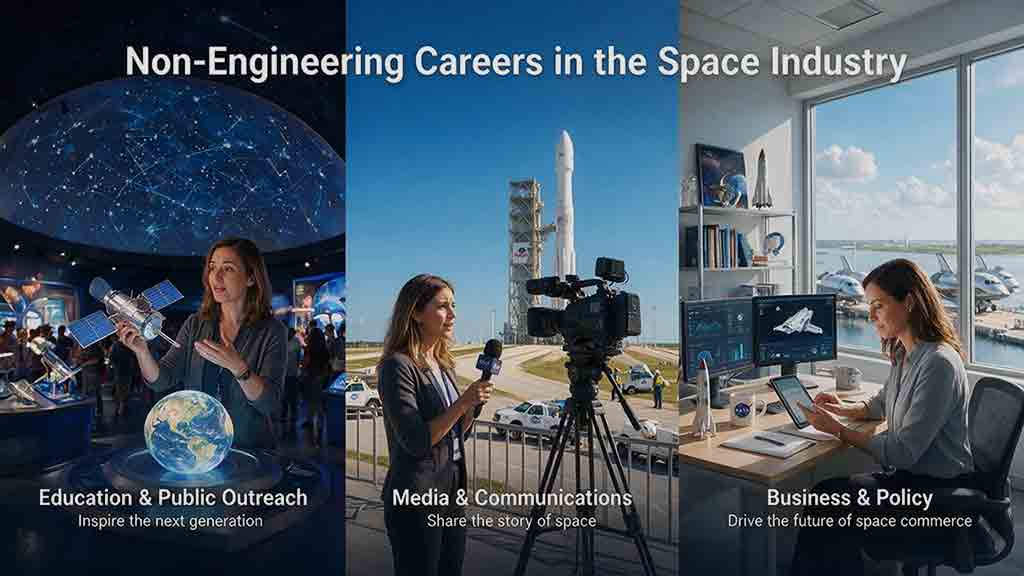
Non-Engineering Careers in the Space Industry
This guide explains how professionals without engineering roles can contribute directly to space missions through program management, procurement, finance, logistics, technical writing, communications, human resources, training, market research, legal support, policy, customer operations, and education. It compares relevant degrees and national salary benchmarks, clarifies the difference between non-engineering, nontechnical, and non-STEM work, and shows how each function manages a mission constraint such as money, time, suppliers, information, workforce, trust, or customer adoption. Original tools—including the Mission Enablement Ledger, Role Output Test, Mission Support Evidence Audit, and Six-Artifact Entry Plan—help readers choose a role, create realistic portfolio evidence, and evaluate career fit. The article also provides practical guidance on NASA and ESA career paths, internships, resumes, technical literacy, work authorization, export controls, background investigations, security clearances, and safe portfolio practices without promising employment or other outcomes.

How to Become a Satellite Systems Engineer
This guide explains how to become a satellite systems engineer by combining technical depth in one spacecraft subsystem with the systems-engineering skills needed to connect mission needs, requirements, interfaces, technical budgets, risks, verification, and operations. It compares suitable engineering degrees, maps common satellite subsystems to practical project evidence, and shows how to build a portfolio without access to flight hardware. Original tools include the Subsystem Anchor and Integration Spine Framework, the Tool-to-Decision Rule, the Mission Thread Portfolio Audit, and an educational satellite power-margin example. The article also covers software choices, entry-level job searches, interviews, INCOSE certification, professional licensure, salary data, international-student considerations, common mistakes, troubleshooting, and a 12-month career plan. Readers gain a practical method for turning coursework and projects into traceable engineering evidence while understanding the limits of occupational statistics, certifications, legal guidance, and publicly available technical standards.
How to Become an Astronomer
This guide explains how to become an astronomer through a practical, evidence-based education and career path. It covers degree options, core physics and mathematics courses, programming, research experience, PhD preparation, graduate funding, postdoctoral training, salaries, job outlook, international-student considerations, and astronomy-related careers outside traditional research. Original tools include the Astronomy Research Loop Audit, Research Contribution Ledger, Two-Market Portfolio Strategy, BLS Denominator Warning, and a one-year evidence plan. The article shows readers how to turn coursework and research into credible proof of skill, compare graduate programs and funding offers, prepare accurate application materials, and avoid common mistakes such as overstating discoveries or confusing combined labor statistics with astronomer-only data. It uses authoritative sources from BLS, O*NET, AAS, AIP, NSF, NASA, leading universities, and USCIS, while clearly explaining the limits of each dataset and avoiding guarantees about admission, funding, employment, or salary.
Explore More Topics
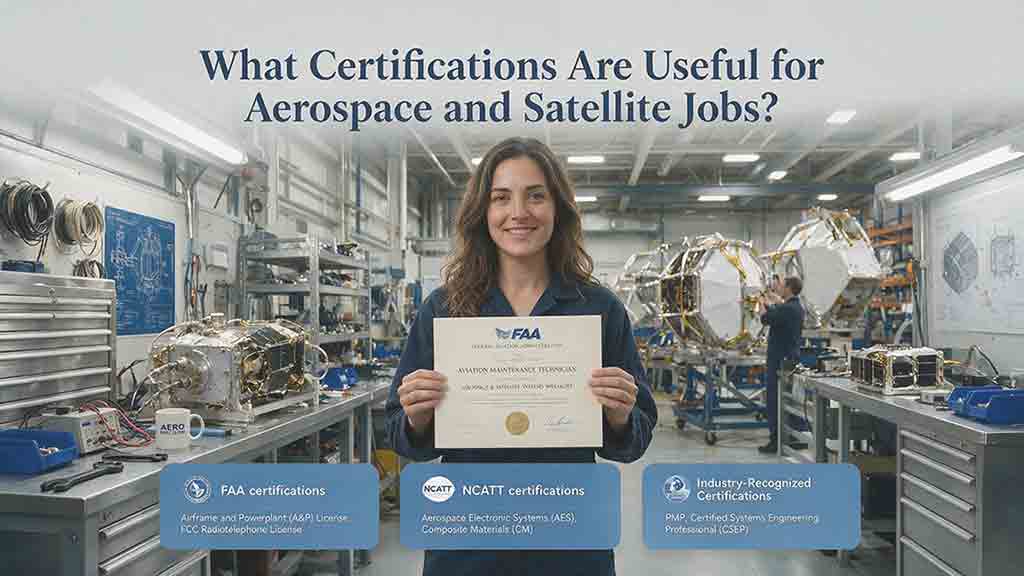
What Certifications Are Useful for Aerospace and Satellite Jobs?
This guide helps students and professionals identify which certifications are genuinely useful for aerospace and satellite jobs. It maps INCOSE, IPC, ASQ, PMI, ISC2, AWS, NCEES, FAA, AS9100-related training, and IAQG auditor authentication to specific work such as systems engineering, electronics assembly, quality, reliability, project leadership, cybersecurity, cloud infrastructure, licensure, and regulated aviation activities. The article clearly distinguishes professional certification, course completion, organizational AS9100 certification, auditor training, IAQG authentication, government certificates, licenses, and security clearances. Original tools—including the Credential Gate Test, Certification Utility Score, One-Gate Rule, Credential Commitment Ledger, employer-demand audit, and a 30-day decision plan—help readers compare role alignment, eligibility, evidence value, portability, maintenance, and rule-change exposure. It also explains the 2026 IAQG transition, PMI’s announced PMP training-provider change, renewal burdens, accurate résumé wording, and why no credential guarantees employment, salary, professional authority, or access.

Online Courses That Can Help You Prepare for a Space Career
This guide helps students and career changers choose online courses that support a specific space-career goal rather than collecting unrelated certificates. It compares NASA, MIT OpenCourseWare, Harvard CS50, University of Colorado Boulder, EPFLx, and other official resources across programming, remote sensing, spacecraft dynamics, mission design, systems engineering, signal processing, and research practice. The article clearly separates free course materials, completion certificates, CS50 Certificates, edX verified certificates, Coursera Career Certificates, university credit, professional certification, and professional licenses. Original tools—including the Role-to-Course Evidence Chain, Course Utility Score, Four-Layer Learning Stack, Evidence Conversion Protocol, and a 12-week study plan—show readers how to identify a skill gap, select a suitable course, build an inspectable project, verify results, and state limitations honestly. It also explains ARSET certificate eligibility, course-age limits, academic-integrity rules, publication safety, and why coursework cannot replace required degrees, supervised experience, work authorization, or professional authority.
Do You Need a Master’s Degree to Work in Space Technology?
This guide explains when a master’s degree is required, preferred, optional, or unnecessary for space-technology careers. It compares bachelor’s-, associate-, master’s-, and doctoral-level entry routes across engineering, software, hardware, analysis, research, project work, writing, and technical operations. Readers learn how to distinguish an absolute degree requirement from a stated preference or an education-and-experience substitution. Original tools—including the Master’s Necessity Ladder, Master’s Pressure Index, Role-Gap Ledger, Replacement Test, and Graduate Commitment Ledger—help applicants audit job postings, identify whether their real gap is knowledge, evidence, experience, or credentials, and make hidden costs visible. A fictional spacecraft thermal-analysis example demonstrates the calculation process without presenting it as a hiring probability. The article also compares graduate-program formats, explains NASA and astronaut exceptions, addresses accreditation and licensure, and separates education from work authorization, export controls, and security-clearance requirements.