Astronomy vs Aerospace Engineering: Which Degree Should You Choose?

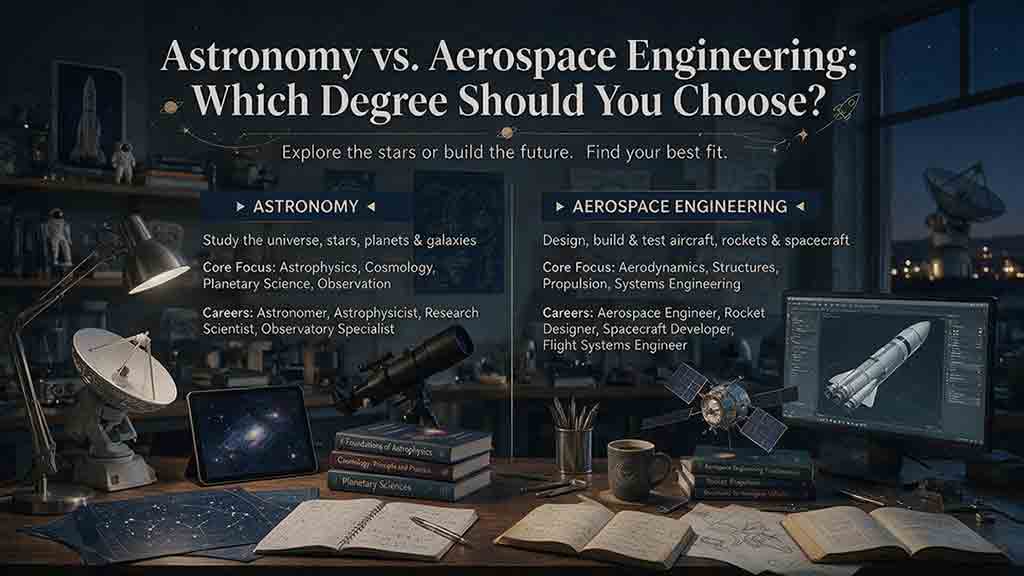
Astronomy vs Aerospace Engineering: Which Degree Should You Choose?
Choose astronomy if you want to investigate stars, planets, galaxies, and physical processes through observation, mathematics, coding, and research. Choose aerospace engineering if you want to design, analyze, build, or test aircraft, spacecraft, propulsion systems, structures, or controls. Aerospace engineering offers a more direct bachelor’s-level occupational route, while research astronomy usually requires graduate study.
Key Takeaways
- Astronomy studies the universe; aerospace engineering develops vehicles and systems that operate in the atmosphere or space.
- Aerospace engineering is usually the more direct choice for students seeking an engineering job immediately after a bachelor’s degree.
- Astronomy is the stronger choice for students committed to scientific research, data analysis, observation, or graduate study in astrophysics.
- The actual curriculum matters more than whether a degree is labeled astronomy, astrophysics, aerospace, aeronautical, or astronautical engineering.
- Neither degree guarantees admission, employment, salary, professional licensure, or a particular role in the space industry.
This guide compares the courses, mathematics, work products, career routes, graduate-school expectations, accreditation, and tradeoffs of the two degrees. It also provides a decision worksheet and curriculum-audit method that you can apply to specific universities.
Scope: This article focuses primarily on undergraduate education and employment in the United States. Degree structures, occupational requirements, accreditation, tuition, immigration rules, professional licensing, and employer expectations vary by institution, jurisdiction, and country. This is general educational guidance, not admissions, financial, legal, licensing, or employment advice.
Astronomy vs Aerospace Engineering: What Is the Main Difference?
Astronomy is a physical science focused on understanding celestial objects and the universe. Aerospace engineering is an engineering discipline focused on designing and evaluating aircraft, spacecraft, and related systems.
The shortest useful distinction is:
Astronomy asks what the universe is doing and why. Aerospace engineering asks whether a human-made flight system will perform as required.
| Comparison | Astronomy | Aerospace engineering |
|---|---|---|
| Primary purpose | Explain and investigate natural phenomena beyond Earth | Design, analyze, build, test, and sustain flight systems |
| Central objects | Stars, planets, galaxies, radiation, cosmic structures, astronomical data | Aircraft, spacecraft, satellites, launch vehicles, propulsion, structures, controls |
| Typical intellectual mode | Scientific observation, inference, theory, data analysis | Design, requirements, modeling, optimization, verification |
| Common undergraduate outputs | Data analysis, computational model, observation report, research paper | Design report, simulation, prototype, test result, engineering trade study |
| Typical entry credential for the named occupation | PhD is usually required for research astronomer positions | Bachelor’s degree is the typical entry education for aerospace engineers |
| Graduate-school pressure | High for independent research and academic astronomy | Optional for many entry-level engineering jobs; useful for specialization or research |
| Programmatic accreditation | Astronomy curricula vary and are not governed by the ABET aerospace criteria | Many U.S. engineering programs seek ABET accreditation |
| Common professional environment | Universities, observatories, laboratories, government, data or software organizations | Aerospace manufacturing, engineering services, government, research, aircraft and spacecraft programs |
| Best fit | Students motivated by scientific questions and research | Students motivated by creating and improving engineered systems |
These categories overlap.
Astronomers may design instruments, write software, and work with engineers. Aerospace engineers may perform research, analyze scientific mission needs, and work with astronomers or planetary scientists.
The distinction concerns the degree’s primary purpose—not a rigid boundary between two communities.
What Do You Study in an Astronomy Degree?
An astronomy degree typically combines physics, mathematics, computing, astronomical science, data analysis, and some form of observation or research.
However, astronomy programs vary substantially.
A 2026 report announced by the American Astronomical Society summarized a survey conducted by the AAS Education Committee’s Subcommittee on UndeRgraduate and Graduate Education. The researchers received 88 responses representing 78 unique institutions. Of those institutions, 66 offered an undergraduate degree or concentration in astronomy and/or astrophysics.
That distinction matters because the survey’s institution count and its course-requirement percentages do not always use the same denominator. The detailed mathematics and computing percentages refer to the reporting degree programs included in that portion of the course-requirement analysis—not automatically to all 78 institutions or all astronomy programs in the United States.
Within the course-requirement analysis, the only subjects required by every reporting degree program were:
- Differential calculus
- Integral calculus
- Lower-division classical mechanics
- Lower-division electricity and magnetism
Requirements diverged after that common foundation:
| Required subject | Share of reporting degree programs |
|---|---|
| Multivariable or vector calculus | 92.3% |
| Differential equations | 75.4% |
| Linear algebra | 60.0% |
| Computer science coursework | 30.8% |
| Statistics coursework | 7.7% |
These percentages should not be interpreted to mean that programs without a separate computer science or statistics requirement provide no programming or data training. The report notes that some institutions teach programming or data science within physics- or astronomy-specific courses instead of requiring separately titled computer science classes.
The report also found variation in required astronomy subjects. Among the reporting programs, commonly required astronomy courses included:
- A lower-division astronomy survey for majors: 49.2%
- Upper-division coursework on stars: 43.1%
- Observational astronomy: 40.0%
- Galaxies and cosmology: 30.8%
The report’s recommended minimum astronomy preparation included:
- Introductory differential and integral calculus
- Introductory mechanics
- Introductory electricity and magnetism
- Some optics and waves
- Intermediate physics involving basic quantum mechanics
- Stellar structure and evolution
- Computational and data-based work with astronomical datasets
- Observational or laboratory techniques
- Scientific literature
- Scientific writing and presentation
- Collaborative project work
These are professional-society recommendations intended to support discussion and curriculum development. They are not binding accreditation requirements for every university.
Common Astronomy Course Areas
Depending on the institution, an astronomy or astrophysics student may study:
- Calculus
- Linear algebra
- Differential equations
- Probability and statistics
- Classical mechanics
- Electricity and magnetism
- Thermodynamics
- Quantum mechanics
- Relativity
- Stellar astrophysics
- Galactic astronomy
- Cosmology
- Planetary science
- Observational astronomy
- Spectroscopy
- Computational physics
- Numerical methods
- Scientific programming
- Data analysis
- Research methods
Some astronomy programs are housed inside physics departments and resemble physics degrees with astronomy electives.
Other programs place more emphasis on observational astronomy, planetary science, public education, data science, or interdisciplinary study. You must inspect the exact required courses rather than judging the program from its title.
What Do You Study in an Aerospace Engineering Degree?
An aerospace engineering degree prepares students to analyze and design systems that fly within the atmosphere, travel through space, or support those activities.
Under the ABET 2026–2027 Criteria for Accrediting Engineering Programs, aerospace and similarly named engineering programs must include modeling, simulation, computing, and testing applied to aerospace systems or subsystems.
ABET also distinguishes among program orientations:
- Aeronautical engineering programs must cover atmospheric flight.
- Astronautical engineering programs must cover spaceflight and the means of reaching space.
- Aerospace engineering programs must include both aeronautical and astronautical content.
- Programs must include design experience appropriate to the program name.
Common Aerospace Engineering Course Areas
Individual curricula vary, but programs commonly include work in:
- Calculus
- Differential equations
- Linear algebra
- Numerical methods
- University physics
- Statics and dynamics
- Mechanics of materials
- Thermodynamics
- Fluid mechanics
- Aerodynamics
- Aerospace structures
- Propulsion
- Flight mechanics
- Orbital mechanics
- Stability and control
- Guidance, navigation, and control
- Systems engineering
- Computer-aided engineering
- Modeling and simulation
- Laboratory testing
- Capstone design
An aerospace program may lean toward aircraft, spacecraft, propulsion, structures, controls, or systems engineering.
A student interested only in spacecraft should not assume that every aerospace curriculum is dominated by spaceflight. Some programs devote substantial required coursework to atmospheric flight.
Which Degree Has More Mathematics?
Both degrees require serious mathematics, but they use it for different purposes.
Astronomy generally uses mathematics to represent natural processes, interpret observations, estimate physical properties, and test scientific models.
Aerospace engineering generally uses mathematics to predict system behavior, evaluate performance, optimize designs, analyze uncertainty, and determine whether requirements can be met.
| Mathematical area | Astronomy use | Aerospace engineering use |
|---|---|---|
| Calculus | Motion, radiation, fields, continuous physical models | Motion, fluids, heat transfer, structures, controls |
| Differential equations | Stellar evolution, orbital systems, waves, cosmology | Flight dynamics, structural response, propulsion, control systems |
| Linear algebra | Data fitting, image processing, numerical models | State-space controls, numerical simulation, structural models |
| Probability and statistics | Measurement uncertainty, inference, survey data | Reliability, testing, uncertainty, quality, estimation |
| Numerical methods | Simulating physical systems and processing datasets | Solving design and performance models |
| Geometry and coordinate systems | Celestial coordinates, orbits, imaging | Vehicle motion, navigation, trajectories, structural geometry |
The better question is not which degree contains “more math.”
Ask which kind of mathematical problem you want to solve repeatedly.
Which Degree Uses More Programming?
Both can require substantial programming.
Astronomy students often use code to:
- Clean and analyze observational data
- Process images or spectra
- Fit models
- Run simulations
- Query scientific archives
- Automate workflows
- Visualize results
- Estimate uncertainty
Aerospace engineering students may use code to:
- Simulate flight dynamics
- Analyze structures
- Model propulsion
- Design control systems
- Optimize trajectories
- Process test data
- Automate engineering calculations
- Connect subsystem models
The programming culture may differ.
Astronomy projects frequently begin with data and scientific questions. Aerospace projects frequently begin with requirements, system behavior, or design decisions.
A degree should not be considered computationally strong merely because one introductory programming course appears in the catalog. Look for repeated use of programming in upper-level courses and projects.
Which Degree Leads More Directly to Employment After a Bachelor’s Degree?
Aerospace engineering generally provides the more direct bachelor’s-to-occupation route.
The U.S. Bureau of Labor Statistics identifies a bachelor’s degree in aerospace engineering or a related field as the typical entry education for aerospace engineers.
For 2024, BLS reported:
- Approximately 71,600 aerospace engineer jobs
- A median annual wage of $134,830
- Projected employment growth of 6% from 2024 to 2034
- About 4,500 projected openings per year on average over that period
These are occupation-wide figures. They are not starting salaries, graduate-placement rates, or guarantees for aerospace engineering majors.
Astronomy bachelor’s graduates follow more varied paths.
The American Institute of Physics studied degree recipients from academic years 2021–22, 2022–23, and 2023–24. Its May 2026 report found that:
- About half entered the workforce after the degree.
- Forty-two percent were enrolled in graduate school during the follow-up period.
- Seven percent were seeking employment.
- Sixty percent of employed graduates worked in a STEM field.
- The private sector employed 40% of employed respondents.
- Many graduates working at colleges or universities viewed those positions as temporary steps toward graduate study.
The report received initial post-degree information for 33% of the degree recipients in the relevant classes, with 85% of that information supplied directly by the recipients. The findings are valuable but should not be treated as a complete census of every astronomy graduate.
Employment-Route Comparison
| Question | Astronomy | Aerospace engineering |
|---|---|---|
| Is the degree tied to one named occupation? | Not closely; graduates enter research, data, software, education, technical, and other roles | More directly tied to aerospace engineering and related engineering work |
| Can graduates work after a bachelor’s degree? | Yes | Yes |
| Is graduate study common? | Yes; especially for astronomy research | Optional for many entry-level roles |
| Is a PhD commonly needed for the field’s research occupation? | Yes | Not for typical entry-level engineering practice |
| Does the bachelor’s degree guarantee field-specific work? | No | No |
| Is portfolio or project evidence useful? | Yes—research, data, code, observation, instrumentation | Yes—design, modeling, testing, controls, systems, hardware |
Why Salary Comparisons Can Be Misleading
Do not compare the BLS median wage for all aerospace engineers directly with the starting salary of a new astronomy graduate.
Those numbers describe different populations.
The BLS aerospace figure includes workers across experience levels, industries, locations, and responsibilities. The AIP astronomy figures describe recent bachelor’s recipients in selected employment sectors.
AIP reported the following medians for the astronomy bachelor’s classes it studied:
- Private-sector STEM positions: $68,500
- College or university positions: $41,600
AIP reported salary results only where its data were sufficient for publication. These values do not represent all astronomy graduates or a guaranteed offer in either sector.
The Salary Denominator Check
Before comparing any two salary figures, identify:
- Occupation: Which workers are included?
- Career stage: New graduates or all experience levels?
- Sector: Private industry, university, government, or combined?
- Degree level: Bachelor’s, master’s, or PhD?
- Time basis: Annual, hourly, academic-year, or twelve-month salary?
- Geography: National, state, city, or employer-specific?
- Sample: Administrative data, survey respondents, or job postings?
If those denominators differ, the numbers should not be presented as a direct contest between degrees.
Does an Astronomy Career Require a PhD?
A PhD is typically required for independent astronomy research and academic astronomy positions.
The BLS Physicists and Astronomers profile states that physicists and astronomers generally need a PhD for research and academic employment.
A bachelor’s degree in astronomy can still support work in:
- Data analysis
- Scientific software
- Observatory support
- Research assistance
- Instrumentation support
- Education
- Technical communication
- Operations
- Government support
- Other STEM occupations
The distinction is between earning an astronomy degree and holding the occupation of research astronomer.
A bachelor’s graduate working as a data analyst or software developer may use astronomy training without being employed under the occupational title “astronomer.”
Does Aerospace Engineering Require a Master’s Degree?
Not usually for entry-level aerospace engineering positions.
BLS identifies a bachelor’s degree as the typical entry education. A master’s degree may still be useful for:
- Specialized controls
- Propulsion
- Structures
- Computational fluid dynamics
- Space systems
- Research and development
- Career changes from another field
- University instruction
- Employer-sponsored technical development
A graduate degree should solve a defined preparation problem.
Do not enroll solely because graduate education appears impressive. Compare the program against the roles you want, the courses you lack, the cost, the funding, and the experience you could gain instead.
Which Degree Is Better for Working in the Space Industry?
The answer depends on what you want to do within the space industry.
Aerospace engineering is usually better for designing or verifying spacecraft and launch systems. Astronomy is usually better for mission science, astronomical data, observation, or research concerning celestial phenomena.
| Desired work | More direct degree | Important qualification |
|---|---|---|
| Design spacecraft structures | Aerospace engineering | Mechanical engineering may also be appropriate |
| Analyze flight or orbital performance | Aerospace engineering | Physics, applied mathematics, or astronomy may support some analytical roles |
| Develop propulsion systems | Aerospace, mechanical, or chemical engineering | Astronomy is not the direct preparation |
| Design attitude-control systems | Aerospace, electrical, mechanical, or controls engineering | Requires controls and system-specific preparation |
| Conduct astrophysics research | Astronomy, astrophysics, or physics | PhD is normally expected |
| Analyze telescope or survey data | Astronomy, astrophysics, physics, data science | Programming and statistics are important |
| Develop scientific mission software | Either can work | Computer science or software engineering may be more direct |
| Build astronomical instruments | Either may contribute | Electrical, optical, mechanical, or computer engineering may be more direct |
| Define science requirements for a mission | Astronomy or related science | Often combined with graduate research expertise |
| Perform spacecraft systems engineering | Aerospace or another engineering discipline | Systems, electrical, mechanical, or software backgrounds are also common |
| Work in mission operations | Either may work | Depends on whether the position emphasizes spacecraft systems or scientific operations |
| Teach university astronomy | Astronomy, astrophysics, or physics | A PhD is generally required |
Neither astronomy nor aerospace engineering is the universally “best degree for space.”
The space sector includes scientific, engineering, software, manufacturing, operations, business, communication, and policy functions.
The Question–Artifact–Credential Test
The Question–Artifact–Credential Test is an original framework developed for this guide.
It evaluates a degree through three linked questions.
1. Which Question Do You Want to Answer?
Astronomy-oriented question:
What physical process explains this observation?
Aerospace-oriented question:
Which design will satisfy these performance and safety requirements?
2. Which Artifact Do You Want to Produce?
Astronomy artifacts may include:
- Reduced dataset
- Scientific model
- Observation plan
- Statistical inference
- Research paper
- Telescope proposal
- Scientific software
- Conference presentation
Aerospace engineering artifacts may include:
- Vehicle design
- Structural model
- Control simulation
- Test procedure
- Requirements document
- Propulsion analysis
- Trade study
- Prototype
- Verification report
3. Which Credential Path Can You Accept?
Astronomy research commonly involves:
- Bachelor’s degree
- Research experience
- PhD
- Possible postdoctoral appointments
- Competition for permanent research positions
Aerospace engineering commonly involves:
- Bachelor’s degree
- Internship, co-op, laboratory, or design experience
- Entry-level engineering work
- Optional graduate specialization
- Possible licensure or employer-specific credentials later
The framework does not rank one route above the other. It identifies whether your preferred question, artifact, and credential path point in the same direction.
The Weighted Degree-Fit Worksheet
The Weighted Degree-Fit Worksheet is an original decision tool. It turns personal priorities into a transparent comparison.
Step 1: Choose Your Factors
Possible factors include:
- Interest in celestial science
- Interest in designing hardware
- Interest in coding and data
- Interest in fluids, structures, or controls
- Desire for a direct bachelor’s-level occupation
- Willingness to pursue a PhD
- Preference for open-ended research
- Preference for defined design requirements
- Cost and expected time in school
- Quality of the specific university program
Step 2: Assign Each Factor a Weight
Use:
- 1 = minor importance
- 3 = meaningful importance
- 5 = essential
Step 3: Score Each Degree
For each factor, score each degree from 1 to 5 based on how well the actual program supports your goal.
Calculate:
[\text{Weighted Degree Score}\sum(\text{factor weight}\times\text{degree score})]
For a percentage:
[\text{Fit Percentage}\frac{\text{Weighted Degree Score}}{5\times\text{sum of all factor weights}}\times 100]
The percentage is not a prediction of happiness, academic success, admission, or employment. It is a structured record of your present priorities.
Worked Example
Consider a fictional student who:
- Enjoys space science
- Strongly wants to design hardware
- Is willing, but not eager, to attend graduate school
- Wants a bachelor’s-level occupational route
- Enjoys coding
- Strongly likes dynamics and controls
| Factor | Weight | Astronomy score | Aerospace score |
|---|---|---|---|
| Explain celestial phenomena | 5 | 5 | 2 |
| Design and test hardware | 5 | 1 | 5 |
| Willingness to pursue graduate study | 4 | 5 | 3 |
| Direct bachelor’s-level occupation | 5 | 2 | 5 |
| Coding and computation | 3 | 5 | 4 |
| Dynamics, fluids, structures, or controls | 4 | 1 | 5 |
| Weighted total | 26 | 79 | 104 |
Maximum possible score:
[5\times26=130]
Astronomy:
[\frac{79}{130}\times100=60.8%]
Aerospace engineering:
[\frac{104}{130}\times100=80.0%]
For this fictional student, aerospace engineering is the stronger fit because the desire to design hardware and enter a defined bachelor’s-level occupation outweighs the student’s interest in astronomy.
A different weighting could reverse the result.
How Do You Compare Two Actual University Programs?
Do not compare degree names alone. Compare their required courses, project access, outcomes, and cost.
The Curriculum-to-Outcome Audit
The Curriculum-to-Outcome Audit is an original evaluation method for comparing specific programs.
Step 1: Define the Outcome
Write one primary outcome.
Examples:
- Enter an aerospace engineering role after graduation
- Apply to astronomy PhD programs
- Work in scientific software
- Support spacecraft mission science
- Build astronomical instruments
- Preserve both engineering and research options
Step 2: Collect Official Documents
Use:
- Degree requirements
- Course catalog
- Prerequisite map
- Accreditation record
- Undergraduate research pages
- Laboratory and facility pages
- Internship or co-op information
- Published cost and financial-aid information
- Graduate or career outcome reports, when available
Avoid treating marketing copy as a substitute for requirements.
Step 3: Map the Required Preparation
| Preparation area | Program A evidence | Program B evidence | Gap |
|---|---|---|---|
| Calculus and differential equations | |||
| Intermediate physics | |||
| Programming | |||
| Statistics and data analysis | |||
| Design | |||
| Laboratory or observation | |||
| Modeling and simulation | |||
| Research access | |||
| Capstone or thesis | |||
| Internship or co-op |
Step 4: Identify the Graduation Artifact
Ask what you could show an employer or graduate committee at graduation.
Possible evidence includes:
- Research thesis
- Published or presented research
- Data-analysis repository
- Observation project
- Capstone vehicle design
- Wind-tunnel or structural test
- Controls simulation
- CubeSat project
- Engineering design review
- Internship report
Step 5: Calculate the Gap Load
Count the important preparation areas that the required curriculum does not cover.
[\text{Gap Load}\text{Number of essential areas requiring electives or outside work}]
A low gap load means the required program already contains much of the preparation you need.
A high gap load is not automatically disqualifying. It means you must confirm that electives, minors, research, or independent projects can fill the missing areas without delaying graduation.
Why Does the Exact Astronomy Curriculum Matter So Much?
Astronomy degree labels do not communicate one uniform course sequence.
The 2026 AAS curriculum study received responses representing 78 unique institutions, 66 of which offered undergraduate astronomy or astrophysics degrees or concentrations. Its detailed course analysis found a shared introductory core but substantial divergence beyond that foundation.
For example, 92.3% of reporting degree programs required multivariable or vector calculus, while 75.4% required differential equations. Combining both figures under a phrase such as “almost all” would hide a meaningful difference between the two requirements.
The AIP outcome report separately found that 56% of astronomy bachelor’s recipients in the academic years studied completed a double major. Physics accounted for 72% of those double majors.
These are different datasets with different units of analysis:
- The AAS study describes institutions and reporting degree programs.
- The AIP study describes recent degree recipients.
The findings should not be combined as though they came from one sample.
This does not mean every astronomy student should double-major.
It means you should check whether the astronomy major includes enough:
- Physics
- Mathematics
- Programming
- Statistics
- Laboratory or observational work
- Research
- Scientific communication
A broad astronomy BA designed for general scientific literacy may not provide the same graduate-school preparation as a physics-intensive astrophysics BS.
Neither degree is inherently inferior. They may serve different outcomes.
Why Does ABET Accreditation Matter for Aerospace Engineering?
ABET accredits individual academic programs, not entire universities or graduates.
For an aerospace engineering degree, accreditation may matter because:
- It provides an external review against applicable engineering criteria.
- Some employers prefer graduates of accredited programs.
- Accredited engineering education is commonly relevant to professional-licensure pathways.
- The program must demonstrate design, technical, educational, and continuous-improvement requirements.
Use the official ABET Accredited Program Search to verify:
- Exact program title
- Degree level
- Campus
- Accreditation commission
- Current status
Do not assume that a university’s general reputation means every engineering program is ABET-accredited.
ABET accreditation also does not guarantee employment, admission to graduate school, licensure, or program quality in every dimension that matters to you.
Which Degree Is More Flexible?
Flexibility depends on the direction of the change.
Astronomy to Aerospace Engineering
An astronomy graduate may have strong physics, mathematics, and programming preparation. The graduate may still lack required engineering subjects such as:
- Design
- Fluid mechanics
- Structures
- Materials
- Propulsion
- Controls
- Engineering laboratories
- Engineering standards
- Capstone design
Moving into aerospace analysis, software, data, instrumentation, or mission operations may be easier than moving directly into a position that requires accredited engineering preparation or specialized design coursework.
Aerospace Engineering to Astronomy
An aerospace graduate may have strong mathematics, mechanics, computation, modeling, and project experience. The graduate may still need:
- Quantum mechanics
- Statistical mechanics
- Advanced electromagnetism
- Astronomy coursework
- Astronomical data analysis
- Research experience
- Evidence of preparation for a specific graduate program
An aerospace degree can support movement toward space science, but admission to an astronomy graduate program depends on the program’s prerequisites and research expectations.
The Bridgeability Principle
A degree transition is easier when the missing preparation consists of a small number of courses or projects.
It is harder when the target field expects an entire sequence that was absent from the original degree.
Before choosing a major because it “keeps options open,” list the actual bridge courses required for both possible destinations.
Should You Double-Major in Astronomy and Aerospace Engineering?
Usually, only when the institution has a feasible plan that does not create excessive cost, delay, or scheduling conflict.
The majors may share:
- Calculus
- Differential equations
- Introductory physics
- Some programming
- Some mechanics
They may diverge substantially in upper-level requirements.
Astronomy may require quantum mechanics, observational work, astrophysics, and research. Aerospace engineering may require fluids, structures, controls, propulsion, laboratories, and capstone design.
Before attempting the combination, check:
- Total credits
- Course sequencing
- Laboratory conflicts
- Prerequisites
- Capstone requirements
- Financial-aid limits
- Expected graduation date
- Whether a minor or research project would achieve the same goal
A double major is not automatically more employable than one well-chosen major with strong experience.
Is a Minor a Better Choice?
A minor can be useful when it fills a defined gap.
Astronomy Major With an Engineering-Related Minor
Possible benefits:
- More design or computational exposure
- Stronger hardware context
- Access to engineering electives
Possible limitations:
- Some engineering courses may be restricted to majors.
- A minor does not normally replace an accredited engineering degree.
- Prerequisite chains may prevent access to advanced courses.
Aerospace Major With an Astronomy Minor
Possible benefits:
- Greater space-science context
- Exposure to stellar, planetary, or observational science
- Better preparation for science-driven missions
Possible limitations:
- A minor alone may not provide enough physics or research preparation for an astronomy PhD.
- The available astronomy courses may be broad surveys rather than advanced astrophysics.
Choose a minor because of the courses and evidence it adds—not because the label looks complementary.
Which Degree Is Better for Different Student Profiles?
| Student profile | More likely fit | Reason |
|---|---|---|
| Wants to discover how stars and galaxies evolve | Astronomy | The central goal is scientific explanation |
| Wants to design satellites or launch vehicles | Aerospace engineering | The central goal is engineered-system performance |
| Loves telescope data and statistical inference | Astronomy | Observation and scientific data are primary |
| Loves fluid dynamics, structures, or controls | Aerospace engineering | These are core engineering domains |
| Wants a defined engineering occupation after a bachelor’s degree | Aerospace engineering | The occupational route is more direct |
| Accepts a PhD as part of the research career path | Astronomy | Research astronomy generally requires doctoral training |
| Wants to write flight or ground software | Either, but compare with computer science | The software role may matter more than the domain label |
| Wants to build telescope instruments | Either, depending on the contribution | Electrical, optical, mechanical, or computer engineering may be more direct |
| Wants maximum scientific depth | Astronomy or physics | Inspect the upper-level physics requirements |
| Wants both aircraft and spacecraft options | Aerospace engineering | Accredited aerospace programs generally cover both domains |
| Wants only spacecraft engineering | Astronautical or space-focused aerospace program | Verify how much of the required curriculum is space-specific |
| Is unsure but enjoys physics and coding | Compare physics, astronomy, aerospace, and computer science | The binary choice may be unnecessarily narrow |
What Are the Main Advantages and Tradeoffs?
| Astronomy advantage | Corresponding tradeoff |
|---|---|
| Direct engagement with fundamental questions about the universe | Independent research careers usually require a PhD |
| Strong scientific-data and computational potential | Program requirements vary substantially |
| Research, observation, and scientific communication experience | Bachelor’s-level job titles may not include “astronomer” |
| Can support software, data, education, and technical careers | Students may need to deliberately add industry-facing skills |
| Often offers close faculty research interaction | Research opportunities depend heavily on the institution |
| Aerospace engineering advantage | Corresponding tradeoff |
|---|---|
| Direct preparation for a named engineering occupation | Curriculum can be highly structured with limited elective space |
| Design, laboratory, simulation, and testing experience | Work may focus more on aircraft than space at some institutions |
| Bachelor’s-level professional entry is common | Employers still expect internships or project evidence |
| Skills transfer to multiple aerospace and engineering sectors | Defense-related positions may have additional eligibility requirements |
| ABET accreditation provides a recognizable program-quality framework | Accreditation does not make every program equally suitable for your goals |
What Common Mistakes Should You Avoid?
Choosing Astronomy Because You Like Space Images
Professional astronomy involves mathematics, physics, programming, uncertainty, reading, writing, and long periods of data analysis.
Interest in visual astronomy is a useful beginning, not a complete test of degree fit.
Choosing Aerospace Engineering Because You Want to Work “At NASA”
NASA and the wider space sector employ many engineering and non-engineering disciplines.
Choose aerospace because you want to perform aerospace engineering work—not solely because of the employer category.
Assuming Astronomy Means Telescope Use Every Night
Modern astronomers often work primarily with computers, archived data, simulations, proposals, and scientific writing.
Observatory visits may represent only a small part of the work.
Assuming Aerospace Engineering Is Only Rocket Design
Aerospace programs and careers may involve aircraft, structures, controls, instruments, satellites, manufacturing, testing, systems, or propulsion.
Comparing Experienced-Worker Wages With Graduate Starting Salaries
This creates a false financial comparison.
Apply the Salary Denominator Check before using wage figures.
Treating Different Survey Denominators as Interchangeable
An institution count, a degree-program percentage, and a degree-recipient percentage describe different units.
State whether a figure refers to institutions, reporting programs, graduates, employed respondents, or another group before comparing it.
Ignoring the Exact Catalog
A program title does not reveal:
- Required physics depth
- Spaceflight content
- Programming intensity
- Research access
- Design exposure
- Laboratory requirements
Treating a Double Major as Automatically Better
Additional coursework may reduce time for research, internships, design teams, or paid work.
Assuming Graduate School Will Repair Every Gap
Graduate programs expect relevant preparation. They are not always designed to replace missing undergraduate foundations.
Ignoring Financial Runway
The astronomy research route may include a PhD and one or more temporary research appointments. Aerospace engineering may permit earlier full-time employment, but outcomes still vary.
Compare total time, funding, debt, and opportunity cost.
Treating Rankings as Curriculum Analysis
A highly ranked institution may still offer a program that does not match your preferred specialization or financial constraints.
How Can You Troubleshoot a Difficult Decision?
| Problem | Likely cause | Practical response |
|---|---|---|
| Both subjects sound equally interesting | You are comparing topics rather than work | Compare weekly artifacts: research analysis versus engineering design |
| You want space but dislike advanced physics | Neither degree may be the best fit | Compare software, business, communications, operations, or technical programs |
| You like astronomy but do not want a PhD | Career outcome is undefined | Investigate data, software, observatory, education, and technical roles |
| You like spacecraft but dislike design projects | Aerospace engineering work may not fit | Compare astronomy, physics, mission operations, policy, or data roles |
| One university offers astronomy but not aerospace | Degree availability is driving the choice | Compare physics, mechanical, electrical, and transfer pathways |
| The aerospace curriculum appears aircraft-heavy | Program emphasis differs from your goal | Audit required astronautics, orbital, spacecraft, and systems courses |
| The astronomy degree has little programming | Industry preparation may be incomplete | Add computer science, statistics, and data projects |
| A double major would delay graduation | The solution is too expensive | Use a minor, electives, research, or one targeted graduate bridge |
| Family members focus only on salary | The comparison uses incomplete denominators | Compare career stage, credential length, debt, and daily work |
| You fear choosing permanently | You have not examined bridge requirements | Build a course-by-course transition map for both directions |
A Four-Week Degree Decision Plan
This plan is an educational framework, not an admissions or career guarantee.
Week 1: Compare the Work
Complete one astronomy task and one engineering task.
Astronomy task:
- Analyze a public astronomical dataset.
- Create one graph.
- Explain the uncertainty.
- Write a short scientific conclusion.
Engineering task:
- Model a simple flight, structural, thermal, or control problem.
- State a requirement.
- Compare two design choices.
- Explain how the result would be verified.
Record which process you wanted to continue after the assignment ended.
Week 2: Audit Two Programs
For each university, collect:
- Required courses
- Prerequisite sequence
- Accreditation
- Research opportunities
- Design teams
- Internship or co-op access
- Graduation requirements
- Published cost
- Financial-aid information
Complete the Curriculum-to-Outcome Audit.
Week 3: Test the Career Route
Review at least ten realistic opportunities connected to each route.
For astronomy, include:
- Graduate programs
- Research assistant roles
- Data or software positions
- Observatory or laboratory support
- Education positions
For aerospace, include:
- Aerospace engineering roles
- Related mechanical, electrical, software, or systems roles
- Internships
- Co-ops
- Research positions
Do not combine senior and entry-level requirements into one list.
Week 4: Make a Reversible Plan
Choose:
- Primary degree
- Three essential electives
- One project or research activity
- One internship target
- One backup occupation
- Bridge courses for the alternative route
- Maximum acceptable cost and graduation time
Document the decision and revisit it after completing foundational physics and mathematics.
Degree-Choice Checklist
Academic Fit
- I have reviewed the required courses, not only the degree description.
- I understand the mathematics sequence.
- I know how much physics each program requires.
- I have checked the programming and statistics requirements.
- I have identified laboratory, observation, research, or design requirements.
Career Fit
- I know the work product I want to create.
- I understand whether my target occupation normally requires graduate school.
- I have reviewed bachelor’s-level alternatives.
- I have separated occupation-wide wages from starting salaries.
- I have identified one backup occupation.
Program Quality
- I have verified the exact aerospace program’s ABET status where relevant.
- I have checked faculty research and undergraduate access.
- I have reviewed capstone, thesis, internship, and co-op opportunities.
- I have checked whether specialized courses are offered regularly.
- I understand whether the aerospace curriculum emphasizes aircraft, spacecraft, or both.
Financial and Practical Fit
- I know the estimated total cost rather than only annual tuition.
- I have considered likely time to graduation.
- I understand the funding model for any planned graduate study.
- I have checked whether a double major or transfer could delay completion.
- I have considered location, housing, work, and family constraints.
Evidence Plan
- I can identify one major research, design, or data artifact I want to complete.
- I know how I will gain programming experience.
- I have an internship, research, or project plan.
- I can explain what the degree will qualify me to do—and what it will not.
- I will not describe educational work as professional authorization or guaranteed preparation.
Which Degree Should You Choose?
Choose astronomy when your central goal is to investigate the physical universe and you are comfortable building a path around physics, computation, research, and potentially a PhD.
Choose aerospace engineering when your central goal is to design, analyze, build, test, or operate aircraft and spacecraft systems and you want a more direct route into an engineering occupation after a bachelor’s degree.
Choose neither automatically.
A student interested mainly in software may be better served by computer science. A student interested in instruments may prefer electrical, optical, mechanical, or computer engineering. A student interested in planetary surfaces may prefer geology or planetary science.
The best degree is the one whose required curriculum, work products, cost, and credential path support the work you actually want to perform.
Frequently Asked Questions
Is Astronomy Harder Than Aerospace Engineering?
Neither degree is universally harder. Astronomy may demand more advanced theoretical physics and research abstraction, while aerospace engineering may impose more structured design, laboratory, teamwork, and prerequisite requirements. Difficulty depends on the program and the student’s strengths.
Can an Astronomy Major Become an Aerospace Engineer?
Possibly, but an astronomy degree may not provide all the engineering design, laboratory, structures, fluids, controls, or accreditation-related preparation expected for aerospace engineering roles. Additional engineering education or a role in software, data, analysis, instrumentation, or operations may be a more direct bridge.
Can an Aerospace Engineer Become an Astronomer?
An aerospace graduate may apply to astronomy or astrophysics graduate programs when the graduate has sufficient physics, mathematics, astronomy, and research preparation. Admission requirements vary, and additional physics or astronomy coursework may be necessary.
Is Astronomy or Aerospace Engineering Better for NASA?
NASA uses both. Astronomy is relevant to scientific research, mission science, data analysis, and observatories. Aerospace engineering is relevant to aircraft, spacecraft, launch systems, controls, structures, propulsion, and systems work. NASA also employs many other disciplines.
Which Degree Pays More?
Available data do not support a simple degree-versus-degree answer. BLS reports occupation-wide wages for aerospace engineers, while AIP reports selected starting outcomes for recent astronomy bachelor’s recipients. Career stage, role, sector, location, graduate education, and experience must be aligned before comparing pay.
Should I Study Physics Instead?
Physics may be a strong alternative when you want deeper physical-science preparation while preserving routes into astronomy, graduate study, software, data, engineering-adjacent work, or other technical fields. Compare the required courses and project opportunities rather than assuming physics is automatically broader.
Sources
U.S. Bureau of Labor Statistics. Aerospace Engineers. Typical entry education, occupational duties, May 2024 wage data, employment, and 2024–2034 projections. Accessed August 1, 2026.
U.S. Bureau of Labor Statistics. Physicists and Astronomers. Research-education requirements, occupational duties, May 2024 wages, employment, and projections. Accessed August 1, 2026.
American Institute of Physics. New Astronomy Bachelors: What Comes Next. Initial outcomes, employment sectors, fields, salaries, graduate enrollment, skills, and methodology for degree recipients from academic years 2021–22 through 2023–24. Published May 26, 2026. Accessed August 1, 2026.
American Institute of Physics. Starting Salary Ranges for New Astronomy Bachelors. Salary data graphic associated with the 2026 astronomy bachelor’s report. Accessed August 1, 2026.
American Institute of Physics. Employment Fields for New Astronomy Bachelors. Employment fields for degree recipients from academic years 2021–22 through 2023–24. Accessed August 1, 2026.
American Institute of Physics. Knowledge and Skills Used by New Employed Astronomy Bachelors. Skill-use data associated with the 2026 astronomy bachelor’s report. Accessed August 1, 2026.
American Astronomical Society. Education Committee Releases New Report on Undergraduate Degree Programs in Astronomy/Astrophysics. Official AAS summary distinguishing 78 responding institutions from the 66 institutions offering an undergraduate astronomy or astrophysics degree or concentration. Published February 23, 2026. Accessed August 1, 2026.
Follette, K., Ferkinhoff, C., Foley, M., MacGregor, M., Morris, M., Masters, K., Rice, T., and Wallace, C. The Landscape of Undergraduate Astronomy and Astrophysics Degree Requirements. Survey methodology, institution and program counts, course-requirement percentages, findings, and recommendations. February 2026. Accessed August 1, 2026.
ABET. Criteria for Accrediting Engineering Programs, 2026–2027. General engineering and aerospace-program criteria. Accessed August 1, 2026.
ABET. Accredited Program Search. Official program-level accreditation database. Accessed August 1, 2026.
ABET. What Is Accreditation?. Scope and purpose of programmatic accreditation. Accessed August 1, 2026.
ABET. Why ABET Accreditation Matters. Education, employer-recognition, mobility, and quality-assurance context. Accessed August 1, 2026.
More from Degrees, Courses & Certifications
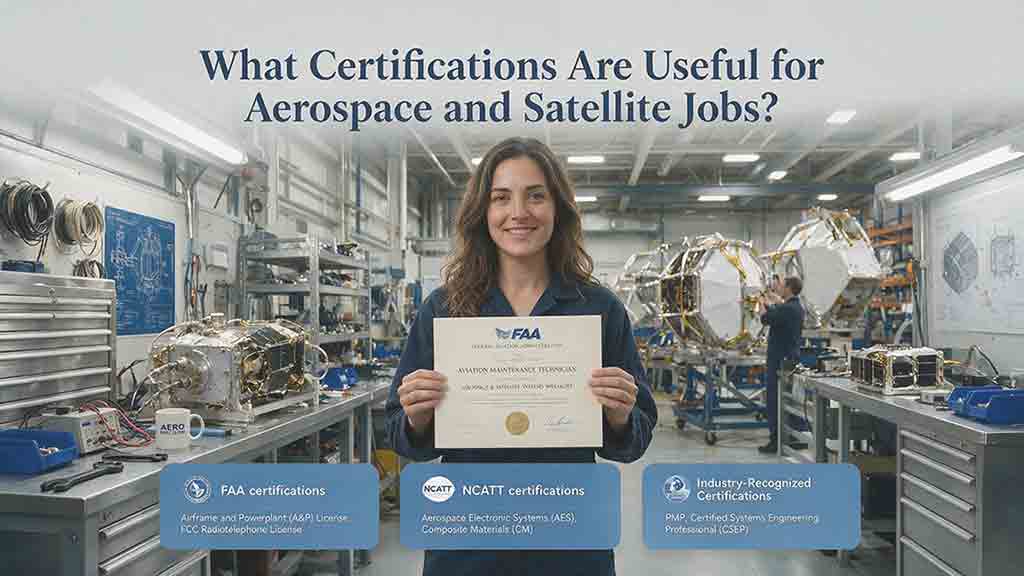
What Certifications Are Useful for Aerospace and Satellite Jobs?
This guide helps students and professionals identify which certifications are genuinely useful for aerospace and satellite jobs. It maps INCOSE, IPC, ASQ, PMI, ISC2, AWS, NCEES, FAA, AS9100-related training, and IAQG auditor authentication to specific work such as systems engineering, electronics assembly, quality, reliability, project leadership, cybersecurity, cloud infrastructure, licensure, and regulated aviation activities. The article clearly distinguishes professional certification, course completion, organizational AS9100 certification, auditor training, IAQG authentication, government certificates, licenses, and security clearances. Original tools—including the Credential Gate Test, Certification Utility Score, One-Gate Rule, Credential Commitment Ledger, employer-demand audit, and a 30-day decision plan—help readers compare role alignment, eligibility, evidence value, portability, maintenance, and rule-change exposure. It also explains the 2026 IAQG transition, PMI’s announced PMP training-provider change, renewal burdens, accurate résumé wording, and why no credential guarantees employment, salary, professional authority, or access.

Online Courses That Can Help You Prepare for a Space Career
This guide helps students and career changers choose online courses that support a specific space-career goal rather than collecting unrelated certificates. It compares NASA, MIT OpenCourseWare, Harvard CS50, University of Colorado Boulder, EPFLx, and other official resources across programming, remote sensing, spacecraft dynamics, mission design, systems engineering, signal processing, and research practice. The article clearly separates free course materials, completion certificates, CS50 Certificates, edX verified certificates, Coursera Career Certificates, university credit, professional certification, and professional licenses. Original tools—including the Role-to-Course Evidence Chain, Course Utility Score, Four-Layer Learning Stack, Evidence Conversion Protocol, and a 12-week study plan—show readers how to identify a skill gap, select a suitable course, build an inspectable project, verify results, and state limitations honestly. It also explains ARSET certificate eligibility, course-age limits, academic-integrity rules, publication safety, and why coursework cannot replace required degrees, supervised experience, work authorization, or professional authority.

Do You Need a Master’s Degree to Work in Space Technology?
This guide explains when a master’s degree is required, preferred, optional, or unnecessary for space-technology careers. It compares bachelor’s-, associate-, master’s-, and doctoral-level entry routes across engineering, software, hardware, analysis, research, project work, writing, and technical operations. Readers learn how to distinguish an absolute degree requirement from a stated preference or an education-and-experience substitution. Original tools—including the Master’s Necessity Ladder, Master’s Pressure Index, Role-Gap Ledger, Replacement Test, and Graduate Commitment Ledger—help applicants audit job postings, identify whether their real gap is knowledge, evidence, experience, or credentials, and make hidden costs visible. A fictional spacecraft thermal-analysis example demonstrates the calculation process without presenting it as a hiring probability. The article also compares graduate-program formats, explains NASA and astronaut exceptions, addresses accreditation and licensure, and separates education from work authorization, export controls, and security-clearance requirements.
Explore More Topics
A Guide to Space Industry Employers and the Roles They Hire For
This guide maps the main types of space industry employers to the roles, outputs, customers, and constraints that define their work. It covers government agencies, intergovernmental organizations, research centers, space-relevant national laboratories, prime manufacturers, suppliers, launch providers, satellite operators, data companies, ground-system firms, contractors, universities, and professional-service organizations. Original tools include the Space Employer Output Map, ORBIT Employer Fit Test, Employer-Role Search Coverage calculation, and a worked geospatial career example. Readers learn why the same job title can mean different responsibilities across employer models, how to verify the legal employer, how to evaluate decision authority and contract conditions, and how to build a focused target list. The article also includes role comparisons, employer-type tradeoffs, eligibility guidance, troubleshooting advice, and a detailed research checklist.

How to Get a Space Industry Job With No Previous Aerospace Experience
This guide explains how to enter the space industry without previous aerospace employment by identifying transferable tasks, choosing realistic entry roles, and building evidence for the constraints that are genuinely new. It introduces the Aerospace Entry Distance Ladder, CLEAR Transfer Test, and Five-Part Bridge Project Standard to help readers distinguish direct task transfer, domain learning, evidence gaps, and formal eligibility barriers. A detailed industrial-automation example shows how test, software, instrumentation, and failure-analysis experience can be translated into spacecraft integration and test without exaggerating authority. The article also covers federal qualifications, contractors, internships, public data, NASA software release categories, résumé wording, interviews, networking, education choices, citizenship, clearance, export controls, and disclosure safety. Readers receive a decision tree, troubleshooting table, candidate-specific recommendations, and a final checklist for planning an accurate, legally safer career transition.
Government vs Commercial Space Careers
This guide compares government, contractor, and commercial space careers through the factors that most affect real career decisions: mission, legal employer, decision authority, technical work, pay structure, benefits, continuity risk, eligibility, publication rights, and long-term mobility. Original tools include the Three-Lane Space Career Model, Decision-Authority Test, Continuity Stack, SPACE Career Fit Matrix, and an offer-normalization worksheet. Worked examples show how to compare federal and commercial compensation while keeping guaranteed cash, target bonuses, estimated benefits, and equity separate. The article also explains contractor authority limits, citizenship, security clearance, export-control access, intellectual property, post-government ethics, and sector-to-sector skill translation. Readers receive interview questions, troubleshooting guidance, candidate-specific recommendations, and a detailed checklist for evaluating actual roles instead of relying on stereotypes about government stability or commercial speed.